




Something stupendous happened in the middle of a recession last year. At a time when vast swathes of Europe were being laid waste by an economic tsunami, world trade grew fastest in the last 50 years. It is not hard to figure where this growth was taking place - not in Europe or the United States.
The long anticipated South-South show is now a reality. Trade data show a paradigm shift from the advanced nations, which will show an import growth of 0.9-1 percent, while the emerging economies will exhibit import growth of 4.5-5 percent this year. What this means is that the emerging nations are trading more among themselves while the West is being edged out of the fastest growing markets.
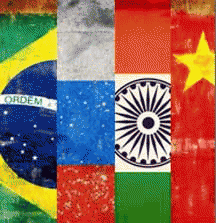
But behind these statistics hides another story - the United States, the flagship of the Anglo-American empire, is listing. And from its shadow is emerging a new world order being drafted by the BRICS: Brazil, Russia, India, China and the latest member, South Africa.
This rainbow coalition is as far removed from the racially homogenous Anglo-American empire as it could possibly be. But what brings them together is a common desire to clean up the huge mess created by the current regime.
TOXIC BANKING
Take high oil prices. Western intervention in Iraq is largely responsible for the ballooning oil prices. If oil prices had increased organically (like the price of any other industrial commodity, say, steel, cement or even silicon) the current price would be $35-50 a barrel. Instead, oil has been hovering in the $100-$150 range the past few years. This one factor has weakened the global economy, hurting virtually everyone on the planet. Western invasions have only added fuel to the already heated West Asian region.
Again, Western bankers in tandem with their central bankers have spewed financial toxins into the world's markets. These manipulative bankers, instead of earning reasonable profits by making their capital work, are spinning off imaginary financial instruments, such as derivatives, and creating virtual wealth. Since this wealth is transient by nature, the gainers are the bankers because only they know when the collapse is coming. They cash out, leaving millions out of pocket.
The BRICS have indicated that this Western way of doing business has to end. Following the recent BRICS summit on Hainan island in China, Brazilian Finance Minister Guido Mantega told the International Monetary Fund in Washington that the United States and other Western countries were attempting to "export their way out of difficult economic situations" by printing money.
The trillion-dollar illicit book-cooking revealed at the financial giants of New York and London is trifling when compared with the US Federal Reserve's skulduggery. For instance, the Feds are known to illegally buy their own bonds through banks in the Caribbean. These banks funnel hundreds of millions of Federal dollars into the bond market, artificially shoring up prices.
For countries like China and Japan, which buy hundreds of billions of dollars worth of these treasury bonds annually, the uptick in prices results in huge losses. Such illegal operations and monetary debasements to revive America's internal economy have failed, but they have succeeded in sparking inflation in the emerging economies.
DITCHING THE DOLLAR
The BRICS have so far sidestepped the issue of such market manipulations carried out at the highest level of American officialdom, but under the current uncertain economic climate they are left with few options but to do the unthinkable: ditch the American dollar.
Undoubtedly, the dollar is the lynchpin of American intervention around the globe. The IMF and the World Bank draw developing countries into their orbit with the promise of dollar loans that will build huge projects, create a thriving private sector and make the ruling elites very wealthy. This has worked remarkably well and dozens of countries have taken the bait, of course with disastrous results for the ordinary people.
John Perkins, who was employed by US agencies to play a leading role in the economic enslavement of several developing nations, wrote the explosive Confessions of an Economic Hitman. He says, "The World Bank is not really a world bank at all; it is, rather, a US bank. Ditto its closest sibling, the IMF."
Perkins, who walked away from the empire in disgust, elaborates how the dollar achieved its undeserved dominance and how the rest of the world that trades in dollars pays an indirect tax to the United States. "During the 1950s and 1960s, credit purchases were made abroad to finance America's growing consumerism, the Korean and Vietnam Wars, and Lyndon B. Johnson's Great Society. When foreign businessmen tried to buy goods and services back from the United States, they found that inflation had reduced the value of their dollars; in effect, they paid an indirect tax. Their governments demanded debt settlements in gold. On August 15, 1971, the Nixon administration refused and dropped the gold standard altogether.
"Washington scrambled to convince the world to continue accepting the dollar as standard currency. Under the Saudi Arabian Money-laundering Affair (SAMA), the royal House of Saud committed to selling oil for only US dollars. Because the Saudis controlled petroleum markets, the rest of the Organization of Petroleum Exporting Countries was forced to comply. As long as oil reigned as the supreme resource, the dollar's domination as the standard world currency was assured -- and the indirect tax would continue."
(Note: You can view every article as one long page if you sign up as an Advocate Member, or higher).
 7
7
 7
7
 7
7






