

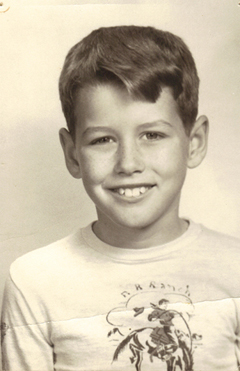
Jonathan Weiner's book's complete title is "Time, Love, Memory: A Great Biologist and His Quest for The Origins of Behavior." It is a very accessible blending of a biography of Seymour Benzer, the most renowned Drosophilist (fruit fly geneticist), with many anecdotes and quotations, and a fascinating history of fruit fly genetics and related molecular biology.
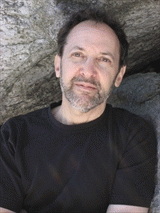
Jonathan Weiner, by and at his official website
(Jonathan Weiner's latest book is "Long For This World: The Strange Science of Immortality")

Seymour Benzer in 1974 with a Drosophila model, by Wikipedia
-
However, I was brought up short by one passage in Time, Love, and Memory on page 244 -
"It is already possible - in fertility clinics it is done every day - to screen the DNA of a set of eight embryos at the eight-cell stage and let the parents pick the one they want to implant in the mother's womb. The more genes there are to screen and the better these gene complexes are understood, the more wealthy parents will select not only the healthiest but also the best and brightest embryo they can, designing the genes of their children....(O)ver the next few centuries whether governments legislate for or against it(,...t)he rich will pick and choose the genes of their children, the poor will not. The gap between rich and poor may widen so far in the third millennium that before the end of it there will not only be two classes of human beings but two species, or a whole Galapagos of different human species. These human species could be prevented from interbreeding by the genetic engineering of chemical incompatibility, so that the egg of one would reject the sperm of the other."
I can't help questioning Weiner's prediction that the wealthy will be able to select genes of their offspring while the poor will not "....over the next few centuries, whether governments legislate for or against it."
Toward the end of Marlon
Brando's autobiography, Songs My Mother Taught Me, that wise and wonderful man
summed up his life's learning as attaining a visceral understanding of how much
mankind is driven by group instincts, and how much every group requires
outsiders to feel superior to. In the paragraph in Time, Love, Memory following
the one quoted from above, Weiner quotes E.O. Wilson saying, "Soon we must
look deep within ourselves and decide what we wish to become....What lifts this
question beyond mere futurism is that it reveals so clearly our ignorance of
the meaning of human existence in the first place." At least, we know what
John Donne's reply to Professor Wilson's musing would be:
"No man is an island, entire of itself; every man is a piece of the continent, a part of the main; if a clod be washed away by the sea, Europe is the less, as well as if a promontory were, as well as if a Manor of thy friends or of thine own were; any man's death diminishes me, because I am involved in Mankind; and therefore never send to know for whom the bell tolls; it tolls for thee."
Hopefully, there are Drosophilists looking for the genes whose sequences determine the proteins for the animal behaviors Brando referred to as "group instincts," and under what conditions their outsider-requiring aspects may be turned off, in order to ameliorate the dystopia of wealth-created castes to which we already belong as well as to prevent the potential dystopia of wealth-created species to which Weiner alludes. I'd call these our "Group-or-Gandhi" sequences, and as fine as this book is, I would have welcomed something in it about Drosophilists' thoughts about them.-



