





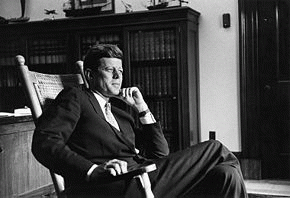
This book should have been titled à ??Kennedy and the Promise of the Kennedy Sixtiesà ? � because it's basically a history of prominent social, cultural and political developments during JFK's almost 1,000 days in office as 35th President of the United States. Kennedy's thousand days lasted from January, 1961 to November, 1963, and then seamlessly blended into à ??The Sixties,à ? � a time still thought of by most Americans in 2009 as something that happened to America during the decade of the 1960's.
I graduated from college in 1963, and when I read Rorabaugh's book in 2004, I found it fascinating to the point of spellbinding. Such was my reward for finding a book which spoke directly to my à ??coming-of-ageà ? � years, a historical period which later regrettably vanished into a time-hole. The book for me was a memory lane experience, and I recommend it without reservation to all of my à ??coming-of-age-from-1960-through-1963à ? � American contemporaries who graduated from college during those four years.
W.J. Rorabaugh has disinterred us.

Only a tiny minority of à ??usà ? � were SNCC or SDS activists on the one hand, or on the other far right-wing conservatives. Instead, a majority of us was so torn by the hopes and disappointments Rorabaugh describes that it was agonizing to commit to choices we correctly perceived would affect the rest of our lives. Even before November 22, 1963, the course the U.S. was following in Indochina was clear, and it solidified most college students' career choices while reinforcing some of us in our commitment to avoid the military at all costs while not pursuing a career. Graduating from a prestigious law school in 1966, I was in a small minority of law school graduates across America that year who eschewed the practice of law and joined the African-American-and-American-Indian-inspired, Leftist, anti-war, sex-drugs-and-rock-and-roll, counter-cultural phenomenon known as The Movement. Not communists, then, many of us became even more disillusioned than those millions of Americans several years younger than us whom we joined, because the early 1960's was a time of great idealism. And we were more appalled than those other millions in the Movement who had been in high-school while witnessing the Vietnam escalation, when one of the Chicago Seven defendants became an insurance salesman.
A problem with the Rorabaugh book is that its Conclusion goes nowhere. Evidently the author, or more likely his editor, was precluded by historical orthodoxy in 2004 from asserting that the Movement in America in the Sixties was a logical development from radicalism during JFK's presidential years, and it was a Good and Necessary Thing. And if this GNT hadn't occurred, in 1968 it's entirely possible Reagan and not Nixon would have got the Republican Party's nomination for president. And if Reagan had become president in 1969, Watergate wouldn't have occurred, and the simple fact is: it's not unlikely that all of us would have succumbed to the cold of a nuclear winter a long, long time ago.






