




"Widespread disruption of electric service can quickly undermine the U.S. government, its military and the economy, as well as endanger "millions," said Joseph McClelland, Director, Reliability, Federal Energy Regulatory Commission.
Government studies state "extreme" solar flare emissions can cause blackouts for weeks, months, or even years in very large areas of the nation. Several are possible during the next ten years of this sunspot cycle.
The NOAA forecasts four "extreme" and many "severe" solar emissions which could threaten the planet during the current decade. NOAA Assistant Secretary Kathryn Sullivan says the intensity of solar storms is expected to peak in 2013 and countries should prepare for "potentially devastating effects." Sullivan, a former NASA astronaut who, in 1984, became the first woman to walk in space, said in Geneva that "it is not a question of if, but really a matter of when a major solar event could hit our planet."
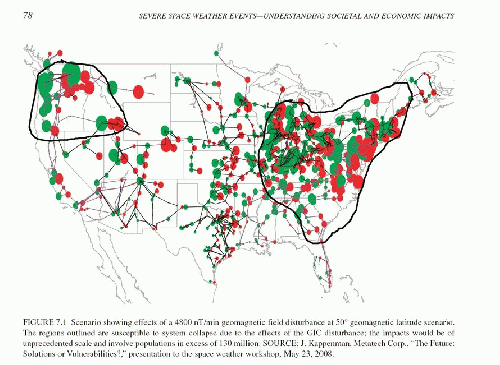
There was a huge solar flare on June 7. It covered half of the sun, and the emission from it grazed Earth's magnetic field. The NASA map above illuminates the possible effect on U.S. power grids if one of the "extreme" or "severe" solar emissions predicted for this decade smashes into our geomagnetic field.
Mobilizing to minimize the damage can stimulate broad support for decentralized energy production and cheap green electricity. Noting wide belief that the economy appears to be headed for disaster, wise leadership can leverage this peril to dispel the gloom, restore the economy, and open paths to increased jobs and income.
On July 13, the NRC said that U.S. plants affected by a blackout should be able to cope without electricity for at least eight hours and should have procedures to keep the reactor and spent-fuel pool cool for 72 hours. Nuclear plants depend on standby batteries and backup diesel generators. It is doubtful if any have enough fuel to last two weeks. When the generators die, the fuel rods would begin to heat the water. Once the water evaporates -- in perhaps two more weeks -- very large amounts of dangerous radiation can escape. The map below illustrates the scale of a potential domestic catastrophe. Winds will carry the fallout over a very much wider area than shown.
Map courtesy of Johan Matson
NASA: Severe Space Weather--Social and Economic Impacts
There is a NASA-funded study by the National Academy of Sciences entitled Severe Space Weather Events--Understanding Societal and Economic Impacts. In the 132-page report, experts detail what might happen to our modern, high-tech society in the event of a "super solar flare" followed by an extreme geomagnetic storm. Storm impact expert John Kappenmann, of Storm Analysis Consultants, looked at the great geomagnetic storm of 1921, which produced ground currents as much as ten times stronger than a 1989 Quebec storm, and modeled its effect on the modern power grid. Of the 5,500 huge transformers potentially at risk, he found more than 350 would have been at risk of permanent damage, and 130 million people would have been without power. The loss of electricity would ripple across the social infrastructure with "water distribution affected within several hours; perishable foods and medications lost in 12-24 hours; loss of heating/air conditioning, sewage disposal, phone service, fuel re-supply and so on." Imagine this continuing for several months or even years and thereby causing meltdowns that could dwarf Fukushima.
The total economic impact in the first year could reach $2 trillion -- 20 times greater than the costs of Hurricane Katrina. The total cost could exceed that of all current wars. And recovery could take more than a decade.
We face a severe emergency. Students of politics know an external threat serves to unite. The nation and the world must now confront an unrecognized nuclear peril! Uniting to confront it can generate the popular and government support necessary to generate millions of jobs and restore the fragile economy.
What can be done?
Events in Japan after the March 11 earthquake have demonstrated the vulnerability of nuclear power plants. The aftermath is far worse than has been publicized. "We have 20 nuclear cores exposed, the fuel pools have several cores each. That is 20 times more potential than Chernobyl," said U.S. Nuclear expert Arnold Gundersen. "You can't clean all this up. We still have radioactive wild boar in Germany 30 years after Chernobyl."
A nuclear waste advisor to the Japanese government reported that an area roughly 17 times the size of Manhattan is now likely uninhabitable.
A recent report by the Oak Ridge National Laboratory discloses that over the standard 40-year license term of nuclear power plants, solar flare activity provides a 33 percent chance of long-term power loss. This is a risk far greater than most other natural disasters, including major earthquakes and tsunamis.
(Note: You can view every article as one long page if you sign up as an Advocate Member, or higher).
 1
1
 1
1
 1
1






