




By Patricia L Johnson and Richard E Walrath
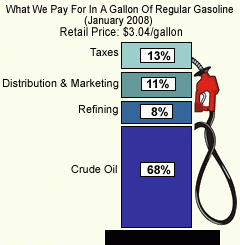
Source: United States Department of Energy
When you allow yourself to be backed into a corner you suffer the consequences in the form of higher prices, and that is basically what has happened to the price of gasoline in the United States.
The retail price of a gallon of gasoline in the United States is split as follows:
- 13% - Taxes
- 11% - Distribution and Marketing
- 8% - Refining
- 68% - Crude Oil
The United States only produces 5.1 million barrels of crude oil per day, while our petroleum consumption exceeds 20.6 million barrels per day.
By using considerably more oil than we produce, the U.S. has to import oil in order to meet our daily needs. At one time the majority of our oil imports came from the various OPEC (Organization of the Petroleum Exporting Countries) but, we only import 5,517,000 barrels of crude per day from OPEC. Algeria, Angola, Ecuador, Indonesia, Iran, Iraq, Kuwait, Libya, Nigeria, Qatar, Saudi Arabia, United Arab Emirates (UAE), and Venezuela are all members of OPEC.
The top three suppliers to the U.S. from the OPEC group are:
- Saudi Arabia - 1,463,000 bpd (barrels per day)
- Venezuela - 1,419,000 bpd
- Nigeria - 1,114,000 bpd
The top U.S. crude oil supplier is Canada at 2,353,000 bpd and Mexico comes in second with 1,705,000 bpd. Non-Opec suppliers result in U.S. imports of 8,190,000 barrels of crude oil per day.
The largest commodity market in the world is crude oil and the leading exchanges for crude oil futures are the NYMEX (New York Mercantile Exchange) and the IPE (International Petroleum Exchange in London). Unless you've been on another planet, you know that oil futures hit a record high of $105.10 on March 6, 2008. There are a couple reasons why oil futures continue to rise and hit a new high.
First is the increased world demand for oil - to that end, the United States, who uses 25% of the world oil supply, requested OPEC to increase production quotas at their Meeting of the Conference of the Petroleum Exporting Countries (OPEC) on March 5, 2008 in Vienna. The conference decided to maintain current production levels and not increase OPEC production as had been requested. Current commercial oil stocks are above their five year average, so they did not see the need for the increase, especially with the economic slowdown in the U.S.
Second is the fall of the U.S. Dollar compared to other currencies. Investors are able to purchase more oil futures with their currency than we are with the U.S. dollar. We'll use the Euro as an example - As of this morning, the Euro has one and a half times the buying power of the USD. 1 USD = 0.648638 EUR - 1 EUR = 1.54169 USD (Live rates at 2008.03.08 17:34:30 UTC)
Since crude oil represents 68% of the price of a gallon of gasoline, the key to understanding fluctuating gasoline prices, is to understand the impact various global/national events have on the price. For an example, we'll use changes in the past 7 years - the period of time that President Bush has been in office.
The first year President Bush was in office was 2001 and at the end of the year the average spot price for an imported barrel of crude oil was $15.86 (December 2001). By December of 2007 the average spot price for an imported barrel had grown to $73.33 (December 2007).There are many factors that influence the price of crude oil and we'll use 2002 as an example because in 2002 the price of crude oil almost doubled, going from $18 per barrel in January to $34 per barrel in December.
In April of 2002 Saddam Hussein suspended Iraqi oil exports for a period of one month. The U.S. was importing 795,000,000 barrels per day from Iraq and the suspension, along with the Venezuela labor strikes in late 2002, created a shortage of crude oil that virtually shut down crude oil production and exports to the U.S.
At the same time, the administration changed the policy on Department of Energy scheduled deliveries to the SPR, Strategic Petroleum Reserves. Prior to 2002 oil companies were allowed to defer deliveries to the SPR when short term oil prices were high compared to long term prices.
(Note: You can view every article as one long page if you sign up as an Advocate Member, or higher).






