| Back OpEdNews | |||||||
|
Original Content at https://www.opednews.com/articles/Chile-73-A-Personal-Testi-Coup_People_Remembrance-230908-335.html (Note: You can view every article as one long page if you sign up as an Advocate Member, or higher). |
|||||||
September 13, 2023
Chile 73: A Personal Testimony (Interview)
By John Hawkins
An interview with Rodrigo Acuna. A personal remembrance of what the Chile coup of 1973 cost the people and what has been learned.
::::::::
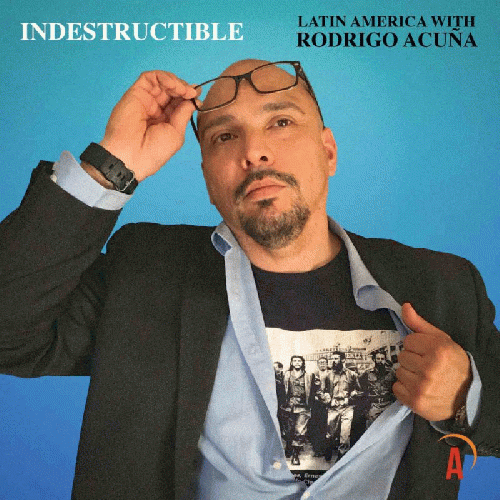
An Interview with Rodrigo Acuña
by John Kendall Hawkins
Dr Rodrigo Acuña is a teacher, writer and expert on Latin American politics. He has published in numerous media and academic outlets which include ALBORADA: Latin America Uncovered, ARENA Magazine, Australian Broadcasting Corporation (ABC), The Conversation, Green Left Weekly, Journal of Iberian and Latin American Research (JILAR), Truthout and Z Network among others. He currently works for the NSW Department of Education and is a contributing editor at Alborada: Latin America Uncovered. He is also the host of Alborada's new podcast Indestructible: Latin America with Rodrigo Acuña. Several of his podcasts there discuss the life of Chile in the last 50 years, including Podcast #11, "Chile, from Allende to Boric." He can be reached on X (Twitter) @rodrigoac7.
We exchanged communiques recently.
#####
JH: It's the 50th anniversary of the Allende coup in September 1973. What have common Chileans learned about their country that they didn't know before the coup? What's the lesson of a half century of healing?
RA: I think some Chileans are always learning new information about the 1973 coup against Allende, such as the important revelation on 2 June 2021 that ASIS was active in Chile during the early 1970s. They were there at the request of the Nixon administration in order to support the CIA. Then there are other revelations like the one that, for several decades, Adriana Rivas (a Pinochet intelligence agent) was living in the Sydney suburb of Bondi working as a nanny and cleaner. In 2007 she was arrested in Chile for the kidnapping an murder of seven people, including a woman who was five months pregnant. Returning to Australia where she had been living since 1978, Rivas, after a massive campaign by the local Chilean Australian community, was arrested in 2019. She is currently incarcerated in a women's prison awaiting extradition to Chile where she will be placed on trial for her alleged crimes.
Now, if you look at the details of the crimes she is being accused of, they are absolutely horrific, however, many Chileans (especially the ones that are economically privileged) have no idea the amount of torture and murder that took place under the US-backed Pinochet regime. Worse, a section of the Chilean population still deny that these crimes even took place. That is why in 2010, the government of president Michelle Bachelet created the Museum of National Memory in Santiago. There, the photos and stories of the victims of the dictatorship can be found as can be school kids who are taken on school excursions to learn about the history of what happened in Chile from 1973 through to 1990.
As for the healing process, I think the continued trials of human rights violators helps as does the recovery of the remains of loved ones who went missing by the military. On the other hand, the scars are too deep to heal completely. Only last month, another member of the Chilean military was sentenced to prison for having participated in the murder of the popular folk singer Victor Jara. Upon his transfer to prison, the former army brigadier took his own life. He was 86 years old and is one of many ex-members of the Chilean military who have committed suicide rather than face time in prison.
JH: I've just watched the recent film, Chile 76, which provides a glimpse of the post-coup years under Pinochet. A period of some 17 years. The film brings a tension that is unique (maybe) to Latin American politics, providing a feeling of numbness as Pinochet dissenters disappear. What can you say about these disappearances?
RA: These disappearances were carried out in order to create a sense of terror and uncertainty among the general population. That is how the film Chile 76 starts: with someone being kidnapped. You do not see the images on the screen as the camera is focusing on paint being stirred, however, any Chilean or Latin American with historical memory will immediately know what is happening when viewing the film. I certainly did.
Regarding the effects of these disappearances, people who had loved ones murdered in this manner during the military dictatorship have never had a full sense of closure. There is no grave for them to lay flowers or hold annual commemorations other than the memorials built for them by the Chilean government or community organisations.
A close friend of my mother, a Chilean-Australian lady in Canberra, for example, had two brothers who worked for president Salvador Allende's personal security team known as the Grupo de Amigos Personales (Group of Personal Friends - GAP). One of her brothers disappeared after the coup and until this day she has never recovered his body. Every few years, once a common grave is discovered, she travels to Chile to see if it is her brother's remains that have been exhumed. Her other brother, who was also in the GAP, was tortured and beaten up so badly by the US-backed Chilean military, he was made an invalid and has lived this way for decades here in Australia. This lady is now in her seventies, cares for her disabled brother and travels to Chile every few years in the hope of finding her other brother. Another family friend I know had her father disappeared and her sister murdered by the military junta. Decades later she is still searching for her father's remains.
At my end, my father spent over two months being interrogated and tortured by the Chilean military and military intelligence during the mid-1970s. His crime was having belonged to the Movimiento de Acción Popular Unitario (Popular Unitary Action Movement - MAPU) and having his visa expire in Argentina while he was working there as a tradesman after having been expelled from university for his left-wing politics. The MAPU was a liberation theology inspired political party that belonged to the Unidad Popular (Popular Unity, UP) government headed by Allende. Well, after my father was deported from Argentina, a local police chief decided to make a name for himself and accuse my father of being an insurgent. He wasn't but it was common for local sergeants and police chiefs to plant evidence on young men if they thought accusing them of being leftist insurgents would result in a promotion. Planting a revolver in his backpack, that is when his nightmare began.
Fast forward decades later and my father never became the school teacher wanted to be in his youth, but instead worked most of his life in a factory making cables. My father is now in his early seventies and only about 15 years ago did his nightmares of being tortured stop. Despite his case being recognised by Amnesty International, and the Australian government granting my family political asylum, until today my father's case has never been acknowledged by the government of Chile.
I share this information with you so you can see the human cost of what was done in Chile and the enormous path of destruction which was left behind by the actions of the Nixon administration in overthrowing Allende. How dare Chileans dream of nationalising their own copper and reinvesting the profits towards building a fairer society.
These are just a small glimpse into the personal stories of the more than 100,000 Chileans that were tortured during the Pinochet dictatorship by the military, police and intelligence services.
JH: Some say Chile was better off without Allende; some say it is better off without Pinochet. Is Chile beginning to heal from the trauma of its own 9/11?
RA: The people that say Chile was better off without Allende never benefited or were conscious of his government's programs. Many kids in the slums had regular access to milk for the first time in their lives at school due to the UP administration. Large public housing programs were established that allowed poor Chileans to live with dignity while Chilean popular culture and indigenous rights were promoted. Unlike never before in Chilean history, education at all levels and publishing houses were promoted through government grants. Although many right-wing upper middle class Chilean women despised president Allende, the same could not be said for many women throughout the country's working class suburbs and slums. These women, like my mother who worked at a government public housing program, were given opportunities they had never had before. When Pinochet and his thugs overthrew Allende, my mother and the entire team she worked with lost their jobs.
Chileans from that era remember these things, despite the impact of boycotts and economic sabotage that was carried out against the UP by important sections of the local business community, their Latin American allies and the United States and European powers. According to historians Simon Collier and William F. Sater in their work 'A History of Chile, 1808-2002' published by Cambridge University Press: "From the beginning, the new government strove hard to fulfil its program. It greatly increased social spending, and made a determined effort to redistribute wealth to the lower-paid and the poor. As a consequence of higher wages and new initiatives in health and nutrition, many poorer Chileans, perhaps for the first time in their lives, ate well and clothed themselves somewhat better than before."
Once Allende was overthrown the nationalisation of Chile's copper industry was reversed while many of the houses and apartments built by the government were handed over to the military. I know this, not only because I have read it in history books, but because one of my aunties and her children were thrown out onto the street once their house built under the UP was possessed by the military.
Regarding the trauma, it will heal once all the generations that lived through the Pinochet regime are gone. The same will be the case with the institutional and economic legacy the Pinochet dictatorship installed through massive terror. Chile is one of the most privatised countries in the world which resulted in the enormous popular protests in late 2019. The massive repression against these protesters, that saw hundreds of Chileans lose their eyesight due to the use of rubber bullets, was done so by Chile's Carabineros (the country's militarised police force). Once the military was called out for several weeks, the killings continued. Both the military and the police are institutions that remain deeply rooted in Pinochet's legacy.
JH: How many Chileans have come to Australia to escape the Pinochet era and how do they maintain a dual culture, especially now discovering that Australia played a part in the downfall of their democracy?
RA: According to a local television report: "Between 1974 and 1981, about 6,000 Chileans were taken in, and hundreds more joined them as part of a family reunion program. In 1971, there were 3,760 Chileans living in Australia, but by 1991, just a year after Pinochet's regime came to an end, there were 24,042."
I would add that before the coup on September 11, 1973, the Chilean community in Australia was virtually non-existent. After 1974 that changed as the first wave of refugees were political. Then, into the decade of the 1980s, many Chileans arrived due to political persecution or because the economic situation for many blue- and white-collar Chileans was appalling.
Finally, regarding a dual culture, many Chilean Australians certainly have one. Some of the younger generation might have lost some of their connection to Chile and its history and culture, however, others have not. This September 12, at the Parliament of New South Wales, a group of Chilean Australians and myself have organised an event that will run for over 6 hours to mark 50 years since the overthrow of Salvador Allende's government. We have several academics, politicians and diplomats speaking as well as Alejando Ferna'ndez Salvador Allende, who is journalist and grandson of president Salvador Allende. We are carrying out this event because we know the local Chilean Australian community is supporting us and are aware of the importance of promoting a collective memory. The same can be said for sections of the border Australian community which were appalled to know one of their former governments sent Australian Secret Intelligence Service (ASIS) agents to work with the Central Intelligence Agency (CIA) to overthrow the democratically elected leftist administration of president Allende.
JH: You are working on your first documentary film, "Venezuela: The Cost of Challenging an Empire." Can you say more about it and how you are applying the insights gained from the destruction of Chile's democracy? And when will it be available for viewing?
The documentary journalist Nicolas Ford and I are working on is about the impact of US economic sanction on Venezuela which has had a leftist democratically elected government since early 1999. The impact has been horrific and cost the lives of tens of thousands of Venezuelans who, for example, can't have numerous medicines imported into the country due to US sanctions.
In the film we talk to many experts on the impact of these sanctions as well as the victims of right-wing violence in the country. From the coverage we often get from the mainstream media, every time there has been an attempted coup or major political turmoil in Venezuela, we are told the country is unstable. Often, all of Venezuela's problems are blamed on the government. Rarely does the mainstream media mention that in almost every single crisis, the majority of victims are poor pro-government supporters murdered by right-wing paramilitary thugs.
Also, the mainstream press never really discusses why the chavistas (i.e. the supporters of the late president Hugo Chavez) continue to win election after election. In fact, with the exception of one parliamentary vote and numerous regional ones, the chavistas have won just about every major election in Venezuela since 1999. This phenomenon is explained by the government's massive programs on social spending, in particular in health, education, sports and the construction of public housing. I know some of these programs well because I wrote a thesis on them.
Obviously, given my history and knowledge of Latin American politics, the connections between Chile under Allende and Venezuela under Chavez and now president Nicolas Maduro are obvious. A key difference between the two though is that, while Chavez was able to reform the military after the short-lived 2002 US-backed coup against his government, Allende was not and was violently overthrown.
Unfortunately, despite some important public support, the film Nicholas and I are making has taken over two years to complete. This is partly because we both have had other commitments but also because it is essentially the two of us that have been working on this project which is our first film. We are now aiming to release 'Venezuela: The Cost of Challenging an Empire' in late 2023 or early 2024.
#####
Authors Website: https://tantricdispositionmatrix.substack.com/
Authors Bio:
John Kendall Hawkins is an American ex-pat freelance journalist and poet currently residing in Oceania.