| Back OpEdNews | |||||||
|
Original Content at https://www.opednews.com/articles/The-Titan-Explosion--The-Freedom_Titan-230716-606.html (Note: You can view every article as one long page if you sign up as an Advocate Member, or higher). |
|||||||
July 16, 2023
The Titan Explosion - The Press Crushes Scientific Research
By Robert A. Leishear, PhD, PE, ASME Fellow
Once again, the mainstream Press stifles, or censors, the Freedom of Speech of reputable experts. Sound scientific results to explain the 'Titan Submarine Explosion' were published through OpEdNews, but primarily only the readers of OpEdNews and their affiliates are aware of this research.
::::::::
Once again, the mainstream press stifles, or censors, the freedom of speech of reputable experts. Sound scientific results to explain the 'Titan Submarine Explosion' were published through OpEdNews, but primarily only the readers of OpEdNews and their affiliates are aware of this research.
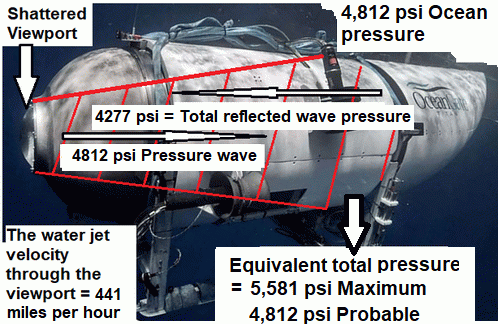
Figure 1. Titan Submarine and pressures during the viewport implosion and the subsequent hull explosion.
(Image by Adapted from Drop The Info / OceanGate by Leishear Engineering, LLC.) Details DMCA
Press Censorship
Requests for publication of the attached article were refused or were unanswered by the Scientific American, the New York Times, the Los Angeles Times, the New York Daily News, and the Washington Post, and even my local newspaper, The Aiken Standard. I am not making specific accusations against specific newspapers. However, there seems to be a form of group think in the press.
When one news outlet prints an article, a flood of similar internet articles on the same topic follows. Then, that topic - the sinking of the Titan in this case - appears many times on the internet from multiple news organizations.
Articles from OpEdNews.com are essentially blocked from the internet in many cases, such as this case for a Titan Submarine Explosion Op Ed.
Science versus Technical Guesswork
For example, the "Animation of [the] Titan sub's demise garners 5 million views in 11 days" (click here). This animation is interesting to watch, but this animation does not fit the technical facts that are presently known about this disaster. Yet, millions of people are taken in by this technically errant video.
I published complex technical conclusions that fit the facts ("The Titan Submarine Implosion - A Fatigue Crack Ruptured the Viewport to Instantly Destroy the Vessel"). This article cannot be found among the many Titan internet articles found by searching 'Titan submarine' on major websites.
The following refused Op Ed condenses my earlier Op Ed, and provides improved explosion pressure predictions, as shown in Figure 1.
Submitted Op Ed Revised: The Cause of the Titan Submarine Explosion
Robert A. Leishear, PhD PE, ASME Fellow
Over and over, the Press incorrectly reports that the Titan submarine imploded, but the facts do not support this narrative. The facts support a conclusion that an explosion destroyed the submarine, rather than an implosion. Large, relatively undamaged, but torn sections of the hull conclude that the submarine blew apart, rather than collapsing in on itself. Such damage is consistent with the implosion of the viewport used to view the Titanic, followed by the explosion of the Titan hull.
The viewport, or porthole, at the front of the Titan submarine imploded to kill all five people on board this 22-foot-long vessel. When the viewport collapsed, a 440-mile-per-hour wall of water burst into the cabin, and deaths were nearly instantaneous. Resultant shock wave pressures then blasted the vessel into multiple pieces.
The dominant theme in Press publications incorrectly mentions that there may have been defects in the hull that caused a hull implosion. I disagree. I stand steadfastly against the tide of current public opinion.
The Titan Destruction
I have used available information to write a detailed technical article, which explains the destruction of the Titan Submarine ("The Titan Submarine Implosion - A Fatigue Crack Ruptured the Viewport to Instantly Destroy the Vessel", click here). My credentials to do so are that I am an expert in failure analysis, and the complex dynamics of liquids and shock waves.
This Op Ed presents a troubleshooting scenario, where engineering troubleshooting is the application of science to a known failure to better understand that failure. As new facts are uncovered, troubleshooting conclusions will improve.
Available facts support the opinion that the viewport collapsed, and then the hull exploded within 3/100ths of a second. This explosion was so fast that the victims would have only seen a momentary flash of the inrush of water as the Titan was demolished.
Explosion Calculations
Explosion pressure estimates have been revised and improved since the initial Op Ed that reported this research. Since there are many different pressures involved in these calculations, Table 1 provides further details.
Even so, dynamic pressures need some explanation. When you apply a pressure to an object, the same pressure pushes back. However, when you apply that same pressure very rapidly, the pressure that pushes back is twice the initial pressure. This effect is known as a dynamic load factor where DLF = 2. For reflected pressure waves, the DLF approaches 5, where the complex physics of such wave DLFs are outside the scope of this Op Ed.
An understanding of dynamic load factors is essential to any analysis of the Titan explosion. Without such an understanding, one can readily reach the false conclusion that a hull implosion destroyed the Titan.
Calculation Results
The following list summarizes pertinent explosion calculations.
- The depth of the explosion was reported in the Press, and that depth yielded an ocean pressure estimate of 4,812 psi, which was the pressure that entered the Titan when the viewport imploded.
- If only this 4,812-psi pressure surge into the cabin is considered, the effective dynamic pressure that pushed outward on the hull equaled 9624 psi - 4812 psi = 4,812 psi - after the external pressure of the ocean pushing inward was considered. In other words, the hull responded as if the internal pressure was twice the external ocean pressure to blast the hull into sections.
- At the viewport, a jet of water formed, and this jet entered the Titan at 441 miles per hour.
- This jet of water expanded until it struck the bulkhead. When the jet struck the bulkhead, the pressure had been reduced to 2,139 psi.
- This pressure wave doubled in magnitude as the wave reflected back toward the viewport from the bulkhead to yield a total pressure due to wave reflection equal to 4,277 psi.
- An alternative explosion pressure calculation was considered, using the Leishear Stress Theory ("Fluid Mechanics, Water Hammer, Dynamic Stresses and Piping Design", click here). Evaluating the 2,139-psi pressure wave, the effective pressure that pushed outward on the hull equaled 5,881 psi.
- That is, the effective outward explosion pressure equaled 4,812 psi to 5,881 psi - after the external pressure of the ocean pushing inward was considered.
- Based on decades of engineering research, this range of pressures provides reasonable explosion-pressure predictions.
- Due to complex plasticity effects, the more likely effective outward explosion pressure estimate is 4,812 psi.
- By way of comparison, automobile tires are pressurized from 30 to 40 psi.
Implosions versus Explosions
The differences between implosions and explosions prove this implosion / explosion theory.
For an implosion, the debris from the Titan would have been expected to settle in a single location. Debris was found in two different locations.
An explosion ripped the Titan into many parts, where two different halves sunk to the ocean floor in two different locations, and those two halves of the submarine were further broken into multiple sections. The retrieved hull section was ripped along mechanical joints and torn through parts of the hull body. Such damages are consistent with explosion damages.
For an implosion, the hull would have been crushed like a paper bag. A hull section was retrieved from the ocean bottom, and that section had no indications of implosion crushing.
Further Proof of a Viewport Implosion and Hull Explosion
The viewport assembly consists of a window for adventure tourists to look out onto the wreck of the Titanic. This assembly keeps the window leak-tight for the submarine. From Titan salvage photos, the entire assembly is missing. Such damage is consistent with the implosion / explosion processes descried here.
All in all, observed damages to the vessel are consistent with a hull explosion, and these damages are not consistent with a hull implosion. Therefore, an implosion of the viewport that caused a hull explosion fits the facts.
What is Fatigue, and How did Fatigue Sink the Titan?
Now, let us consider the viewport implosion a little more carefully. To do so, a structural-failure mechanism known as fatigue needs some mention.
When a structure is flexed back and forth, or cycled, that structure cracks. Sometimes the structure cracks after millions of cycles, sometimes the structure cracks after only a few cycles. An example of low-cycle fatigue occurs when you flex a coat hanger back and forth until it cracks. The life of a design can only be determined with certainty through fatigue-crack testing.
Fatigue cracks and damages affect many industries ("The U.S. Government Murders Us Through Indifference and Deceit - Cover-ups Throughout U.S. Industries"). Bridges collapse. Jet aircraft have crashed. Merchant ships have sunk. Water mains break. Power plant piping explodes. Cross-country gas pipelines explode.
The viewport window cracked due to fatigue cracking to destroy the Titan Submarine.
Fatigue Failure Testing was Deadly Inadequate for the Titan
Reportedly, the Titan had 50 test dives and three trips to the site of the Titanic wreck. There is no evidence of fatigue-test data for the Titan viewport window.
Fatigue failures are remarkably complicated, and care needs to be taken to guard against such failures. Hopefully, the U.S. Coast Guard will reach this Lesson Learned during their multi-million-dollar investigation of the Titan devastation and deaths.
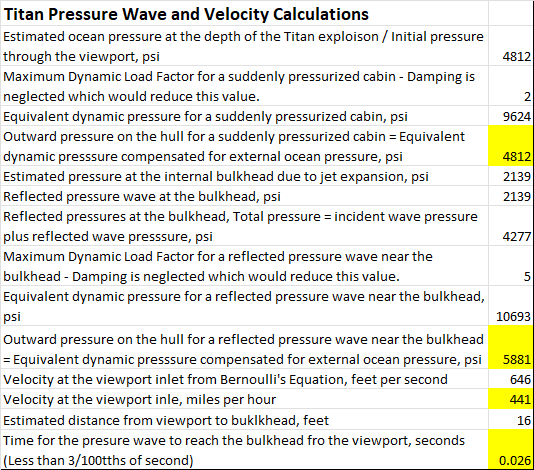
Table 2. Titan submarine pressure calculations for explosion analysis for the hull.
(Image by Leishear Engineering, LLC) Details DMCA
Addendum, 7/17/2023
An article proves the importance of non-scientific endorsements by the Press.
Along with a link to this Op Ed, I sent a tweet to the Post that stated, "This article claims that the Titan sunk because it got wet. Try science". The implication is ridiculous that a submarine being towed through the water somehow contributed to the sinking, since boats travel the waterways every day. The Post did not respond, of course.'The flawed design choices on the janky sub were likely made with the intention of keeping costs low and making the vessel carrying wealthy tourists down to view the Titanic's wreckage as profitable as possible, several engineers told the New York Times Friday.
One cost-cutting measure included renting a mothership called the Polar Prince that was too small to carry the Titan on deck, meaning it had to drag the submersible through the ocean for three days from Newfoundland to the crash site, the report said.
The hack resulted in the sub being "tossed around pretty roughly.'
(Article changed on Jul 20, 2023 at 5:10 PM EDT)
Authors Website: http://www.leishearengineeringllc.com
Authors Bio:
Robert A. Leishear, PhD, P.E., PMP, ASME Fellow, Who's Who in America Top Engineer, Who's Who Millennium Magazine cover story, NACE Senior Corrosion Technologist, NACE Senior Internal Piping Corrosion Technologist, ANSYS Expert, AMPP Certified Protective Coatings Inspector, NACE Cathodic Protection Tester, Structural Steel Worker, Welder, Carpenter, and Journeyman Sheet Metal Mechanic, is a Consulting Engineer for Leishear Engineering, LLC, and worked as a Lead Research Engineer (Principal Researcher) for the U.S. Department of Energy's (DOE) Savannah River National Laboratory (IQ = 161). He has also worked as a design engineer, test engineer, and plant engineer in nuclear waste facilities and nuclear fuel reprocessing facilities. Additionally, Dr. Leishear worked as a lead electronic packaging design engineer for military aircraft and missile systems. In this position, he designed the first wireless aircraft radar system, and he patented an electromagnetic interference mechanism to ensure that aircraft radar computer systems remained operational for second strike capabilities in the event of nuclear war, where this mechanism was installed on all personal computers and printers for decades. Dr. Leishear has written more than 210 technical publications on water hammer, nuclear plant explosions, and other research. Publications by the American Society of Mechanical Engineers include two water hammer and piping design books and Honors Journal publications. Dr. Leishear received the Mensa, Copper Black Award for Creative Intelligence for his research on nuclear power plant explosions and petroleum industry explosions. He was appointed as an ASME Fellow for his research on water hammers, which are directly applicable to industrial explosions. Dr. Leishear earned a B.S. in Mechanical Engineering from Johns Hopkins University, and at the University of South Carolina, he earned M.S. and PhD degrees in Mechanical Engineering, and also earned a Master of Engineering degree in Nuclear Engineering. For these degrees he studied, fracture mechanics, water hammer, fluid mechanics, mass transfer, gas dynamics, materials science, fatigue cracking, advanced thermodynamics, reactor thermal hydraulics, risk analysis, engineering law, reactor design, reactor physics, radiation shielding, reactor materials science, nuclear fuel cycles, reactor water chemistry, nuclear material safeguards, finite element analysis, structural vibrations, machinery vibrations, HVAC design, combustion, explosions, and structural analysis. He has also extensively studied nuclear reactor physics, nuclear reactor thermal/fluid modeling, and nuclear reactor fuel design through Oak Ridge National Laboratories, the University of Illinois, the University of Barcelona, and the U.S. NRC; 12 corrosion courses through the Association for Materials Protection and Performance (AMPP/NACE); water treatment classes through the American Water Works Association; 7 combustion courses through the Combustion Institute at Princeton University and CERFACS; 20 Fluent and Ansys computer modeling courses; plus International Nuclear Law at the University of Singapore and International Radiological Protection at Stockholm University in Sweden through the OECD, Nuclear Energy Agency. He also completed two years of full-time training at the DOE, Savannah River Site to understand infrastructure, diesel engines, pumps, compressors, fans, heat exchangers, evaporators, steam systems, air and nitrogen systems, mixing, instrumentation, calibrations, machinery design, fire protection systems, safety analysis, emergency response, radiation worker, electrical worker, first aid, explosion risks, plus 17 ASME courses on pressure vessel design, inspection, and piping design. At SRS, he also studied nuclear industry processes, which included chemistry, radiochemistry, and physics for nuclear waste disposal and nuclear fuel reprocessing. He was also trained for 6 weeks at SRS as an HVAC, electrical, and electronics systems mechanic. Prior to his academic education, Bob Leishear earned his indenture papers through a four-year sheet metal apprenticeship, and he attended six months of training to learn to weld, build steel plate construction, and cut steel with an acetylene torch.