| Back OpEdNews | |||||||
|
Original Content at https://www.opednews.com/articles/What-Are-Political-Theolog-by-Thomas-Farrell-Belief_Catholic_Evil_Faith-210501-401.html (Note: You can view every article as one long page if you sign up as an Advocate Member, or higher). |
|||||||
May 1, 2021
What Are Political Theologies of Sacred Rhetoric? (REVIEW ESSAY)
By Thomas Farrell
What are political theologies of sacred rhetoric? Examples of political theologies of sacred rhetoric would include Pope Francis' widely read 2015 eco-encyclical and various speeches and writings of the Reverend Dr. Martin Luther King, Jr. Steven Mailloux has operationally defined and explained the expansive term political theologies of sacred rhetoric -- referring to religiously motivated political speech and activism.
::::::::
Duluth, Minnesota (OpEdNews) May 1, 2021: Figuratively speaking, I write to sing my praises of Steven Mailloux for his perceptive scholarly essay "Political Theologies of Sacred Rhetoric" in the anthology Responding to the Sacred: An Inquiry into the Limits of Rhetoric, edited by Michael Bernard-Donals and Kyle Jensen (Penn State University Press, 2021, pages 77-98).
Now, certain OEN readers may have experienced the sacred in their lives at one time or another. Those OEN readers who may have experienced the sacred in their lives may have also given voice to their experience(s) and expressed themselves to the best of their ability about what they experienced. In addition, perhaps in certain cases their experience(s) of the sacred in their lives may have prompted them to engage in political activism. In the course of their activism, they may have even articulated their sacred motives and theologies. In short, they may have articulated what Mailloux refers to as political theologies of sacred rhetoric.
For example, I assume that the Reverend Dr. Martin Luther King, Jr. (1929-1968), was prompted to engage in political activism because he interpreted certain experiences in his life as experiences of the sacred. However, Mailloux does not happen to advert explicitly in his essay "Political Theologies of Sacred Rhetoric" to any of Dr. King's speeches or writings as examples of political theologies of sacred rhetoric.
For a relevant discussion of Dr. King, see Rufus Burrow's book God and Human Dignity: The Personalism, Theology, and Ethics of Martin Luther King, Jr. (University of Notre Dame Press, 2006).
However, Mailloux does explicitly refer to the extemporary speech and the formal publications of Pope Francis (born Jorge Mario Bergoglio in Buenos Aires, Argentina in 1936; elected pope in 2013). Pope Francis is not only the first pope from South America, but also the first Jesuit pope. Consequently, Mailloux discusses Jesuit spirituality in connection with Pope Francis.
The formal publications of Pope Francis that Mailloux refers to are available in English at the Vatican's website, as Mailloux notes in his bibliography entries about each of them. Of course, Pope Francis' most widely read formal publication was his 2015 eco-encyclical, known formally as Laudato si': On Care for Our Common Home, which unmistakably represents one example of what Mailloux refers to as political theology of sacred rhetoric.
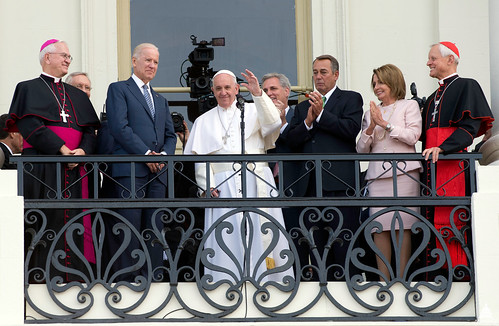
However, because President Joseph R. Biden, Jr., is a practicing Catholic, we should also note here that Mailloux also refers to Pope Francis' 2015 "Address of the Holy Father" to the U.S. Congress as another example of what he refers to as political theology of sacred rhetoric.
Now, because Pope Francis is the first Jesuit pope, a word is called for here about the Jesuit order. The Jesuit religious order in the Roman Catholic Church is known formally as the Society of Jesus. It was founded by St. Ignatius Loyola (1491-1556), who is the author of the short book of incisive instructions known as the Spiritual Exercises. The incisive instructions are designed for persons on retreat to follow as they undertake guided imagistic meditations and contemplations during their retreat. As part of the lengthy Jesuit formation, Jesuits such as Jorge Mario Bergoglio make two thirty-day retreats in silence (except for the daily conferences with the retreat director) following the Spiritual Exercises of St. Ignatius Loyola. To replenish their spiritual lives, Jesuits usually make an eight-day retreat once a year, following a streamlined version of the Spiritual Exercises of St. Ignatius Loyola.
I am here referring to guided imagistic meditations and contemplations because I am borrowing the term imagistic from the classicist Eric A. Havelock's use of the term imagistic thought in his seminal book Preface to Plato (Belknap Press of Harvard University Press, 1963). By doing this here, I hope to call to mind the oral-aural processing involved in making the Spiritual Exercises of St. Ignatius Loyola.
Now, Jesuit formation is lengthy and involves many dimensions of their lives - above and beyond those special times of prayer when they are making retreats following the Spiritual Exercises of St. Ignatius Loyola. Even though Jesuit formation is deliberate and self-conscious, we should reflect here on the relatively unconscious ways in which we are formed by the cultures and sub-cultures in which we have grown up (e.g., American culture in general and/or American Catholic sub-culture, etc.). Because our relatively unconscious cultural conditioning is manifold, Jesuit formation is designed to be manifold.
The late American Jesuit psychiatrist W. W. Meissner (1931-2010) examines the psychology of the Spanish mystic in his book The Psychology of a Saint: Ignatius of Loyola (Yale University Press, 1992).
Now, Jesuits are not the only persons who make eight-day retreats, or even thirty-day retreats, following the Spiritual Exercises of St. Ignatius Loyola. Indeed, the Jesuits run retreat houses where various persons may make such retreats.
Persons make Ignatian retreats at Jesuit retreat houses to step back a bit from their regular daily lives and to replenish their spiritual lives by making time in their lives to experience the sacred to the extent that they can. As far as I know, the experience of the sacred is open to all persons, including all persons who read op-ed pieces at OEN, as I noted above.
Now, because the meditative practice known as mindfulness is well known in the United States, I should point out here that the practice of guided meditation and contemplation following the instructions in the Spiritual Exercises of St. Ignatius Loyola is strikingly different from the meditative practice known as mindfulness. In an Ignatian retreat, the person is called upon to engage his or her imagination and senses as well as his or her memory.
One of the distinctive repeated instructions in the Spiritual Exercises of St. Ignatius Loyola calls for the person making the retreat to round off the meditation in question with a colloquy - that is, with a two-way conversation with the person in the meditation (e.g., Jesus or Mary), in which the person making the retreat supplies both sides of the conversation. For understandable reasons, we have no way of knowing just how well, or not, persons making retreats did with this instruction.
Now, see the short book The Spiritual Exercises of Saint Ignatius: A Translation and Commentary by George E. Ganss, S.J. (St. Louis: Institute of Jesuit Sources, 1992). Mailloux refers to Ganss' 1992 translation, but in a different 1992 book. (The Institute of Jesuit Sources is no longer in St. Louis; it has been relocated to Boston College, the Jesuit university in the Chestnut Hill area of the greater metropolitan Boston area.)
But then-Cardinal Bergoglio gave a preached retreat following the Spiritual Exercises of St. Ignatius Loyola to the bishops of Spain. Bergoglio's remarks have been published in the short 2013 book credited to Pope Francis titled In Him Alone: Spiritual Exercises Given to His Brother Bishops in the Manner of Saint Ignatius Loyola (San Francisco: Ignatius Press). Mailloux refers to the pope's remarks in that retreat.
Now, the repeated instruction in the Spiritual Exercises of St. Ignatius Loyola calling for the person making the retreat to engage in a colloquy accentuates how they involve what may be described as self-persuasion. However, George T. Tade (died in 2006) of Texas Christian University does not happen to advert explicitly to this repeated instruction in his article "The Spiritual Exercises: A Method of Self-Persuasion" in the Quarterly Journal of Speech, volume 43 (1957): pages 383-389.
From antiquity onward in Western culture, persuasion has been understood as the domain of rhetoric, a term Mailloux uses in the title of his essay and a term that also appears in the subtitle of the book in which his essay appears.
But Mailloux does not happen to advert explicitly to Tade's 1957 article. However, Mailloux refers explicitly to Michel Foucault's terminology about such exercises as "technologies of the self" (page 79). Consequently, Mailloux says, "The Ignatian Spiritual Exercises are a Jesuit self-technology that shapes character: there is an ordering of the retreatant's inner life, an ordering that might be called an aesthetics of experience [based on the Jesuit retreatant's memory of his life and sins], an ordering that is best understood as a self-directed ethics [involving examining one's sins] tied to an other-directed politics [in one's post-retreat life and actions]" (page 79).
An other-directed politics in one's post-retreat life and work may include political activism and what Mailloux refers to as political theologies of sacred rhetoric.
Mailloux also says, "Motivated by an act of faith that derives from other readings of texts and life, the retreatant [making a retreat following the Spiritual Exercises of St. Ignatius Loyola] performs the exercises as a technology of the self that shapes one as a specific kind of believing subject. That is, as subjects already believing at least something about the Spiritual Exercises, Jesuit traditions, and other theological and political matters, retreatant are formed and form themselves as believing subjects in terms of Ignatian spirituality. Belief precedes and follows the performance of the exercises" (page 79).
Now, how does Mailloux operationally define and explain the sacred? He says, "We can think of the sacred as an appearance, extension, irruption of the supernatural in the natural, of the divine within the human. Such phenomena certainly resist rhetorical articulation, since human rhetoric - the use of signs [and sounds] in a context to have effects - is always limited by the natural, the conditioned, the finite, the contingent. Nonetheless, if we define spiritual as 'concentrated attention to the sacred,' there are spiritual rhetorics that relate us to the supernatural, spiritual rhetorics that have both individual personal and collective political effects. These rhetorics include community religious rituals as well as private prayers and meditations" (page 78).
Now, how does Mailloux operationally define and explain political theology? He says, "Political theology deals with the connection between political praxis and religious belief. It is any implicit or explicit theory relating worldly action within power relations to speculative thinking about the world beyond" (page 77).
For his information about Pope Francis, Mailloux draws on Massimo Borghesi's 2017 book The Mind of Pope Francis: Jorge Mario Bergoglio's Intellectual Journey, translated by Barry Hudock (Collegeville, MN: Liturgical Press Academic; orig. Italian ed., 2017).
See my OEN article "An Intellectual Biography of Pope Francis" (dated October 28, 2018):
But also see my OEN article about how Pope Francis is doctrinally conservative titled "Pope Francis on Evil and Satan" (dated March 24, 2019):
Now, from Borghesi (esp. pages 6-14 and 79-85). Mailloux learned how deeply the young Bergoglio was influenced by the French Jesuit Hegel specialist and theologian Gaston Fessard (1897-1978), whose distinguished work in French about the Spiritual Exercises of St. Ignatius Loyola young Bergoglio read between 1962 and 1964 (page 6).
Concerning Fessard, Mailloux says, "Gaston Fessard was a French philosopher [and theologian] whose Christian political theology derived from his dialectical thinking and his experience of the Ignatian Spiritual Exercises. Fessard Hegelian commentary La dialectique des "Exercices spirituels" de Saint Ignace de Loyola [1956] was considered by his fellow Jesuit and noted rhetorician Walter Ong to be the best philosophical treatment of Ignatius' text yet written. Fessard's commentary had a profound effect on a range of Catholic thinkers, including Pope Francis, who recently said, 'The - in quotes - "Hegelian" writer - but he is not Hegelian, though it may seem like he is - who had a big influence on me was Gaston Fessard. I've read La dialectique des "Exercices spirituels" de Saint Ignace de Loyola, and other things by him, several times. That work gave me so many elements that later became mixed in [to my thinking]" (page 84; Mailloux is quoting from Borghesi's book, page 6; and the bracketed material is in Borghesi's text).
Now, Fessard's "fellow Jesuit and noted rhetorician Walter Ong [1912-2003; Ph.D. in English, Harvard University, 1955]" has himself discussed St. Ignatius Loyola and the Spiritual Exercises in three important publications:
(1) Ong's scholarly article "'A.M.D.G.' [Abbreviation for the Latin phrase For the greater glory of God]: Dedication or Directive?" in the now-defunct Jesuit-sponsored journal Review for Religious, volume 11, number 5 (September 15, 1952): pages 257-264; which is reprinted in volume three of Ong's Faith and Contexts (Atlanta: Scholars Press, 1995, pages 1-8).
(2) Ong's scholarly article "St. Ignatius' Prison-Cage and the Existentialist Situation" in the Jesuit-sponsored journal Theological Studies, volume 15, number 1 (March 1954): pages 34-51; which is reprinted in volume two of Ong's Faith and Contexts (Atlanta: Scholars Press, 1992b, pages 52-67).
(3) Ong's scholarly book Hopkins, the Self, and God (University of Toronto Press, 1986, esp. pages 54-88 and 113-122), the published version of Ong's 1981 Alexander Lectures at the University of Toronto.
In Ong's 1986 book, among other things, he says that "Ignatius' little volume" was not only a major landmark in the Christian ascetical tradition, but also a major landmark "in the development of Western consciousness - though not necessarily a major determinant, for its influence was of limited range. The Exercises show Western consciousness maximizing more and more explicitly the human person and that particularizing center of the person which is free human decision, the act of will, which Hopkins identified as 'the selfless self of self'" (page 56).
Ong also says, The Spiritual Exercises are at the service of grace, not a mechanism for grace. There is no mechanism for grace" (page 67). In plain English, if we define grace as the experience of receiving the benefactions of the sacred (as Mailloux uses the term sacred), then there is no guarantee that what Mailloux and Foucault refer to as technologies of the self will automatically result in a person receiving certain benefactions of the sacred such as those received by St. Ignatius Loyola. Nevertheless, the absence of such a guarantee should not prevent us from hoping to receiving certain benefactions of the sacred.
Now, in my introductory book Walter Ong's Contributions to Cultural Studies: The Phenomenology of the Word and I-Thou Communication, 2nd ed. (New York: Hampton Press, 2015; 1st ed., 2000), I note that Ong, who was fluent in French, was based in Paris in a Jesuit residence there for three full years (November 17, 1950 to November 16, 1953) when he was researching the work of the French Renaissance logician and educational reformer and Protestant martyr Peter Ramus (1515-1572) - whose residential college at the University of Paris used to be located not far from the Jesuit residence where Ong had a room. Gaston Fessard also had a room there, and so did the posthumously famous French Jesuit paleontologist and religious thinker Pierre Teilhard de Chardin (1881-1955).
Ong himself refers to Fessard in three of his early books as a Catholic public intellectual (as we might term his role in them):
(1) Ong's book American Catholic Crossroads: Religious-Secular Encounters (New York: Macmillan, 1959, pages 57 and 77).
(2) Ong's book The Barbarian Within: And Other Fugitive Essays and Studies (New York: Macmillan, 1962, page 229).
(3) Ong's book In the Human Grain: Further Explorations of Contemporary Culture (New York: Macmillan, 1967, page 71).
In my estimate, these three early books by Ong, along with his earlier book Frontiers in American Catholicism: Essays on Ideology and Culture (New York: Macmillan, 1957), can accurately be characterized as examples of what Mailloux refers to, rather expansively, as political theology of sacred rhetoric. However, in my estimate, most of Ong's other books, including Hopkins, the Self, and God (1986), mentioned above, cannot comfortably be characterized as further examples of what Mailloux refers to as political theology of sacred rhetoric.
Now, after Mailloux discusses Fessard at length (pages 84-93), he eventually rounds off the text of his fine scholarly essay by saying, rather modestly, "In all the rhetorical activities I have described throughout this essay - the performance of spiritual exercises, political-theological interventions in the public sphere, revivals of eloquentia perfecta within Jesuit college curricula - attention to the sacred plays a crucial role, sometimes explicitly, sometimes implicitly. In showing how such spiritual rhetorics function in different domains, I have tried to demonstrate how rhetoric, in theory and practice, is both enabled and constrained by the sacred as a manifestation of the supernatural and a target of the spiritual" (page 94).
Mailloux should be credited for operationally defining and explaining the admittedly expansive term political theologies of sacred rhetoric that can include certain statements of Pope Francis, Dr. King, Fessard, Ong, and others. This is no mean achievement.
(Article changed on May 05, 2021 at 7:33 AM EDT)
Authors Website: http://www.d.umn.edu/~tfarrell
Authors Bio:
Thomas James Farrell is professor emeritus of writing studies at the University of Minnesota Duluth (UMD). He started teaching at UMD in Fall 1987, and he retired from UMD at the end of May 2009. He was born in 1944. He holds three degrees from Saint Louis University (SLU): B.A. in English, 1966; M.A.(T) in English 1968; Ph.D.in higher education, 1974. On May 16, 1969, the editors of the SLU student newspaper named him Man of the Year, an honor customarily conferred on an administrator or a faculty member, not on a graduate student -- nor on a woman up to that time. He is the proud author of the book WALTER ONG'S CONTRIBUTIONS TO CULTURAL STUDIES: THE PHENOMENOLOGY OF THE WORD AND I-THOU COMMUNICATION (Cresskill, NJ: Hampton Press, 2000; 2nd ed. 2009, forthcoming). The first edition won the 2001 Marshall McLuhan Award for Outstanding Book in the Field of Media Ecology conferred by the Media Ecology Association. For further information about his education and his publications, see his UMD homepage: Click here to visit Dr. Farrell's homepage.
On September 10 and 22, 2009, he discussed Walter Ong's work on the blog radio talk show "Ethics Talk" that is hosted by Hope May in philosophy at Central Michigan University. Each hour-long show has been archived and is available for people who missed the live broadcast to listen to. Here are the website addresses for the two archived shows:
Click here to listen the Technologizing of the Word Interview
Click here to listen the Ramus, Method & The Decay of Dialogue Interview