Washington, DC has been continuously militarized beginning the week leading up to Joe Biden's inauguration, when 20,000 National Guard troops were deployed onto the streets of the nation's capital.
::::::::
From Substack
Washington, DC has been continuously militarized beginning the week leading up to Joe Biden's inauguration, when 20,000 National Guard troops were deployed onto the streets of the nation's capital. The original justification was that this show of massive force was necessary to secure the inauguration in light of the January 6 riot at the Capitol. But with the inauguration over and done, those troops remain and are not going anywhere any time soon. Working with federal law enforcement agencies, the National Guard Bureau announced on Monday that between 5,000 and 7,000 troops will remain in Washington until at least mid-March.
The rationale for this extraordinary, sustained domestic military presence has shifted several times, typically from anonymous U.S. law enforcement officials. The original justification the need to secure the inaugural festivities is obviously no longer operative. So the new claim became that the impeachment trial of former President Trump that will take place in the Senate in February necessitated military reinforcements.
On Sunday, Politico quoted "four people familiar with the matter" to claim that "Trump's upcoming Senate impeachment trial poses a security concern that federal law enforcement officials told lawmakers last week requires as many as 5,000 National Guard troops to remain in Washington through mid-March."
The next day, AP, citing "a U.S. official," said the ongoing troop deployment was needed due to "ominous chatter about killing legislators or attacking them outside of the U.S. Capitol." But the anonymous official acknowledged that "the threats that law enforcement agents are tracking vary in specificity and credibility." Even National Guard troops complained that they "have so far been given no official justifications, threat reports or any explanation for the extended mission nor have they seen any violence thus far."
It is hard to overstate what an extreme state of affairs it is to have a sustained military presence in American streets. Prior deployments have been rare, and usually were approved for a limited period and/or in order to quell a very specific, ongoing uprising to ensure the peaceful segregation of public schools in the South, to respond to the unrest in Detroit and Chicago in the 1960s, or to quell the 1991 Los Angeles riots that erupted after the Rodney King trial.
Deploying National Guard or military troops for domestic law enforcement purposes is so dangerous that laws in place from the country's founding strictly limit its use. It is meant only as a last resort, when concrete, specific threats are so overwhelming that they cannot be quelled by regular law enforcement absent military reinforcements.
Deploying active military troops is an even graver step than putting National Guard soldiers on the streets, but they both present dangers. As Trump's Defense Secretary said in response to calls from some over the summer to deploy troops in response to the Black Lives Matter and Antifa protests: "The option to use active duty forces in a law enforcement role should only be used as a matter of last resort, and only in the most urgent and dire of situations."
Are we even remotely at such an extreme state where ordinary law enforcement is insufficient? The January 6 riot at the Capitol would have been easily repelled with just a couple hundred more police officers. The U.S. is the most militarized country in the world, and has the most para-militarized police force on the planet. Earlier today, the Acting Chief of the Capitol Police acknowledged that they had advanced knowledge of what was planned but failed to take necessary steps to police it.
Future violent acts in the name of right-wing extremism, as well as other causes, is highly likely if not inevitable. But the idea that the country faces some sort of existential armed insurrection that only the military can suppress is laughable on its face.
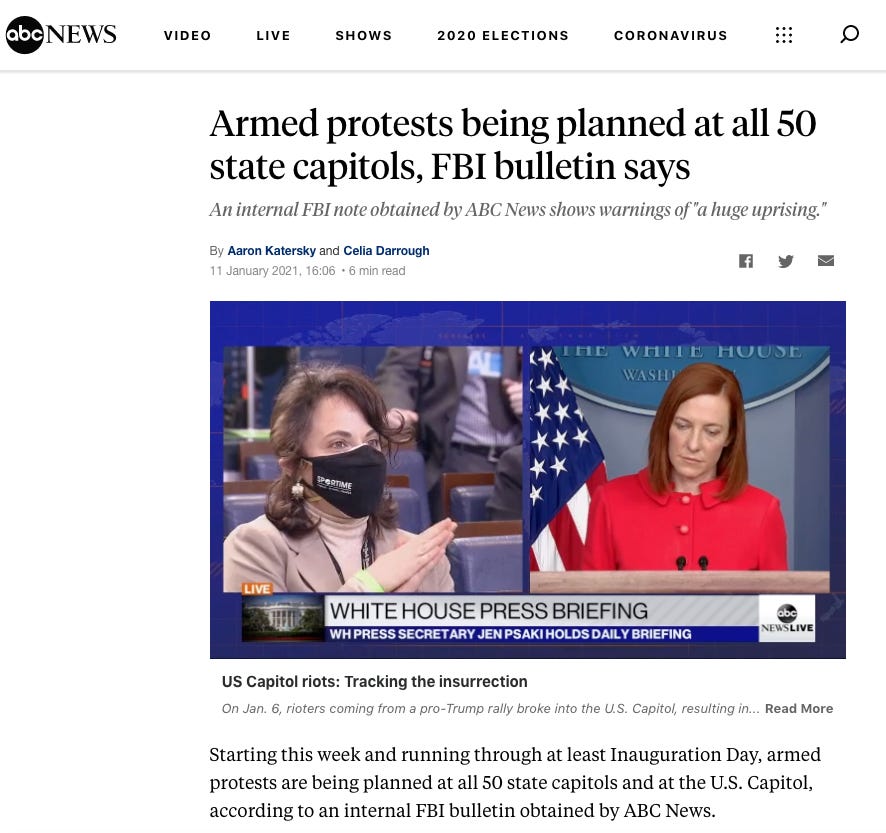
Recall that ABC News, on January 11, citing "an internal FBI bulletin obtained by ABC News," claimed that "starting this week and running through at least Inauguration Day, armed protests are being planned at all 50 state capitols and at the U.S. Capitol." The news outlet added in highly dramatic and alarming tones:
"The FBI has also received information in recent days on a group calling for 'storming' state, local and federal government courthouses and administrative buildings in the event President Donald Trump is removed from office prior to Inauguration Day. The group is also planning to 'storm' government offices in every state the day President-elect Joe Biden will be inaugurated, regardless of whether the states certified electoral votes for Biden or Trump."
![]() None of that happened. There was virtually no unrest or violence during inauguration week except for some anti-Biden protests held by leftist and anarchist protesters that resulted in a few smashed windows at the Oregon Democratic Party and some vandalism at a Starbucks in Seattle. "Trump supporters threatened state Capitols but failed to show on Inauguration Day," was the headline NBC News chose to try to justify this gap between media claims and reality
None of that happened. There was virtually no unrest or violence during inauguration week except for some anti-Biden protests held by leftist and anarchist protesters that resulted in a few smashed windows at the Oregon Democratic Party and some vandalism at a Starbucks in Seattle. "Trump supporters threatened state Capitols but failed to show on Inauguration Day," was the headline NBC News chose to try to justify this gap between media claims and reality
This threat seems wildly overblown by the combination of media outlets looking for ratings, law enforcement agencies searching for power, and Democratic Party operatives eager to exploit the climate of fear for a new War on Terror. But now is not a moment when there is much space for questioning anything, especially not measures ostensibly undertaken in the name of combating white-supremacist right-wing extremism just as no questioning of supposed security measures was tolerated in the wake of the 9/11 attack. And so the scenes of soldiers on the streets of the nation's capital, there in the thousands and for an indefinite period of time, is provoking little to no concern.
What makes this all the more remarkable is that a mere seven months ago, a major controversy erupted when The New York Times published an op-ed by Sen. Tom Cotton (R-AR) which, at its core, advocated the deployment of military troops to quell the social unrest, protests and riots that erupted over the summer after the killing in Minneapolis of George Floyd. To justify the deployment of National Guard and active duty military forces, Cotton emphasized how many people, including police officers, had been seriously maimed or even killed as part of that unrest:
Outnumbered police officers, encumbered by feckless politicians, bore the brunt of the violence. In New York State, rioters ran over officers with cars on at least three occasions. In Las Vegas, an officer is in "grave" condition after being shot in the head by a rioter. In St. Louis, four police officers were shot as they attempted to disperse a mob throwing bricks and dumping gasoline; in a separate incident, a 77-year-old retired police captain was shot to death as he tried to stop looters from ransacking a pawnshop. This is "somebody's granddaddy," a bystander screamed at the scene.
(Cotton's claim that police officers "bore the brunt of the violence" was questionable, given how many protesters were also killed or maimed, but it is true that numerous police officers were attacked, including fatally). Cotton acknowledged that the central cause of the protests was a just one, noting they were provoked by "the wrongful death of George Floyd." He also strongly affirmed the right of people to peacefully protest in support of that cause, accusing those justifying the violence of "a revolting moral equivalence of rioters and looters to peaceful, law-abiding protesters," adding: "A majority who seek to protest peacefully shouldn't be confused with bands of miscreants." But he insisted that, absent military reinforcements, innocent people, principally ones in poor communities, will suffer. "These rioters, if not subdued, not only will destroy the livelihoods of law-abiding citizens but will also take more innocent lives," Cotton wrote, adding: "Many poor communities that still bear scars from past upheavals will be set back still further."
The backlash to the publication of this op-ed was immediate, intense, and, at least in my memory, unprecedented. Very few people were interested in engaging the merits of Cotton's call for a deployment of troops in order to prove the argument was misguided. Their view was not that Cotton's plea for soldiers in the streets was misguided, but that advocacy for it was so obscene, so extremist, so dangerous and repugnant, that the mere publication of the op-ed by The Paper of Record was an act of grave immorality.
"I'll probably get in trouble for this, but to not say something would be immoral. As a black woman, as a journalist, I am deeply ashamed that we ran this," pronounced the paper's Nikole Hannah-Jones in a now-deleted tweet. The New York Times Magazine writer Taffy Brodesser-Akner posted a multi-tweet denunciation that compared Cotton to an anti-Semite who "says, 'The Jew is a pig,'" argued that "hatred dressed up as opinion is not something I have to withstand," and concluded with this flourish: "I love working at the Times and most days of the week I'm very proud to be part of its mission. But tonight, I understand the people who treat me like I work at a tobacco company."
Former NYT editor and Huffington Post editor-in-chief Lydia Polgreen announced, also in a now-deleted tweet: "I spent some of the happiest and most productive years of my life working for the New York Times. So it is with love and sadness that I say: running this puts Black @nytimes staff -- and many, many others -- in danger."
That publication of the Cotton op-ed "puts Black New York Times staff in danger" became a mantra recited by more journalists than one can list. Two editors, including the paper's Editorial Page editor James Benett and a young assistant editor Adam Rubenstein were forced out of their jobs, in the middle of a pandemic, for the crime not of endorsing Cotton's argument but merely airing it.
Media reports attributed their departure to a "staff revolt." The paper itself appended a major editor's note: "We have concluded that the essay fell short of our standards and should not have been published." In addition to alleged flaws in the editorial process, the paper also said "the tone of the essay in places is needlessly harsh and falls short of the thoughtful approach that advances useful debate."
There is a meaningful difference between deploying National Guard troops and active duty soldiers on American streets. But both measures are extraordinary, create a climate of militarization, have a history of resulting in excessive force against citizens engaged in peaceful protest and constitutionally protected dissent, and present threats and dangers to civil liberties far beyond ordinary use of law enforcement.
Why was the idea of troops in American streets so grotesque and offensive in June, 2020 but so normalized now? Why were these troops likely to indiscriminately arrest and murder black reporters and other journalists over the summer but are now trusted to protect them? And what does it say about the current climate, and the serious dangers it poses, that the public is being trained so easily to acquiesce to extreme measures in the name of domestic security?
We are witnessing the media and their public treat what ought to be regarded with great suspicion as not only normal but desirable, all through the manipulation of fears and inflation of threats. That does not bode well for those who seek to impede the imminent attempt to begin a new domestic War on Terror.
Authors Bio:
[Subscribe to Glenn Greenwald] Glenn Greenwald is a journalist,former constitutional lawyer, and author of four New York Times bestselling books on politics and law. His most recent book, "No Place to Hide," is about the U.S. surveillance state and his experiences reporting on the Snowden documents around the world. His forthcoming book, to be published in April, 2021, is about Brazilian history and current politics, with a focus on his experience in reporting a series of expose's in 2019 and 2020 which exposed high-level corruption by powerful officials in the government of President Jair Bolsonaro, which subsequently attempted to prosecute him for that reporting.
Foreign Policy magazine named Greenwald one of the top 100 Global Thinkers for 2013. He was the debut winner, along with "Democracy Now's" Amy Goodman, of the Park Center I.F. Stone Award for Independent Journalism in 2008, and also received the 2010 Online Journalism Award for his investigative work breaking the story of the abusive detention conditions of Chelsea Manning.
For his 2013 NSA reporting, working with his source Edward Snowden, he received the George Polk Award for National Security Reporting; the Gannett Foundation Award for investigative journalism and the Gannett Foundation Watchdog Journalism Award; the Esso Premio for Excellence in Investigative Reporting in Brazil (he was the first non-Brazilian to win); and the Electronic Frontier Foundation's Pioneer Award. The NSA reporting he led for The Guardian was also awarded the 2014 Pulitzer Prize for Public Service. A film about the work Greenwald and filmmaker Laura Poitras did with Snowden to report the NSA archive, "CitizenFour," directed by Poitras, was awarded the 2015 Academy Award for Best Documentary.
In 2019, he received the Special Prize from the Vladimir Herzog Institute for his reporting on the Bolsonaro government and pervasive corruption inside the prosecutorial task force that led to the imprisonment of former Brazilian President Lula da Silva. The award is named after the Jewish immigrant journalist who was murdered during an interrogation by the Brazilian military dictatorship in 1977. Several months after the reporting began, Lula was ordered released by the Brazilian Supreme Court, and the former President credited the expose's for his liberty. In early 2020, Brazilian prosecutors sought to prosecute Greenwald in connection with the reporting, but the charges were dismissed due to a Supreme Court ruling, based on the Constitutional right of a free press, that barred the Bolsonaro government from making good on its threats to retaliate against Greenwald.
After working as a journalist at Salon and The Guardian, Greenwald co-founded The Intercept in 2013 along with Poitras and journalist Jeremy Scahill, and co-founded The Intercept Brasil in 2016. He resigned fromThe Intercept in October, 2020, to return to independent journalism.
Greenwald lives in Rio de Janeiro, Brazil with his husband, Congressman David Miranda, their two children, and 26 rescue dogs. In 2017, Greenwald and Miranda created an animal shelter in Brazil supported in part through public donations designed to employ and help exit the streets homeless people who live on the streets with their pets.