| Back OpEdNews | |||||||
|
Original Content at https://www.opednews.com/articles/Let-s-Hear-it-for-Original-by-Steven-Jonas-Confirmation_Congress_Fascism_Government-200922-612.html (Note: You can view every article as one long page if you sign up as an Advocate Member, or higher). |
|||||||
September 22, 2020
Let's Hear it for Original Intent
By Steven Jonas
As the confirmation process for Trump's third Supreme Court Justice barrels along, we are going to her alot about "Original Internet," a favorite saw of Justice Scalia (except when it wasn't). In my book "The 15% Solution" I wrote a fictional Supreme Court decision, authored by "Chief Justice Steps" that overturns "Marbury v. Madison" etc., revoking established Review power for the Court. This column presents that chapter.
::::::::
-------------------------------------------------------------------------------------------
"Either this nation shall kill racism, or racism shall kill this nation." (S. Jonas, August, 2018)
------------------------------------------------------------------------------------------
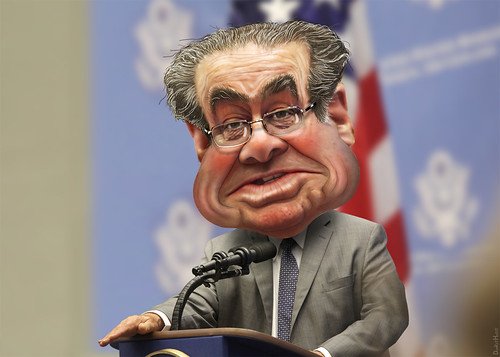
As the Trumpublicans© bull their way to an extra Supreme Court Seat*, you are going to hear a lot about "Original Intent." "We want to make sure that the majority of Justices on the bench [would that they could be ALL ours] are committed to the Doctrine of Original Intent." That is that the Constitution should be interpreted in the context of the meanings of the language in which it was written over 230 years ago. The most prominent recent avatar of this approach was Justice Antonin Scalia. He was clearly devoted to the doctrine of "original intent" --- except when for political reasons he wasn't. See, e.g., his majority opinion in "Heller," on gun control, which opened the modern floodgates for the NRA and the gun industry for which they are the shills. The Second Amendment begins with the words "A well-regulated militia." Giving permission for private ownership of guns in the home had nothing to do with militias, well-regulated or not. But Scalia had the votes, and away he went.
In this context, let's take a look at the Doctrine of Original Intent in terms of the Court and its powers. Everybody takes for granted that the Supreme Court is a co-equal branch of government, actually a little bit more than co-equal. That is because it has the power to declare actions of the other two branches "unconstitutional," and thus make them null and void. Which is quite a bit of power. Surely that power is clearly written into the Constitution, is it not? Well, it's not. The balance of this column will show a) that indeed it's not and b) how, nevertheless, it came to be, functionally.
In 1996, under the pseudonym "Johnathan Westminster," I published a book entitled "The 15% Solution: A Political History of American Fascism, 2001-2022." In 2013 I published a 3rd version (not a third edition) of the book under the title "The 15% Solution: How the Republican Religious Right Took Control of the U.S., 1981-2022 ." (Actually, if Trump is reinstalled as President --- note I didn't use the word "win" --- that is precisely what is going to happen, more under Barr than under Trump [which will be the subject of another column shortly down the road].) That book, with an eye-catching cover if I do say so myself (although I did not design it), is advertised with every one of my OEN columns, towards the end of each.
In the plot of the book (which I wrote in 1994-95) control of the instruments of government get tighter and tighter for the Right. One venerable institution which could get in the way, even though the Right has a major majority, is the Supreme Court. So, a case comes up (it's school prayer case, actually, sponsored by the old Southern Racist-Rightist Jesse Helms, see the Postscript at the end of this column) that gives the Court the chance to do away with the powers of judicial review. A majority decision written by Chief Justice Steps (Scalia, It., get it?) reviews the cases that in the early 19th century formed what came to be known as "judicial review," and gave the Supreme Court that "over-rule/declare-Unconstitutional" power. Which, in fact, you may be surprised to learn is nowhere to be found in the Constitution's Article III (which defines the Supreme Court) or anywhere else for that matter. So in my book Chief Justice "Steps" proceeded. And here, with introductory material, is his (fictional, do recall) opinion in the case, "Anderson v. Board of Education," from Chapter 5, of the book (as fictionally summarized in the Supreme Court Bulletin of the time, which is a real publication).
-------------------------------------------------------------------------------------------
Summary of the Decision (Supreme Court Bulletin [fictional])
"Supreme Court Has No Constitutional Review Authority"
Anderson v. Board of Education, CerÂtiorari to United States Court of ApÂpeals for the Third Circuit.
No. 101"11. Argued October 31, 2002Decided May 13, 2003.
Petitioner, a parent acting on behalf of her minor child, brought a civil acÂtion against the Board of Education of the state of New Jersey seekÂing to preÂvent it from enforcing a law passed durÂing the 2001 sesÂsion of the State LegisÂlature mandating voluntary prayer in the public schools of that state. Both the trial and appeals courts in the state of New Jersey found for the respondent. Petitioner appealed to the SuÂpreme Court. WithÂout arguing the merits, responÂdent filed a brief claiming that under 28 U.S.C., Chap. 81, para. 1260, generÂally known as the "Helms AmendÂment [1]," the U.S. SuÂpreme Court did not have juÂrisdiction in this case.
Held: Under the cited section of the U.S. Code, the Supreme Court has no jurisdiction to review appeals of state school prayer statutes. FurÂther, there can be found in the Constitution of the United States no grant of authority to the Supreme Court to review the action of any other branch of the Federal Government or any branch of any state government for its "constitutionality."
(a) Article 3, Section 2 of the Constitution defines the authority of the Federal judicial power: "The judicial power shall extend to all casÂes, in law and equity, arising under this constitution, the laws of the United States, and treaties made, or which shall be made under their authority; to all cases affectÂing ambassadors, other public ministers and consuls; to all cases of admiralty and maritime jurisdiction; to controÂversies to which the United States shall be a party; to controversies between two or more states."
(b) It is clear that the plain language of this article supports the holdÂing of the Court. Under the Doctrine of Original Intent, by which the Constitution should always be interpreted, it is clear that the ConstiÂtution means only what it says, not what any individual judge or group of judges collectively think that it ought to say or would like it to say. It thus beÂcomes clear that the series of decisions handed down by Chief Justice John Marshall and his colleagues in the first quarter of the 19th century which established the theory of Supreme Court "judicial reÂview" for "constituÂtionality" were based on faulty legal reaÂsoning.
(c) In the first of these cases, Marbury v. Madison, the Court invalÂiÂdated an "Act of Congress giving the Court jurisdiction to hear origiÂnal appliÂcations for writs of mandamus, because in such cases the ConÂstituÂtion limits the SuÂpreme Court to appellate jurisdiction" (Cox). While that opinÂion may be valid, nowhere does the Constitution give the Court the power to apply it with the force of law. Rather, as in Great Britain, the legislaÂtive branch, through the will of the majority, is the only apÂpropriate judge of the "constitutionality" of its own acts. In his written opinion, the Chief Justice stated that if "the courts lacked the power to give sting to constituÂtional safeguards . . . , the LegislaÂtive and ExecuÂtive Branches might too often override the Constitution" (Cox). That may well be true. But if the Founding Fathers had wanted to give the Federal judiciary that "protecÂtive" function, they would have clearly writÂten it into the ConstituÂtion. Chief Justice Marshall was reading into the ConstiÂtution words that he wanted to see but were not there [emphasis added].
(d) In Martin v. Hunter's Lessee, Justice Joseph Story expanded the SuÂpreme Court's review powers to include decisions made by the State courts (Cox). Like Chief Justice Marshall, Justice Story was reading into Article 3, Section 2 of the Constitution what he wanted to see there. In Cohens v. VirÂginia Chief Justice Marshall affirmed Justice Story's conÂcluÂsion in Martin, using the same faulty reasoning (Cox).
(e) Finally, in McCulloch v. Maryland, Chief Justice Marshall not only reaffirmed the Court's review authority, unstated in the ConstituÂtion, but found in it other "implied powers," giving the Congress auÂthority to undertake acÂtions not otherwise specified by the Constitution (in this case renewing the charter of the United States Bank which it had originally established in 1791) (Cox).
(f) After extensive review of the opinions and reasoning in the deciÂsions made in the aforementioned cases, careful review of the language of the ConÂstitution itself, and a consideration of the available evidence on Original Intent, the Court was able to find no basis for the concluÂsions on "implied powers" that Chief Justice Marshall and his colleagues drew in those decisions referable to the authority of either the Supreme Court or the Congress. Thus, the Court held, the precedents estabÂlished by those cases and all their successors down through the years were based on faulty reaÂsoning and a reading of the ConstiÂtution not in acÂcord with the Doctrine of Original Intent. Thus, those faulty preceÂdents must be abandoned. Since the specifics of Marbury, Martin, Cohens, and McCulloch had long since become moot, the Court chose not to reverse those decisions. However, it did reverse the holdings made in those cases, that the Supreme Court had any power to review the actions of the FedÂeral ExecuÂtive and Legislative branches, or any State courts, for their "constituÂtionality."
11 F. 11th 111, Affirmed. Chief Justice Steps delivered the opinion of the Court; seven justices joining, one dissenting.
Author's Commentary (from the book; still fictional)
Anderson v. United States was the most signifiÂcant decision handed down by the Supreme Court in the old United States since Marbury v. Madison, reÂferred to in the decision summary reproduced above. In that case, Chief JusÂtice John Marshall had established the power of the SuÂpreme Court to review actions of the two other branches of the Federal government. As corÂrectly noted by Chief Justice Steps that power is noÂwhere clearly grantÂed to it by the Constitution itself. Nevertheless, MarÂshall said, if the Supreme Court found such actions to be unconstiÂtutional, they were null and void. His reasonÂing went as follows (Cox):
"The Constitution is either a superior paramount law, unÂchangeÂable by ordinary means, or it is on a level with ordinary legislaÂtive acts, and, like other acts, is alterÂable when the legisÂlature shall please to alter it. If the former part of the alternaÂtive be true, then a legislative act conÂtrary to the Constitution is not law; if the latter part be true, then written constitutions are abÂsurd atÂtempts, on the part of the people, to limit a power in its own nature illimitable."
Marshall, of course, held that the "former alternative" was true, its truth found in the fact of the Constitution itself. He then drew the deÂfensiÂble conÂclusion that the body given the power to adjudicate disputes arising under the Constitution, and Article 3 Section 2 surely did that, indeed had the power to review the actions of the other two governÂmenÂtal branches for their constituÂtionality. That authority was extended to the appellate review of state court decisions having constitutional impliÂcations under the defenÂsible conclusion that by ratifying the ConÂstitution in the first place, the states had ceded to the UnitÂed States that appellate jurisdiction, which is clearly conÂtained in Article 3 Section 2 (see the decision in Cohens).
Once the Court under Marshall's leadership had made those judgments, the full American power structure quickly came to agree with him. The JefferÂsonians did make several modest attempts to undermine the indeÂpendence and authority of the Supreme Court, but failed and ultimateÂly gave up. [Jefferson himself said that his opponents would "retreat into the judiciary as a stronghold, the tenure of which renders it difficult to dislodge them."] From that time onwards, American jurisprudence came to be firmly established in the legal structure that Chief Justice Marshall had constructed on the Constitution's base, as he interpreted it.
One very important principle set forth by Marshall, and subsequentÂly accepted by all parties to American government down to the TransiÂtion Era, was that the Constitution was a document that meant more than it explicitly said, that was open to interpretation, and held within itself "imÂplications." And by implication that meant the Constitution was a docuÂment that could grow and change with changing times and circumstances, that it was indeed designed to grow and change with changing times and circumstances.
During the Transition Era there came to be propounded what the SuÂpreme Court Bulletin's summary of Anderson refers to as the "DocÂtrine of Original Intent." One of its early protagonists was one Edwin Meese, the most promiÂnent of President Ronald Reagan's several AttorÂneys General, later President of Right-Wing Reaction's Transition Era coordinating body, the highly secretive Council for National Policy (the highly secretive coordinating body for a wide range of Reactionary Republican and Christian Rightist organizations during the run-up to fascism). A forÂmer local prosecutor with no backÂground in ConÂstiÂtuÂtionÂal law, a lawyer who once was supposed to have said that if the police arrested someÂone that was eviÂdence enough he or she was guilty, Meese held that if it wasn't in the ConstiÂtuÂtion, in clear lanÂguage, it didn't exist.
A more cerebral proponent of the Doctrine was one Robert Bork. He had two principal claims to fame. One was that as the third"ranking JusÂtice DeÂpartment official in 1973, on the orders of President Richard M. Nixon he fired a supposedly independent prosecutor during the scanÂdal that eventually came to be known by the name "Watergate" and that eventually led to Nixon's resignation as President. (Bork's two superiÂors at the time both resigned rather than carry out an order which inÂdeed was later found to be unlawful.)
The other was that he was the most celebrated failed Supreme Court nomiÂnee in the history of the old U.S. And his nomination failed preÂcisely because he held to Constitutional theories that were completeÂly at odds with those held by almost everyone else at the time considÂered to be an authority on the matÂter. But his time eventually came. The Court did adopt the theory he esÂpoused so eloquently in so many legal papers and articles. Summarizing the theory, Bork held that (1993):
". . . principles not originally understood to be in the ConstituÂtion [have no constitutional validity]. Where the Constitution is silent, [a Supreme Court] Justice has no [legislative review] authority. To act against legislaÂtion without authority is to enÂgage in civil disobedience from the bench and to perpetrate limÂited coups d'e'tat that overthrow the American form of governÂment."
By implication, of course, Bork was attacking Marshall, because what he found in the Constitution was certainly not originally underÂstood to be there (assuming that "originally" in this context means "when the ConstiÂtuÂtion was written"). And by so doing, Bork was in the front of a moveÂment to deny 200 years of American jurisprudence. His, in essence, was the thinkÂing behind Anderson.
It is interesting that Bork's theory of Original Intent would appear to have much in common with the theory of "Biblical Innerantism" that was all the rage among the Religious Right during the Transition Era and proÂvided a major piece of the foundation of the thinking that lead to American Fascism. But that's another story, one we will get to later.
A spirited attack on the theory of Original Intent had been offered a few years before Bork wrote the article cited above by Judge Irving R. Kaufman, a Federal Circuit Court of Appeals judge (1987):
"I regard reliance on original intent to be a largely specious mode of inÂterÂpretation. I often find it instructive to consult the Framers when I am called upon to interpret the Constitution, but it is the beginning of my inquiry, not the end. For not only is the quest for 'intent' fraught with obstacles of a practical naÂture notably that the Framers plainly never foresaw most of the problems that bedevil the courts today - it may also be more undemocratic than competing methods of construing the ConstiÂtuÂtion.
"If the search for 'intent' sums up the constitutional enterÂprise, then curÂrent generations are bound not merely by general lanÂguage but by speÂcific conceptions frozen in time by men long dead. . . .
"The open"textured nature of most of the vital clauses of the ConÂstituÂtion signifies that the drafters expected future generaÂtions to adapt the language to modern circumstances, not conÂduct judiÂcial autopsies into the minds of the Framers. When the Founding Fathers talked about due proÂcess, equal protection and freeÂdom of speech and reliÂgion, they were emÂbracing genÂeral principles, not specific solutions [emphasis added]."
Kaufman here is of course defending the expansive approach to ConÂstituÂtional interpretation that lead to the broadening of protections for indiÂvidual rights that so enraged Right"Wing Reactionaries in the latter half of the 20th century and lead eventually to Anderson.
It is ironic that in his younger days Kaufman was the judge who preÂsided over the trial of Ethel and Julius Rosenberg, accused of being atomic"weapons spies, convicted, and eventually executed. Many peoÂple around the world thought the trial and the subsequent failed appeals proÂcess were possibly rigged and certainly major miscarriages of jusÂtice. Both Ethel and Julius were politiÂcal progressives and he was an active member of the Communist Party. Ethel was almost certainly not a spy, and if Julius was, he was apparently engaged only in stealing industrial, not atomic weapons, secrets.
The trial and execution of the Rosenbergs, it was revealed later, feaÂtured unprecedented collusion between the Federal Bureau of InvestiÂgation, the FedÂeral Department of Justice, and the Courts, including both Judge Kaufman and the Supreme Court (Meeropol; Schneir and Schneir; Wexley). But it was a major feature of the so"called "McCarÂthy Period" (1945"60). During that time of so"called "anti"Communist hysteria," indiÂvidual rights for many left"wing Americans were harshly suppressed. PunÂishment, most often in the form of political and judiÂcial harassment and loss of employment, not imprisonment or death, was meted out simply for having, holding to, and expressing unpopular ideas, not for engaging in any even faintly illegal activity.
As an echo in a way of McCarthyism, in Anderson a group of Right"Wing Reactionary justices overturned the whole U.S. legal tradiÂtion from the time of the founding and organization of the Republic because they didn't like the outcomes that tradition had produced. With the Court out of the way, by its own hand no less, Right"Wing Reaction had sucÂceedÂed in emasculating the powers of one of the three protectors of AmeriÂcan constitutional democracy, the Courts, the meÂdia, and the Congress, on which it had set its sights during the TransiÂtion Era (see Appendix III). Thus, Anderson significantly accelerated the development of fascism in the old U.S. But who ever said that the Court was not always truly a political institution (Rodell)?
-----------------------------------------------------------------------------------------------
And so ends the excerpt from my book.
References:
Bork, R., "The Senate's Power Grab," New York Times, June 23, 1993.
Cox, A., The Court and the Constitution, Boston, MA: Houghton Mifflin, 1987, pp. 58, 59, 63, 66, 75, 342, 360.
Kaufman, I.R., "No Way to Interpret the Constitution," New York Times, Jan. 2, 1987.
Meeropol, R., "Critique with Mort Meclosky," WUSB"FM, 90.1, Stony Brook, NY, October 30, 1995.
Rodell, F., Nine Men: A Political History of the Supreme Court from 1790 to 1955, New York: Random House, 1955.
Schneir, W. and Schneir, M., Invitation to an Inquest, New York: DouÂbleday, 1965.
Supreme Court Bulletin (Windham, NH), "Supreme Court Has No Constitutional Review Authority," Vol. 24, No. 8, June 2003, p. 3. [Note: this is a fictional reference.]
Wexley, J., The Judgment of Ethel and Julius Rosenberg, New York: Cameron and Kahn, 1955.
-------------------------------------------------------------------------------------------------
Postscript (back to real time):
There was a real "Helms Amendment," offered in Congress a number of times from the early 1980s onwards by Senator Jesse Helms (R"NC) (Cox) and his ideologiÂcal succesÂsors. Here is the real language from the real bill, that was really introduced to the Congress in 1991, as S. 77: "Sec. (a) This section may be cited as the 'Voluntary School Prayer Act'. (b) (1) ChapÂter 81 of title 28, UnitÂed States Code, is amended by adding at the end thereof the following new section: #1260. Appellate jurisdiction: limitations '(a) NotwithÂstandÂing the provisions of secÂtions 1253, 1254, and 1257 of this chapter and in accorÂdance with section 2 of Article III of the Constitution, the Supreme Court shall not have jurisdiction to review, by appeal, writ of certiorari, or otherwise, any case arising out of any State statute, ordiÂnance, rule, regulation, practice, or any part thereof, or arising out of any act interÂpreting, applyÂing, enforcing, or effecting any State statute (and etc.) which relates to voluntary prayer, Bible readÂing, or religious meetings in public schools or public buildÂings . . .'"
Yes, Senator Helms really did write that language and really introduced that piece of legislation. It never did pass. But under Trumpite Theo-fascism, who knows?
------------------------------------------------------------------------------
* The Trumpubs.(C) say, as they dash to confirm as Trump's third nominee someone who will be if anything even further to the Right than the previous two, that in contradistinction with what they did to the Merrick Garland nomination, they are following a "non-political path." That is because, according to Moscow Mitch, this time the same party is in charge of both the Presidency and the Senate. (Somehow in Repub.-think that makes it "non-political." Huh?) Interestingly enough, by doing so they are clearly saying that when they deep-sixed Garland, nominated by Pres. Obama, they were in fact playing politics. But then again, consistency has never been a trait of the Republican Party, throughout its history.
(Article changed on September 23, 2020 at 16:58)
(Article changed on September 24, 2020 at 00:44)
Authors Website: http://thepoliticaljunkies.org/
Authors Bio:
Steven Jonas, MD, MPH, MS is a Professor Emeritus of Preventive Medicine at StonyBrookMedicine (NY). As well as having been a regular political columnist on several national websites for over 20 years, he is the author/co-author/editor/co-