| Back OpEdNews | |||||||
|
Original Content at https://www.opednews.com/articles/Attuning-Ourselves-to-the-by-Thomas-Farrell-Christianity_Creative-Imagination_Creative-Power_Creative-Problem-Solving-200901-889.html (Note: You can view every article as one long page if you sign up as an Advocate Member, or higher). |
|||||||
September 1, 2020
Attuning Ourselves to the Creative Universe (REVIEW ESSAY)
By Thomas Farrell
Forrest G. Robinson's book Love's Story Told: A Life of Henry A. Murray (Harvard University Press) tells in detail the sad story of the secret extramarital love affair for more than forty years of Dr. Murray, M.D., Ph.D. (1893-1988) and Mrs. Christiana Morgan (1897-1967), both of the Harvard Psychological Clinic. In the 1920s, each of them was analyzed in Zurich by the Swiss psychiatrist Dr. C. G. Jung, M.D. (1875-1961).
::::::::
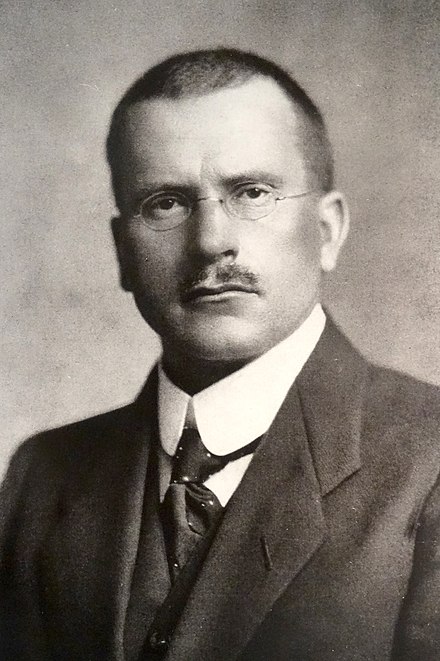
CGJung.
(Image by (From Wikimedia) unknown, upload by Adrian Michael, Author: unknown, upload by Adrian Michael) Details Source DMCA
Duluth, Minnesota (OpEdNews) September 1, 2020: How do we as individual persons embrace the creative universe? Perhaps we can imagine our own personal creative spirit as attuning us to the creative universe.
Dr. Henry Alexander Murray, Jr., M.D., Ph.D. (1893-1988) and his muse/lover for more than forty years, Christiana Drummond Councilman Morgan (1897-1967), imagined that through the extramarital love affair they were mutually cultivating not only their own individual creative spirits but also the combined creative spirit of their dyad, as they rather impersonally referred to their personal love relationship, as their way of attuning themselves to the creative universe.
Now, in 1970 and 1971, Forrest Glen Robinson (born in 1940; Ph.D. in English, Harvard University, 1967) started interviewing Dr. Murray, the retired director the Harvard Psychological Clinic, about his long but secret extramarital love affair with Christiana Morgan of the Harvard Psychological Clinic.
By 1970, Christiana Morgan was deceased, and so was Dr. Murray's first wife Josephine ("Jo") Lee Rantoul Murray (1894-1962). In 1969, Dr. Murray married his second wife Caroline ("Nina") Chandler Fish Murray (1920-2015).
Christiana Morgan's husband William ("Will") Otho Potwin Morgan (1895-1934), an anthropologist, had died earlier. They had a son named William Peter Councilman Morgan (1921-??).
For a major biography of Christiana Morgan, see the American Jungian analyst Claire Douglas' 1993 book Translate This Darkness: The Life of Christiana Morgan (Simon & Schuster). But also see my OEN article "Christiana Morgan on Creative Personal Transformation" (dated August 23, 2020):
Now, for a heterosexual man such as Dr. Murray, the anima archetype in his psyche was involved in his attraction, for example, to his first wife and to his second. The obvious involvement of the anima archetype in his relationships with his wives compounds the difficulty of explaining his projection of the anima archetype in his psyche onto Christiana Morgan. Clearly, the difference with her is a difference in degree, not a difference in kind. The difficulty of explaining what happened to him in relation to her is that she appears to have been ready, from her own previous sexual relationships involving anima projections onto her, to have been prepared to receive and respond and carry his projection onto her.
But whatever else may be said about their long personal relationship, in my estimate, their relationship did not involve what the now famous Jewish philosopher and theologian Martin Buber (1878-1965) refers as an I-Thou encounter in his now famous book I and Thou, translated by Walter Kaufmann (Charles Scribner's Sons, 1970; orig. German ed., 1923; first English translation, 1937; Buber added the postscript in 1957).
I would describe their so-called "dyad" as a romantic mutual admiration society between two (eventually, but not at the beginning) trained psychoanalysts that at times included candid and searching conversations about themselves and their relationship. As I will explain momentarily, their lives and their relationship also involved the American novelist and poet Herman Melville (1819-1891) and the Swiss psychiatrist and psychological theorist C. G. Jung, M.D. (1875-1961).
WALTER J. ONG AND THOMAS AQUINAS
My favorite scholar is the American Jesuit Renaissance specialist and cultural historian Walter J. Ong (1912-2003; Ph.D. in English, Harvard University, 1955). As part of his Jesuit training, he completed three graduate degrees in philosophy (1941), English (1941) and theology (1948), all from Saint Louis University, before he started his doctoral studies in English at Harvard University.
For his Master's degree in English, Ong wrote his thesis, under the direction of the young Canadian Catholic convert Marshall McLuhan (1911-1980), on the sprung rhythm in the posthumously published poetry of the Victorian Jesuit poet Gerard Manley Hopkins (1844-1889). Ong's thesis was published, slightly revised, in 1949 as "Hopkins' Sprung Rhythm and the Life of English Poetry." It is reprinted in An Ong Reader: Challenges for Further Inquiry, edited by Thomas J. Farrell and Paul A. Soukup (Hampton Press, 2002, pages 111-174).
James I. Wimsatt of the University of Texas at Austin accepted Ong's challenge to study Hopkins' sprung rhythm further in his book Hopkins' Poetics of Speech Sound: Sprung Rhythm, Lettering, Inscape (University of Toronto Press, 2006).
Ong himself continued to study Hopkins life and poetry through book reviews and articles. The culmination of Ong's study of Hopkins is his 1986 book Hopkins, the Self, and God (University of Toronto Press), the published version of his 1981 Alexander Lectures at the University of Toronto.
As part of Ong's graduate studies in philosophy and theology (with classes and exams in Latin), he studied the Thomistic philosophy and theology, which the Second Vatican Council (1962-1965) in the Roman Catholic Church downgraded a wee bit from its most favored status previously in the twentieth century. But this tiny downgrading of Thomism was a blessing in disguise because it subsequently opened the way for various scholars to study Aquinas' spirituality in far greater depth than it had been studied previously.
For an accessible presentation of Aquinas' thought about spirituality, see the American Episcopal priest Matthew Fox's 2020 560-page book Sheer Joy: [Four] Conversations with Thomas Aquinas on Creation Spirituality (Ixia Press/ Dover Publications; orig. ed., 1992). Fox creatively structures Aquinas' thought in the four constructed conversations in the book into his four-fold account of creation spirituality:
(1) the Via Positiva (pages 57-187);
(2) the Via Negativa (pages 189-243);
(3) the Via Creativa (pages 245-382);
(4) the Via Transformativa (pages 383-515).
In my estimate, the best way we can attune ourselves to the creative universe is by following what Fox refers to as creation spirituality as Aquinas operationally defines and explains each of the four paths of creation spirituality in this book.
But for a more succinct presentation of Aquinas' thought, see Fox's short 2020 book The Tao of Thomas Aquinas: Fierce Wisdom for Hard Times (iUniverse).
Of course, Aquinas' thought about creation spirituality includes the two accounts of creation in the book of Genesis. For Aquinas, creation is ongoing - even though God is portrayed in one account in Genesis as resting on the seventh day of creation. For Aquinas, God may be resting, comparatively speaking, but God's creation has not stopped. Moreover, as Fox notes (pages 125-132), Aquinas' thought is compatible, broadly speaking, with evolutionary theory.
Now, Ong embraced evolutionary theory. Ong also never tired of celebrating the French Jesuit paleontologist and religious thinker Pierre Teilhard de Chardin (1881-1955).
Teilhard's two most important books are (1) The Human Phenomenon, translated by Sarah Appleton-Weber (Sussex Academic Press, 1999; orig. French ed., 1955) and (2) The Divine Milieu, translated by Sion Cowell (Sussex Academic Press, 2004; orig. French ed., 1957).
Generally speaking, if you see the universe as creative, and if you see yourself as embracing and embodying the creative universe in your decision-making and actions, then the spirit of creation spirituality as articulated by Fox and Aquinas in their creatively constructed conversations may appeal to you.
For an introductory survey of eleven of Ong's books and selected articles, see my book Walter Ong's Contributions to Cultural Studies: The Phenomenology of the Word and I-Thou Communication, 2nd ed. (Hampton Press, 2015; 1st ed., 2000).
TRYING TO EMBRACE THE CREATIVE UNIVERSE THROUGH AN EXTRAMARITAL LOVE AFFAIR
Now, as noted above, in 1970 and 1971, Robinson interviewed Dr. Murray at length and tons of other people, with the explicit agreement that he would not publish his planned biography of Dr. Murray until after his death - thereby assuring all the other people that he interviewed that Dr. Murray would not see their comments. Robinson's 1992 book Love's Story Told: A Life of Henry A. Murray (Harvard University Press) is a major biography of Dr. Murray.
Now, the young Dr. Murray formed an extraordinary identification with the American novelist and poet Herman Melville (1819-1891) after he read Melville's 1851 novel Moby-Dick in 1924, the year in which Dr. Murray turned thirty-one - roughly Melville's age when he was writing his 1851 novel. Granted, in terms of class background, perhaps Melville and Murray were somewhat similar, except that Murray's family was obviously far richer than Melville's family had been - and Murray's father did not die when he was twelve, as Melville's father did.
Great literary fame had escaped Melville in his lifetime. He died in relative obscurity. The Melville revival, of which Dr. Murray became a part, started in 1919, the centennial of Melville's birth. Around the same time, Hopkins' poetry, mentioned above, was posthumously published.
For accounts of Melville's father, see Laurie Robertson-Lorant's Melville: A Biography (Clarkson Potter Publishers, 1996) and Hershel Parker's Herman Melville: A Biography: Volume 1: 1819-1851 (Johns Hopkins University Press, 1996).
But skipping over those dis-similar features in his fanciful identification with Melville, Murray interpreted Captain Ahab in Moby-Dick as representing a defiant protest against conventional Christianity. Now, by the time Murray started reading Melville's 1851 novel in August 1924, during a transatlantic voyage, he had already launched his thirty-year-long love affair with the married mother Christiana Morgan. So Murray, himself a married father, fancifully imagined himself as also engaged in a defiant protest against conventional Christianity - but never to the point at which he would divorce his wife, Josephine Rantoul Murray. Figuratively speaking, Murray wanted to have his cake and eat it too.
Moreover, Christiana Morgan then read Moby-Dick and joined Murray in his fanciful interpretation of their secret love affair as an Ahab-like defiant protest against conventional morality.
But let's take a step back from their fanciful view of their love affair. If a man, say, wanted to be really defiantly unconventional, he could, in theory, remain a bachelor, and he might even live alone in the wilderness of Montana, as Ted Kaczynski (born in 1942; Ph.D. in mathematics, University of Michigan, 1967) did. But that would be far too unconventional for a man like Dr. Murray. No, Dr. Murray did not want to be that unconventional. Rather, he wanted to be conventional enough in certain ways such as having a conventional marriage and a conventional father (of a daughter) and a conventional social life. But his sex drive evidently needed other outlets than just his conventional wife. Moreover, his fancy needed to embellish his extramarital sex life with an elaborate fanciful dress.
Christiana Morgan also found it convenient to embellish her extramarital sex life with an elaborate fanciful dress. So these two were clearly well-adapted to one another as extramarital lovers.
In addition, Dr. Murray tended to work out analogies between events in his own life and certain events in Melville's life circa 1850-1852. Now, in 1926, Dr. Murray began researching a biography of Melville, which he never got around to completing. As a matter of fact, Dr. Murray started a number of projects that he never got around to completing. However, Dr. Murray mistakenly saw Melville's life after 1852 as involving a sharp decline, so he had little interest in Melville's works after 1852.
Now, as far as we know, Melville did not engage in an extramarital love affair. Moreover, as far as we know, he did not engage in an incestuous sexual affair with any of his four sisters - or with any alleged half-sister (if he had a half-sister). However, to be sure, Melville did imagine a fanciful brother-sister incest theme in his 1852 novel Pierre. In that novel, Melville also portrayed a kind of mother-son psychological incest, figuratively speaking. Dr. Murray discusses those two incest themes and other important themes in his lengthy "Introduction" to Melville's 1852 novel Pierre in the 1949 Hendricks House edition (pages xiii-ciii).
But for a more balanced discussion of Melville's life and work, see the American Jungian analyst Dr. Edward F. Edinger's short book Melville's Moby-Dick: A Jungian Commentary: An American Nekyia (New Directions, 1978). Also see Vincent Kenny's book Herman Melville's Clarel [1876]: A Spiritual Autobiography (Archon Books/ Shoe String Press, 1973).
But Robinson does not happen to advert to Edinger's or Kenny's books. Then again, Robinson himself does not list all of Dr. Murray's publications in chronological order by their dates of publication. Rather, Robinson refers the interested reader to other authors' publications about Murray (pages 447-448, note for page 369; but also see page 446, note for page 368 for some of Murray's Melville-related publications; in addition, see page 400, note for page 86 for references to Murray's earlier publications).
The most extensive listing of Dr. Murray's wide-ranging publications that I have found is the categorized bibliography in the 1981 640-page book Endeavors in Psychology: Selections from the Personology of Henry A. Murray, edited by Edwin S. Shneidman (Harper & Row, pages 617-623). Not surprisingly, Shneidman, who hero-worshipped Dr. Murray, included two lengthy selections from his 1938 750-page book Explorations in Personality: A Clinical and Experimental Study of Fifty Men of College Age (Oxford University Press): (1) "Introduction to Explorations in Personality" (pages 101-124) and (2) "Proposals for a Theory of Personality" (pages 125-203).
According to Robinson (page 374), Shneidman "has insisted [that Dr. Murray's 1938 book] is Harry's Moby-Dick." Robinson says, "Take it away, and its author is a relatively minor figure in the annals of the discipline [of academic psychology]" (page 374). Counting Dr. Murray himself, his 1938 book involved the collaboration of twenty-eight staff members at the Harvard Psychological Clinic, each of whom is named on the title page (including Christiana D. Morgan).
In addition, an extensive selection of nearly 600 letters between Dr. Murray and Lewis Mumford (1895-1990) has also been published as the 2007 450-page book "In Old Friendship": The Correspondence of Lewis Mumford and Henry A. Murray, 1928-1981, edited by Frank G. Novak, Jr. (Syracuse University Press). Because I mentioned Marshall McLuhan above as the director of Ong's 1941 Master's thesis on Hopkins, I should note here that McLuhan was impressed with Mumford's 1934 book Technics and Civilization (Harcourt, Brace). In any event, McLuhan is mentioned in four of their letters in the 1950s (pages 311, 315, 322, and 337).
But if we were to construct a spectrum of views with techno-phobe and techno-phile as the two extremes and with a mid-point, then we would have to situate McLuhan, Mumford, Siegfried Giedion, and Jacques Ellul on the techno-phobe side of the mid-point (along with Ted Kaczynski, the infamous Unabomber, mentioned above). But it is not entirely clear to me where Dr. Murray would be located on this spectrum, but I suspect that he would also be on the techno-phobe side of the mid-point. In any event, the various twentieth-century people on the techno-phobe side of the mid-point, and the more recent twenty-first century techno-phobes, are continue the trend pioneered historically in nineteenth-century Romanticism.
However, by contrast, Ong would be on the techno-phile side of the mid-point, but he is not uncritical of technology. In short, Ong is clearly not an uncritical techno-phile.
Now, according to Robinson, in the 1920s, Dr. Murray, Christiana Morgan, and their circle of friends became interested in C. G. Jung's books Psychological Types: Or, The Psychology of Individuation, translated by H. G. Baynes (Harcourt, Brace, 1926; orig. German ed., 1921) and Psychology of the Unconscious: A Study of the Transformations and Symbolisms of the Libido: A Contribution to the History of the Evolution of Thought, translated by Beatrice M. Hinkle (Moffatt, Yard, 1916; orig. German ed. in two parts, 1911 and 1912).
But that's not all. Subsequently, both Dr. Murray and Christiana Morgan went to Switzerland to be psychoanalyzed by the famous Swiss psychiatrist Dr. C. G. Jung, M.D. (1875-1961). Dr. Jung himself was a conventionally married man (to a wealthy woman), but he had a younger woman named Antonia (Toni) Wolff (1888-1953) as his mistress. For Dr. Jung, his mistress Toni Wolff represented an anima figure - and according to Jung, it was good for him to cultivate his anima, while he maintained his conventional marriage to his wealthy wife, Emma Jung (1882-1955).
For a biography of Toni Wolff, see the late Nan Savage Healy's 2017 book Toni Wolff & C. G. Jung: A Collaboration (Tiberius Press).
In any event, Dr. Jung suggested to Dr. Murray that he should follow his example - and Christiana Morgan went along with this arrangement to be Dr. Murray's secret mistress and anima figure in his life. But remember that Melville only imagined an anima figure (Isabel) in his 1852 novel Pierre. As far as we know, Melville did not try to have a protracted love affair with a mistress who could also serve as an anima figure in his life.
Now, Dr. Jung had earlier engaged in a dangerous form of self-exploration that he came to refer to as active imagination. But his explorations got so dangerous at a certain juncture that he had to call on his former patient Toni Wolff to help bail him out, so to speak. In addition, Dr. Jung processed his experiences of active imagination by painting works of art showing his visions.
When Dr. Jung urged Christiana Morgan to engage in active imagination, she turned out to be extraordinarily adept at it. He also urged her to paint works of art based on her visions. Because she had earlier been trained in art, she turned out to be quite adept at painting works of art based on her visions.
Claire Douglas also edited the two-volumes titled Visions: Notes of the Seminar Given in 1930-1934 by C. G. Jung (Princeton University Press, 1997). His seminars were based on some of Christiana Morgan's paintings of her visions. Douglas' edited transcripts of what Jung said are based on the most recently updated notes of Mary Foote of what Dr. Jung said in the seminars. Dr. Murray had written a postscript for an earlier (1976) edition of Jung's vision seminars, as Robinson notes (page 402, note for page 97; pages 411-412, notes for pages 164 and 165; and page 418, notes for pages 207 and 208).
Dr. Jung was adept at what he referred to as amplification, so he was extraordinarily articulate in his associations about what her visions called to his mind. Even so, he did not completely understand her visions - but then neither did Christiana Morgan herself, evidently. Robinson discusses Claire Douglas' 1989 published critique of Jung's commentaries (pages 207-208).
In Douglas' 1993 book Translate This Darkness: The Life of Christiana Morgan. she explicitly states that the subtext of her biography is "what befalls a woman who strives to create a life of her own while remaining in thrall to the idea of Romantic love" (page 15) - which strikes me as an astute estimate of Christiana Morgan. In addition, Douglas says that "Morgan's most creative and lasting work remained the series of visionary images she had had when she was barely thirty" (pages 315-316). Perhaps her visionary images should be gathered together and published in a folio-sized book.
According to Robinson, Christiana Morgan had a total of 119 visions between July 1926 and January 1928. He says, "In her chronological and topical file, Christiana notes that the visions ended on June 14, 1928. It appears that she stopped writing them down in January of that year. Most of the early visions appear in Jung's Vision Seminars. . . . [But] the last of the visions to appear in The Vision Seminars occurred on December 10, 1926" (page 411 in note for page 165 in his book).
Now, in 1997, Princeton University Press published two lengthy volumes titled Visions: Notes of the Seminar Given in 1930-1934 by C. G. Jung, edited by Claire Douglas, with an "Introduction" by her in volume one (pages ix-xxxiii).
For Dr. Jung's works of art and his transcriptions in calligraphy of his own active imagination experiences, see the folio-sized book titled The Red Book: Liber Novus, edited by Sonu Shamdasani; preface by Ulrich Hoerni; translated by Mark Kyburz, John Peck, and Sonu Shamdasani (Norton, 2009).
Now, have you heard of Ted Kaczynski, mentioned above - also known as the infamous Unabomber? The Wikipedia entry about him is substantially longer than the Wikipedia entry about Dr. Murray. According to the Wikipedia entry, Ted Kaczynski attended Harvard as an undergraduate from 1958 to 1962. As a sophomore, he voluntarily participated in a study led by Dr. Murray that lasted for three years, during which time he could have stopped participating if he had wanted to. But he voluntarily continued, as did the other student participants, evidently. But Alston Chase (born in 1935), a retired philosophy professor who also attended Harvard as an undergraduate in the 1950s, has written extensively about the Harvard study to criticize it and Murray as unethical by today's standards. As far as I know, no one has written a defense of the study.
It strikes me as worthwhile to quote the lengthy paragraph in which Robinson describes the study:
"It is certainly true that research took a firmer hold on Harry's attention during the late 1950s than at any other time during the postwar years. Working with a new federal grant, a new staff, and a new cohort of subjects, he turned to the close study of interactions between people in pairs under conditions of stress. Testing was intensive, covering a wide range of psychological processes observed in various settings, by numerous means (questionnaires, interviews, life histories, projective tests, filmed interactions) and by different members of the staff. The first objective, as Harry described it in an early research plan, was to 'discover all that can be known (more than has ever yet been known) about 20 or more stressful, dyadic episodes' of a special type. From this base, and for the duration of the three-year testing period assigned to each group of subjects, a variety of other questions about dyadic interactions - centering on perception and recall of self and other under stress - were studied. Harry made ample provision as well for the assessment of research techniques and for the refinement of relevant theoretical systems. In its fullest elaboration, as it was administered between 1959 and 1962, the stressful dyadic situation took the form of a debate between the subject and a well-prepared 'stooge.' As instructed, the unwitting subject attempted to represent and to defend his personal philosophy of life [which seems to presuppose that Harvard undergraduates in the late 1950s already had formulated a philosophy of life]. Invariably, however, he was frustrated, and finally brought to expressions of real anger, by the withering assault of his older, more sophisticated opponent. The carefully staged episode, as Harry describes it in his 'Studies of Stressful Interpersonal Disputations,' was tracked from start to finish on audiotape and film, while fluctuations in the subject's pulse and respiration were measured on a cardiotachometer. All subsequent inquiry revolved around the records and the memories of this intense experience" (pages 337-338).
According to Robinson's note on page 440, Dr. Murray's article "Studies of Stressful Interpersonal Disputations" was published in the American Psychologist, volume 18 (1963): pages 28-36. It was reprinted in the 1965 book Theories of Personality, edited by Gardner Lindzey and Calvin S. Hall (John Wiley & Sons, pages 176-184).
CONCLUSION
It would not be unfair to look at Dr. Murray's publications after the inception of his secret extramarital affair with Christiana Morgan as owing something to her and their creative love affair. Because they kept their affair a secret, so as not to hurt their spouses, children, and others, Dr. Murray understandably wanted their affair to be made public after his death. That's why he agreed to be interviewed by Robinson.
In an autobiography published as "The Case of Murr," originally in 1967 and then subsequently reprinted in Endeavors in Psychology: Selections from the Personology of Henry A. Murray, edited by Edwin S. Shneidman (1981, pages 52-78), mentioned above, Murray understandably does not make his secret extramarital affair with Christiana Morgan public. Rather, he accentuates his encounter with Jung in Zurich in 1925 - after he had fallen in love with Christiana Morgan - that is, after he had projected his anima archetype onto her, thereby making her his femme inspiratrice (see pages 54, 56, and 58).
But Dr. Murray seems to see himself as the kind of man who needs "a femme inspiratrice here and there along the way" (page 58) - that is, he is charismatic and charming a serial projector of his anima archetype onto attractive intelligent upper-class women who are willing to serve him as sex partners and muses.
Both Homeric epics, the Iliad and the Odyssey, begin with an invocation of the Muse, which I interpret as an acknowledgment of the creativity of the unconscious in the human psyche of the singer of tales/poet. But it is rather dramatic shift to go from the ancient (male) Greek invocation of the Muse to the male practice of projecting the anima archetype in his psyche onto a certain woman and then pursuing her as a sex partner and muse. One of the famous portrayals of the seemingly irresistible force of the anima archetype's in a man's psyche is H. Rider Haggard's 1887 novel She.
In my estimate, St. Ignatius Loyola (c.1491-1556) experienced the irresistible force of the anima archetype surfacing in his psyche as he was recuperating from being wounded in battle in Pamplona. This is my Jungian interpretation of the American Jesuit psychiatrist and Freudian analyst W. W. Meissner's Freudian analysis in his 1992 book The Psychology of a Saint: Ignatius of Loyola (Yale University Press). As Meissner repeatedly hints titillatingly, Ignatius Loyola may have projected his anima archetype onto his sister-in-law who was caring for him. But Meissner also hints that Ignatius Loyola projected his anima archetype onto the Blessed Virgin Mary (as portrayed in a work of art in Loyola castle). On balance, it was, in my estimate, less disruptive for Ignatius Loyola to project his anima archetype onto the admittedly heavenly figure of Mary, rather than projecting it onto a mortal woman such as his sister-in-law to carry for him.
In any event, the upshot of the surfacing of the anima archetype in Ignatius Loyola's psyche as he was recovering from his wound in Loyola castle was that he then set out on his famous religious quest seeking out spiritual directors who could help him his inner spiritual life.
For his account of his religious quest, see the book A Pilgrim's Testament: The Memoirs of Saint Ignatius of Loyola, translated by Parmananda R. Divarkar, S.J.; edited by Barton T. Geger, S.J. (Institute of Jesuit Sources, 2020).
In my estimate, Melville, Dr. Jung, and Dr. Murray were other men in whom the anima archetype in their psyches surfaced significantly enough to demand their attention. Like Ignatius Loyola, each of them was, in effect, being urged to undertake a religious quest in his own personal life. For Melville, his religious quest included his new career as a poet, which started before the Civil War (1861-1865) and continued long after it. However, for Dr. Jung and Dr. Murray, their respective religious quests included remaining married and also having at least one significant mistress each as they attempted to the best of their ability to work through the surfacing of the anima archetype in their psyches.
Melville's surviving poetry has been gathered together in the volume Herman Melville: Complete Poems, edited by Hershel Parker (Library of America, 2019), published on the occasion of the centennial of his birth.
Now, can the counterpart to the anima archetype in a man's psyche surface in a woman's psyche? Yes, no doubt about it. When this happens in a woman, she is being summoned to undertake her own religious quest - as Christiana Morgan surely was being summoned.
Now, as we might expect, the feminist Claire Douglas criticizes both Dr. Jung and Dr. Murray for their respective projections of anima archetype onto women. However, in the case of Dr. Murray, he co-authored a remarkable number of publications with other men, which suggests that he found certain men to be muses - not just certain women. (See the index in her book for femme inspiratrice and for women.)
In any event, the inception of Dr. Murray's secret extramarital love affair with Christiana Morgan prepared him for the extraordinary encounter with Dr. Jung in 1925. For Dr. Murray, that encounter was involved creative personal transformation that he devoted the rest of his life to working out - most notably in his secret extramarital love affair with Christiana Morgan.
As Robinson's biography of Dr. Murray makes clear, their secret love affair worked out reasonably well for him, as he was remarkably productive up to his retirement from Harvard in 1962 at the age of 69 - but he continued to publish subsequently.
But Christiana Morgan died in 1967 at the age of 69, possibly as the result of suicide. As the feminist author and Jungian analyst Claire Douglas makes clear in her 1992 biography of Christiana Morgan, she did live a fulfilling life to a certain degree - as a Jungian analyst and as a contributor to certain works that Dr. Murray carried out at the Harvard Psychological Clinic. Douglas carefully lists Christiana Morgan's published and unpublished works and her correspondence (pages 66-369). However, in the final analysis, Christiana Morgan's secret love affair with Dr. Murray did not, in the end, provide her with enduring satisfaction in her life, as she turned more and more to drinking. In my estimate, Douglas' criticisms of Dr. Murray's behavior in their secret love affair are not only fair but astute.
But are there any lessons to be learned from those two lovers and their decades-long extramarital affair - and/or from the competing accounts of their affair presented by Robinson and Douglas?
Don't take Dr. Jung as your exemplar and guide!
Leave out Melville and the imaginary characters from his novels and from other literary and mythical sources from your ways of imagining and referring to one another!
Rather than reading about Romanticism and Byronic heroes, read Martin Buber's book I and Thou. Try to encounter one another in meaningful dialogue.
But if we want to attune ourselves to the universe's creativity, then we should strive to express our creativity in our decision-making and actions - both in our small, private actions and in our more public actions.
For further reading on this theme, see Teilhard's book The Divine Milieu, mentioned above, and Fox's book Sheer Joy: [Four] Conversations with Thomas Aquinas on Creation Spirituality (esp. pages 245-382), also mentioned above.
Authors Website: http://www.d.umn.edu/~tfarrell
Authors Bio:
Thomas James Farrell is professor emeritus of writing studies at the University of Minnesota Duluth (UMD). He started teaching at UMD in Fall 1987, and he retired from UMD at the end of May 2009. He was born in 1944. He holds three degrees from Saint Louis University (SLU): B.A. in English, 1966; M.A.(T) in English 1968; Ph.D.in higher education, 1974. On May 16, 1969, the editors of the SLU student newspaper named him Man of the Year, an honor customarily conferred on an administrator or a faculty member, not on a graduate student -- nor on a woman up to that time. He is the proud author of the book WALTER ONG'S CONTRIBUTIONS TO CULTURAL STUDIES: THE PHENOMENOLOGY OF THE WORD AND I-THOU COMMUNICATION (Cresskill, NJ: Hampton Press, 2000; 2nd ed. 2009, forthcoming). The first edition won the 2001 Marshall McLuhan Award for Outstanding Book in the Field of Media Ecology conferred by the Media Ecology Association. For further information about his education and his publications, see his UMD homepage: Click here to visit Dr. Farrell's homepage.
On September 10 and 22, 2009, he discussed Walter Ong's work on the blog radio talk show "Ethics Talk" that is hosted by Hope May in philosophy at Central Michigan University. Each hour-long show has been archived and is available for people who missed the live broadcast to listen to. Here are the website addresses for the two archived shows:
Click here to listen the Technologizing of the Word Interview
Click here to listen the Ramus, Method & The Decay of Dialogue Interview