| Back OpEdNews | |||||||
|
Original Content at https://www.opednews.com/articles/Resurrect-the-World-by-End-by-Mike-Rivage-Seul-Easter_Faith_Immigration_Jesus-200408-665.html (Note: You can view every article as one long page if you sign up as an Advocate Member, or higher). |
|||||||
April 12, 2020
Resurrect the World by Ending the War on Drugs!
By Mike Rivage-Seul
EASTER SUNDAY HOMILY: Cessation of the Drug War, decriminalization and legalization of drugs of all kinds, would reshape our world in ways that would reduce and/or eliminate many of its most vexing problems. It would truly be an Easter event.
::::::::
Readings for Easter Sunday: ACTS 10:34A, 37-43; PS 118:1-2, 16-17, 22-23; Colossians 3: 1-4; Pascal Victim Sequence; 1 Corinthians 5: 7B-8A; John 20: 1-9
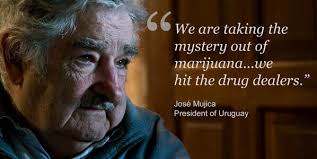
On this Easter Sunday, I want to tell you a story of resurrection. It involves the ex-president of Uruguay, Jose Mujica, and his personal transcendence after three years in a tomb. It's about how he advanced not only his country's resurgence from its profound drug problem, but from a pattern of corrupt oppressive government.
The story is intimately connected with that of the poor man, Jesus, whose immortality billions celebrate today. As today's readings tell us, this healer, teacher and champion of the poor spent three days in a tomb and is more alive today than ever he was 2000 years ago.
Focus on Mujica's story comes from a personal experience that I had last January when I spent a couple of weeks at the border in Tijuana Mexico. There I worked with pro bono lawyers and volunteers offering legal help to immigrants, refugees and asylees. The group is called Al Otro Lado.
In helping clients fill out paperwork, I discovered that most of the Mexicans, Hondurans, Guatemalans, and others I interviewed were driven from their countries of origin by drug gangs.
On the one hand, the experience made me think in general about drugs, addiction, and our country's century-long "War on Drugs." On the other hand, it drove me to reflect more deeply on resurrection and the possibilities for new life we celebrate on this Easter day.
The War on Drugs
Start with the war on drugs. Of course, we're no closer to winning it than when first it began in 1914. (Before then, you could buy cocaine-based remedies, for example, at your local drug store and at a low price.)
Moreover, so many of the problems that plague our world can be traced back to that spectacularly unsuccessful war. It's not just the addiction and the gangs. It's also the billions upon billions of dollars that have been wasted, the corruption of governments and law enforcement agencies throughout the world, the millions of users who have been incarcerated or forced to leave their countries by drug gangs, as well as the thousands upon thousands who have been murdered by them and their police mob counterparts.
It all made me think: what if there were no drug war? What if drugs were entirely legal again? Wouldn't that drive the gangs out of business? And wouldn't all those other related problems disappear? Wouldn't that lead to a kind of resurrection of humanity?
Think about it. Drug decriminalization and legalization would profoundly change the world!
But you might wonder (as I did) wouldn't drug decriminalization and legalization also vitiate the planet? Wouldn't our kids (and maybe we ourselves) all get hooked and end up staggering around in drug-induced stupors?
As it turns out, the answer is No. As Johann Hari points out in his page-turner study, Chasing the Scream, less than 10% of those who use even cocaine, crack, and Oxycontin get hooked. The other 90% often take those controlled substances for recreation every weekend (and even on weekdays) and still carry on normally in their families. They hold steady jobs and contribute to their communities. Even those who become addicted mature out of their problem after about 10 years. This means that the War on Drugs, laws against narcotics, and the resulting havoc are connected with something like 10% of users.
All of this is because drug addiction is not the result of chemical "hooks," so that anyone taking them becomes ipso facto obsessed. Instead, addiction is caused primarily by personal and social problems connected with childhoods marked by abuse, with loneliness, meaningless work, and lack of human connection.
Addictions are psychological and social diseases. They are not crimes. Punishing drug use as criminal only causes more drug use by aggravating its causes.
The Case of Uruguay
And that brings me to Jose Mujica and his resurrection from three years in a tomb. Mujica was a Tupamaros (Robin Hood) guerrilla during Uruguay's revolutionary war against the country's military dictatorship during the 1970s and '80s. He was captured by government forces, tortured mercilessly, and imprisoned for 12 years three of them in the bottom of a well that his captors thought would be his final resting place. Those years gave him lots of time to think about life and his country's problems.
When the revolution Mujica supported eventually triumphed, he in effect returned from the dead only to be elected his country's president for five years (2010-2015). It was then that he set about decriminalizing the use of drugs beginning with marijuana. Contrary to all expectations, he was successful in reaching that goal.
[Not only that: as president, Mujica himself continued to live with his wife in their simple farmhouse. He gave 90% of his income as president to the poor (living on $775 per month), sold his presidential limousine to travel on public transportation, and passed legislation to give a laptop to every child in the country.]
The point here, however that the president's action on the drug front represented a first step towards bankrupting his country's drug cartels. His ultimate goal was to provide for users of all drugs a cheaper, safer, cleaner product, and set up locations for safe drug consumption. The facilities would be staffed by medical personnel and by counsellors and life coaches intent on helping their clients find work, housing, and more meaningful lives.
In this way, drug cartels would suffer defeat and the country's drug problem would be solved. Those are the results already achieved by comparable policies in Switzerland, Portugal and elsewhere.
Easter Readings
Now, keeping in mind what I've just said about Mujica and drug use in general, read the liturgical selections for this Easter Sunday. They recall that like Jose Mujica, Jesus of Nazareth set about bringing healing to the sick, liberation of captives from prison, and relief for the oppressed. Christian faith professes that such commitment brings enlightenment and (somehow) never-ending life. (What follows are my "translations." The originals can be found here.)
ACTS 10:34A, 37-43: Peter's First Proclamation of Jesus' Resurrection: From the beginning, Jesus of Nazareth embodied God's Holy Spirit of healing the sick and liberating the oppressed. For that, the Romans crucified him (their policy with all rebels). However, three days later, some of us (not all) were privileged to recognize him as still alive during our ritual meals together. Inspired by that experience, we ask you to join us in continuing Jesus' work of healing and liberation.
PS 118: 1-2, 16-17, 22-23: Response to Peter's Proclamation: Thank you, Divine Mother for this happy day! You have been so good to us, so powerful and unfailingly compassionate. You use the world's "weakest" to contradict its idea of power. With you, we acknowledge that the "weakest" are actually the strongest. Thank you, again!
COL 3: 1-4: Where God's Holy Spirit Is Found: Yes, our Easter faith is that the Holy Spirit is found in the sick, the oppressed, in those executed by the state, and in those the world despises. Realizing this truth represents OUR resurrection! Let's keep our eyes on the prize the ultimate triumph promised us by the example of Jesus (and Jose Mujica).
Easter Sequence: On Death Row and in Drug Addicts: Thank you, Divine Mother, for contradicting the world's judgment that the poor and despised (like Jesus on death row or drug addicts today) are somehow sinful. In fact, the supreme victim of empire's capital punishment has proved more immortal than Rome itself. Jesus lives; Rome is all but forgotten! We can't even find his tomb or decaying body. Help us, Divine Mother, to synchronize our lives' energies with those of our Master.
John 20: 1-9: And in Female Leadership: Jesus' beloved and dearest disciple, Mary Magdalen, achieved full enlightenment when everyone else was in dark mourning over Jesus' death. Three days later, on visiting Jesus' tomb, she realized that his True Self was not even there! So, she (even as a woman without standing before the law!) became the first to recognize what later was called Jesus' "resurrection." Meanwhile, Peter, "the first pope," was slower than others to accept what Mary saw immediately. She (the despised) rather than the men, was the first truly enlightened follower of Jesus. As Jesus himself said (in the Gospel of Thomas) she rather than Peter should be recognized as the "apostle of apostles."
Conclusion
Today's readings along with Chasing the Scream and its story of Jose Mujica invite readers to imagine a world turned upside-down -- where death and burial do not have the final word -- where prisoners are freed and those the world writes off as dead return to fullness of life to change the world. In our context torn apart by a futile drug war, the readings can call us to imagine a human community where those sick with addiction are treated as human beings instead of being criminalized. In the spirit of Easter, that would be a resurrected world:
- With greatly reduced crime and a shrunken prison system
- Where police forces could be downsized and rehabilitated in the eyes of poorer communities as a welcome rather than a threatening presence
- Where countries like Mexico would be liberated from control by drug cartels
- Where refugees from those countries would be dramatically reduced or eliminated, thus greatly impacting immigration problems and the perceived need for baby jails and expensive border walls.
- Where the billions upon billions of dollars currently spent in a clearly unsuccessful war on drugs -- including those huge police forces, overcrowded prisons, and enormous bureaucracies intended to administer it all -- could be re-channeled to help the merely 10% percent of drug users whose habits are problematic.
In short, cessation of the Drug War, decriminalization and legalization of drugs of all kinds, would reshape our world in ways that would reduce and/or eliminate many of its most vexing problems. It would truly be an Easter event.
Authors Website: http://mikerivageseul.wordpress.com/
Authors Bio:
Mike Rivage-Seul is a liberation theologian and former Roman Catholic priest. His undergraduate degree in philosophy was received from St. Columban's Major Seminary in Milton Massachusetts and awarded through D.C.'s Catholic University. He received his theology licentiate from the Atheneum Anselmianum and his doctorate in moral theology (magna cum laude) from the Academia Alfonsiana in Rome where Mike studied for five years. There he also played club basketball for Eurosport and a team within Rome's Stella Azzurra professional organization. In 1972 he served for a year as coordinator of volunteers in Monsignor Ralph Beiting's Christian Appalachian Project. Then for 40 years, Mike taught theology and general studies at Berea College in Kentucky receiving its Seabury Award for excellence in teaching, Berea's highest faculty award. At Berea, Mike founded its Peace and Social Justice Studies program. He and his wife, Peggy, also organized and started the Berea Interfaith Taskforce for Peace. For years, he periodically taught liberation theology in a Latin American Studies Program in Costa Rica sponsored by the Council for Christian Colleges and Universities. In Costa Rica Mike and Peggy were fellows at the liberation theology research institute, the Departamento Ecumenico de Investigaciones (DEI) headed by the great Franz Hinkelammert. In Mexico, they also served as fellows and program directors in San Miguel de Allende's Center for Global Justice. Mike's studies and teaching have brought him to countries across Europe and to Cuba (on 10 occasions), Nicaragua (12 occasions), Guatemala, Honduras, Mexico, Israel, India, Zimbabwe, South Africa, and Brazil where he and Peggy were associates of Paulo Freire. Mike's languages include Latin, Greek, Hebrew, French, Italian, German, Portuguese, and Spanish. For three years he was a monthly columnist at the Lexington Herald-Leader in Lexington Kentucky. He has contributed more than 400 articles to the online news source OpEdNews where he is a senior editor. He has also published in the DEI's Pasos Journal, in the National Catholic Reporter and Christianity Today. His scholarship has been cited in the New York Times. Mike has authored or edited 10 books including one of poetry and a novel based on his experiences in Cuba. His latest book is The Magic Glasses of Critical Thinking: seeing through alternative fact & fake news (Peter Lang publishers). He blogs at http://mikerivageseul.wordpress.com/ Attempting to appropriate his identity as an ordained exorcist (all Catholic priests are), Mike also reads Tarot cards. He is a lifelong golfer and Chicago Cubs fan.