| Back OpEdNews | |||||||
|
Original Content at https://www.opednews.com/articles/Laissez-faire-Free-or-Fai-by-Edward-Campbell-Agreements_Antitrust_Fair-Trade_Fair-sustainable-Trade-160328-469.html (Note: You can view every article as one long page if you sign up as an Advocate Member, or higher). |
|||||||
March 28, 2016
Laissez-faire? Free or Fair Markets? -Restraint of Trade- Part 3
By Edward Campbell
Restraint of trade is another outcome of the free-trade myth. America has not bought it except in the limited areas of patents and copyrights approved by the Constitution. Private restraints of trade are frowned upon by national policies adopted by both parties.
::::::::
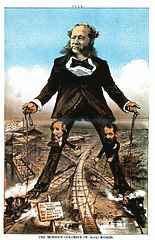
File:Modern Colossus of Rail Roads - Keppler 1879.jpg - Wikimedia ...
(Image by (From Wikimedia) Joseph Keppler (1838–1894) / 'The Modern Colossus of (Rail, Author: See Source) Details Source DMCA
Restraint of trade is a common-law doctrine relating to the enforceability of contractual restrictions on freedom to conduct business. It is a precursor of modern competition law. In an old leading case of Mitchel v Reynolds (1711) Lord Smith LC said,[Mitchel v Reynolds (1711) 1 P Wms 181].
The law early recognized that a trader could control the distribution of the products or services he offered and completely restrict competitive access to the market. Indeed the Constitution recognizes congressional authority to authorize this in limited areas for limited time periods to encourage innovation and originality: Article 1 Section 8 provides in pertinent part that Congress has the power to pass laws "To promote the Progress of Science and useful Arts, by securing for limited Times to Authors and Inventors the exclusive Right to their respective Writings and Discoveries;..." But the Constitution does not appear to grant Congress the authority to restrain trade or commerce by recognizing in private persons the nobility rights in the form of the power of plutocracies, oligarchies or aristocracies to exercise the private right to restrain trade either by law or treaty as that is prohibited to the United States by Article 1 Section 9 of the Constitution.
In fact Congress has attempted to prohibit such activity. The first significant attempt to regulate interstate commerce was authored by John Sherman, a Republican from Ohio in the 1890 Sherman Anti-Trust Act. In the US, the first significant discussion of this act occurred in the Sixth Circuit's opinion by Chief Judge (later US President, 1908-1913 and still later appointed by President Warren G. Harding in 1921 as the Supreme Court Chief Justice) William Howard Taft, a Republican, in 1898 in United States v. Addyston Pipe & Steel Co. Taft was the chosen successor of Theodore Roosevelt, a Republican. Judge Taft explained the Sherman Antitrust Act of 1890 as a statutory codification of the English common-law doctrine of restraint of trade, as explicated in such cases as Mitchel v Reynolds. The court distinguished between naked restraints of trade and those ancillary to the legitimate main purpose of a lawful contract and reasonably necessary to effectuation of that purpose. An example of the latter would be a non-competition clause associated with the lease or sale of a bakeshop, as in the Mitchel case. Such a contract should be tested by a "rule of reason," meaning that it should be deemed legitimate if "necessary and ancillary." An example of the naked type of restraint would be the price-fixing and bid-allocation agreements involved in the Addyston case. Taft said that "we do not think there is any question of reasonableness open to the courts to such a contract." The Supreme Court affirmed the judgment. During the following century, the Addyston Pipe opinion of Judge Taft has remained foundational in antitrust analysis.
John D. Rockefeller of Standard Oil, James B. Duke of the tobacco industry, and J. Pierpont Morgan of railroad fame became the targets of Teddy Roosevelt as president, who was soon to earn the name of Trust Buster. John D. Rockefeller during this time could see the potentials in the oil industry and to overcome the price fixing of certain railroads that he could not dominate, he started building pipe lines, Eventually he came to control the market through monopoly ownership. Even Republicans thought poorly of this. As more recently, proved by Bernie Madoff, one does not steal from the rich and as proven as early as the American Revolution (The Cornerstone Brief) with impunity.
Our point is, regardless of party platforms of the major parties and Ronald Reagan, fair markets, and not free and unbridled, markets have continued to be the rule in the United States and the question the voter must decide is who is going to do the most to preserve the consumer's rights in a fair market.
"it is the privilege of a trader in a free country, in all matters not contrary to law, to regulate his own mode of carrying it on according to his own discretion and choice. If the law has regulated or restrained his mode of doing this, the law must be obeyed. But no power short of the general law ought to restrain his free discretion."
The law early recognized that a trader could control the distribution of the products or services he offered and completely restrict competitive access to the market. Indeed the Constitution recognizes congressional authority to authorize this in limited areas for limited time periods to encourage innovation and originality: Article 1 Section 8 provides in pertinent part that Congress has the power to pass laws "To promote the Progress of Science and useful Arts, by securing for limited Times to Authors and Inventors the exclusive Right to their respective Writings and Discoveries;..." But the Constitution does not appear to grant Congress the authority to restrain trade or commerce by recognizing in private persons the nobility rights in the form of the power of plutocracies, oligarchies or aristocracies to exercise the private right to restrain trade either by law or treaty as that is prohibited to the United States by Article 1 Section 9 of the Constitution.
In fact Congress has attempted to prohibit such activity. The first significant attempt to regulate interstate commerce was authored by John Sherman, a Republican from Ohio in the 1890 Sherman Anti-Trust Act. In the US, the first significant discussion of this act occurred in the Sixth Circuit's opinion by Chief Judge (later US President, 1908-1913 and still later appointed by President Warren G. Harding in 1921 as the Supreme Court Chief Justice) William Howard Taft, a Republican, in 1898 in United States v. Addyston Pipe & Steel Co. Taft was the chosen successor of Theodore Roosevelt, a Republican. Judge Taft explained the Sherman Antitrust Act of 1890 as a statutory codification of the English common-law doctrine of restraint of trade, as explicated in such cases as Mitchel v Reynolds. The court distinguished between naked restraints of trade and those ancillary to the legitimate main purpose of a lawful contract and reasonably necessary to effectuation of that purpose. An example of the latter would be a non-competition clause associated with the lease or sale of a bakeshop, as in the Mitchel case. Such a contract should be tested by a "rule of reason," meaning that it should be deemed legitimate if "necessary and ancillary." An example of the naked type of restraint would be the price-fixing and bid-allocation agreements involved in the Addyston case. Taft said that "we do not think there is any question of reasonableness open to the courts to such a contract." The Supreme Court affirmed the judgment. During the following century, the Addyston Pipe opinion of Judge Taft has remained foundational in antitrust analysis.
John D. Rockefeller of Standard Oil, James B. Duke of the tobacco industry, and J. Pierpont Morgan of railroad fame became the targets of Teddy Roosevelt as president, who was soon to earn the name of Trust Buster. John D. Rockefeller during this time could see the potentials in the oil industry and to overcome the price fixing of certain railroads that he could not dominate, he started building pipe lines, Eventually he came to control the market through monopoly ownership. Even Republicans thought poorly of this. As more recently, proved by Bernie Madoff, one does not steal from the rich and as proven as early as the American Revolution (The Cornerstone Brief) with impunity.
Our point is, regardless of party platforms of the major parties and Ronald Reagan, fair markets, and not free and unbridled, markets have continued to be the rule in the United States and the question the voter must decide is who is going to do the most to preserve the consumer's rights in a fair market.
Authors Bio:
AB 1959 and JD 1963, University of Missouri, Columbia. 50 years active member of Washington State Bar Association, mostly civil and commercial office, trial and appellate practice and Superior Court Arbitrator for about 40 years or so, since the program was initiated. Former AAA panel member. Also admitted to Missouri Supreme Court and past member of that bar, and currently admitted to U.S. Supreme Court, 9th Circuit Court of Appeals and the East and West U.S. District Courts of Washington State. Has spent about 50 years, on and off, researching this book which started when he was promoting in the Seattle area discussion groups based upon materials from Robert Maynard Hutchins’ Center for the Study of Democratic Institutions with the Center’s encouragement in the later 1960's. Author of the Filibuster Solution, 2011 and The ornerstone brief, And Secrets of the Forgotten American Revolution, 2015