| Back OpEdNews | |||||||
|
Original Content at https://www.opednews.com/articles/Robert-Reich-Clinton-Can-by-Joan-Brunwasser-2016-Presidential-Primary-Candidates_Bernie-Sanders-Presidential-Campaign_Billionaires_Change-160224-310.html (Note: You can view every article as one long page if you sign up as an Advocate Member, or higher). |
|||||||
February 24, 2016
Robert Reich: Clinton Can't Achieve Magnitude of Change Needed; Sanders Can
By Joan Brunwasser
Incrementalism no longer works. Income, wealth, and political power continue to concentrate at the top -- and reinforce each other. This can't be reversed unless a large # of Americans demand it to be -- which requires bold ideas, a strong political movement, and tenacity. The practical choice isn't small adjustments vs. big change [but] whether they come through the democratic process or through authoritarian populism [Trump]
::::::::
Reich Lists 3 Ingredients Necessary for Change that Bernie's Campaign Includes

My guest today is economist, author, professor of public policy, political commentator and former Secretary of Labor, Robert Reich. Welcome back to OpEdNews, Bob.
JB: We last spoke back in 2014. Lots has happened since then. A few weeks back, you wrote a great Op-Ed piece, The Volcanic Core Fueling the 2016 Election[1.26.16]. What is the volcanic core you're referring to? Tell us more, please.
RR: Hi, Joan. I'm referring to a large and growing commitment to wrest control of our democracy and economy back from the moneyed interests -- Wall Street, big corporations, and billionaires. It's becoming a movement. You can see it in the Sanders campaign, for example -- especially among young people who poured into the Iowa caucuses February 1st. But I also see some evidence of the same movement in Republican campaigns.
JB: You mention in your piece that there are many voters who are weighing their options and deciding between Sanders and Trump. That's counterintuitive and also astounding. Can you explain the phenomenon for us? Is it something that is particular to 2016 or have you seen it before?
RR: I've never seen anything like it before, and I was flabbergasted when I began hearing it from voters on my book tour -- mostly from "red state" voters in the South and the Midwest. When I asked them to explain, they talked about crony capitalism, political corruption, corporate welfare, the Wall Street bailout, the Trans Pacific Partnership, the escalation of big money in politics, and so on. What's so striking is that many of them described themselves as conservative Republicans or Tea Partiers, but they sounded like Bernie Sanders.
JB: That is really fascinating. And quite unexpected. You wrote in your OpEd piece, "It's about power -- whether those who have it will keep it, or whether average Americans will get some as well." I think that's exactly on target. And it may be so, but aren't candidates' actual policy plans important to the voters, too?
RR: Of course, but politicians don't have a prayer of getting their plans enacted without the public behind them. And that's why movement politics is so important. The Civil Rights Act of 1964 couldn't have become realities without the Civil Rights movement. The National Labor Relations Act of 1935 wouldn't have stood a chance without the growth of a strong labor movement. Movement politics is especially important in times like these, when the moneyed interests have such a chokehold on our political system.
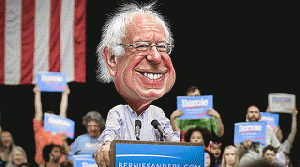
From flickr.com/photos/47422005@N04/21035735086/: Bernie Sanders - Caricature
(Image by DonkeyHotey) Details DMCA
JB: Ultimately, how realistic is it for outsiders to challenge the system? Trump is a special case because of his unlimited funds so he has no need for Super PACS or establishment acceptance. But how about Bernie? He's an Independent, not even a Democrat and all the powers that be, in and out of the party, keep talking about his unelectability. Your thoughts?
RR: The only people capable of challenging the system are outsiders who (1) raise lots of money from small donors, (2) mobilize a small army of citizens who will continue to push for major reforms even if (especially if) their candidate succeeds but even if he or she doesn't, and (3) use the campaign to help educate the public on what's really happening. In all these respects, Bernie Sanders is doing what's necessary.
JB: You're quite familiar with both of the Democratic candidates. You've known Hillary for decades, her husband even longer, and served in President Clinton's cabinet. But you're also a progressive and Hillary, despite her protestations, mostly is not. Can you compare and contrast Bernie and Hillary, both in style and substance? I think your unique perspective will be helpful to our readers.
RR: I've known Hillary Clinton since she was a freshman at Wellesley, and have always admired her. Of all the candidates now seeking the presidency she's most ready to assume the role and do it exceedingly well. She's extraordinarily smart and disciplined, works fiercely hard, has been a senator and a secretary of state, and has virtually apprenticed for the job -- as a First Lady more directly involved in policy than any other First Lady in history, save perhaps Eleanor Roosevelt. And I think she could accomplish some important incremental changes.
But I don't think she can achieve the magnitude of change that's needed because she isn't leading a movement to reclaim our economy and democracy from the moneyed interests, as is Bernie Sanders..I've worked with Bernie for over twenty years, and know him as someone deeply committed to social justice. Yet his campaign really isn't about him, per se. If Elizabeth Warren had run instead of Bernie, she'd be heading up the same movement. The movement was already there, building steam. ( think Bernie would be the first to admit this.)
JB: I'm curious whether Warren would have had an easier time if she had been running. Maybe it doesn't really matter. Readers may simply be afraid to reach for, and ultimately vote for, big change, Robert. The echo chamber is awash with attacks and so many, many discouraging words. What would you say to those readers?
RR: Incrementalism no longer works. Income, wealth, and political power continue to concentrate at the top -- and reinforce each other. This can't be reversed unless a large number of Americans demand it to be -- which requires bold ideas, a strong political movement, and tenacity. The practical choice isn't small adjustments versus big change. Big changes will come. The question is whether they come through the democratic process or through authoritarian populism mobilized by someone like Donald Trump. The democratic (small "d") version seems to me to be far safer.
JB: Agreed. Thanks so much for talking with me again, Robert. It's always great to get your perspective on things.

***
some of my previous interviews with Reich:
Robert Reich Warns: Millions of Voters Could Be Turned Away in November 3.17.2014
Robert Reich and his new film, "Inequality for All" - An In-Depth Interview 10.2.2013
Robert Reich on "Bungee-Jumping Over the Fiscal Cliff" 12.8.2012
Robert Reich on Romney, the New Gilded Age and More 9.5.2012
*
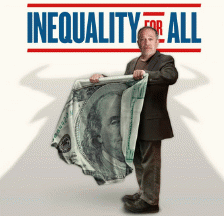
Inequality for All is available on Netflix: great film, not preachy, with lots of suggestions for how to get involved
Authors Website: http://www.opednews.com/author/author79.html
Authors Bio:
Joan Brunwasser is a co-founder of Citizens for Election Reform (CER) which since 2005 existed for the sole purpose of raising the public awareness of the critical need for election reform. Our goal: to restore fair, accurate, transparent, secure elections where votes are cast in private and counted in public. Because the problems with electronic (computerized) voting systems include a lack of transparency and the ability to accurately check and authenticate the vote cast, these systems can alter election results and therefore are simply antithetical to democratic principles and functioning.
Since the pivotal 2004 Presidential election, Joan has come to see the connection between a broken election system, a dysfunctional, corporate media and a total lack of campaign finance reform. This has led her to enlarge the parameters of her writing to include interviews with whistle-blowers and articulate others who give a view quite different from that presented by the mainstream media. She also turns the spotlight on activists and ordinary folks who are striving to make a difference, to clean up and improve their corner of the world. By focusing on these intrepid individuals, she gives hope and inspiration to those who might otherwise be turned off and alienated. She also interviews people in the arts in all their variations - authors, journalists, filmmakers, actors, playwrights, and artists. Why? The bottom line: without art and inspiration, we lose one of the best parts of ourselves. And we're all in this together. If Joan can keep even one of her fellow citizens going another day, she considers her job well done.
When Joan hit one million page views, OEN Managing Editor, Meryl Ann Butler interviewed her, turning interviewer briefly into interviewee. Read the interview here.
While the news is often quite depressing, Joan nevertheless strives to maintain her mantra: "Grab life now in an exuberant embrace!"
Joan has been Election Integrity Editor for OpEdNews since December, 2005. Her articles also appear at Huffington Post, RepublicMedia.TV and Scoop.co.nz.