| Back OpEdNews | |||||||
|
Original Content at https://www.opednews.com/articles/The-Boss-Who-Fought-for-th-by-Walter-Brasch-Class_History_History_History-Activism-150907-542.html (Note: You can view every article as one long page if you sign up as an Advocate Member, or higher). |
|||||||
September 7, 2015
The Boss Who Fought for the Working Class
By Walter Brasch
At a time when the working class is under attack, and not one Republican candidate for president believes in unions, one of the nation's most influential capitalists spoke out for social justice and for the workers. This is his story.
::::::::
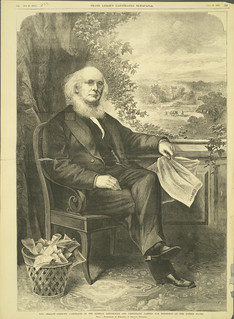
by Walter Brasch
He was born into poverty in New Hampshire in 1811.
His father was a struggling farmer. His mother did most of the other chores.
He was a brilliant student, but the family often moved, looking for a better life--a couple of times so the father could avoid being put into debtor's prison.
At the age of 15, he dropped out of school and became a printer's apprentice, sending much of his wages to help his family.
For several years, he worked as an apprentice and then as a printer, his hands covered by ink, his body ingesting the chemicals of that ink.
He worked hard, saved money, helped others achieve their political dreams, became the editor of newspapers, and soon became an owner.
In the two decades leading to the Civil War, Horace Greeley had become one of the most powerful and influential men in America. His newspaper, the New York Tribune, was the nation's largest circulation newspaper.
But instead of becoming even richer, he used his newspaper as a call for social action. For social justice.
In 1848, as a congressman fulfilling the last three months of the term of an incumbent who was removed from office, Greeley introduced legislation to end flogging in the Navy, argued for a transcontinental railroad, and introduced legislation to allow citizens to purchase at a reduced price land in unsettled territories as long as they weren't speculators and promised to develop the land. The Homestead Act, which Congress finally passed 13 years later, helped the indigent, unemployed, and others to help settle the American west and Midwest. But in his three months in office he also became universally hated by almost everyone elected to Congress. The social reformer in his soul had pointed out numerous ethical and criminal abuses by members of Congress; his party didn't ask him to run for a full term.
He called for all American citizens--Blacks and women included--to be given the rights of the vote.
In 1854, Greeley became one of the founders of the Republican party. For more than two decades, he had been a strong abolitionist and now the new political party would make the end of slavery one of its founding principles. He was one of the main reasons why his friend, Abraham Lincoln, whom he helped become president, finally relented and two years after the civil war began, finally issued the Emancipation Proclamation.
More than 225,000 Americans (of a nation of about 35 million) bought his relatively objective and powerful history of the civil war, making the book one of the best-sellers in the nation's nine decade history. In today's sales, that would be about two million copies.
Unlike some editors who pandered to the readers and advertisers, he maintained a separation of editorial and advertising departments, and demanded the best writers and reporters, no matter what their personal opinions were. Among those he hired were Mark Twain, Henry David Thoreau, Ralph Waldo Emerson, and Karl Marx. And at a time when newsrooms were restricted to men, he hired Margaret Fuller to be his literary editor.
He believed in a utopian socialism, where all people helped each other, and where even the most unskilled were given the opportunity to earn a living wage.
He demanded that all workers be treated fairly and with respect. In 1851, he founded a union for printers.
When his employees said they didn't need a union because their boss paid them well and treated them fairly, he told them that only in a union could the workers continue to be treated decently, that they had no assurances that some day he might not be as decent and generous as he was that day. The union was for their benefit, the benefit of their families, and their profession, he told them.
In 1872, Horace Greeley ran for the presidency, nominated on both the Democrat and Liberal Republican tickets. But, his opposition was U.S. Grant, the war hero running for re-election on an establishment Republican ticket.
Weeks before the electoral college met, Horace Greeley, who lost the popular vote, died, not long after his wife.
The printers, the working class, erected monuments in his honor.
And everyone knew that the man with a slight limp, who usually dressed not as a rich man but as a farmer coming into town to buy goods, who greeted everyone as a friend, who could have interesting conversations with everyone from the illiterate to the elite, was a man worthy of respect, even if they disagreed with his views. For most, Horace Greeley was just a bit too eccentric, his ideas just too many decades ahead of their time.
On this Labor Day weekend, when not one Republican candidate for president believes in unions, when CEOs often make more than 100 times what their workers earn, when millionaires and billionaires running for office pretend they are populists, when even many in the working class seem more comfortable supporting the policies and political beliefs of the elite, the nation needs to reflect upon the man who knew that without the workers, there would be no capitalism.
[Dr. Brasch has been a member of several crafts, arts, and trade labor unions. He proudly sees himself not as among the elite but as a part of the working class. His latest book is Fracking Pennsylvania: Flirting With Disaster]
Authors Website: http://www.walterbrasch.com
Authors Bio:
Walter Brasch is an award-winning journalist and professor of journalism emeritus. His current books are Before the First Snow: Stories from the Revolution , America's Unpatriotic Acts: The Federal Government's Violation of Constitutional and Civil Rights, and 'Unacceptable': The Federal response to Hurricane Katrina, available at amazon.com, borders.com and most major on-line bookstores. BEFORE THE FIRST SNOW is also available at www.greeleyandstone.com (20 discount)
Walter Brasch, a deeply valued Senior Editor at OpEdNews passed from this world on February 9, 2017, age 71, his obituary follows:
Walter M. Brasch, Ph.D., age 71, of 2460 Second Street, Bloomsburg (Espy), died Thursday, Feb. 9, 2017, at Geisinger Medical Center, Danville surrounded by his family.
He was an award-winning former newspaper reporter and editor in California, Iowa, Indiana, and Ohio; professor emeritus of mass communications and journalism at Bloomsburg University; and an award-winning social issues journalist and book author.
Walter was born March 2, 1945, in San Diego, the son of Milton Brasch and Helen (Haskin) Brasch and was a 34 year resident of Espy.
In his early years he was a writer-producer for multimedia and film companies in California, and a copywriter and political analyst for advertising and public relations companies. For five years during the late 1990s, he was the media and social issues commentator for United Broadcasting Network. He was also the author of a syndicated newspaper column since 1992 and the creative vice-president of Scripts Destitute of Phoenix.
Dr. Brasch was a member of the Local Emergency Planning Committee and was active in the Columbia County Emergency Management Agency. He was vice-president of the Central Susquehanna chapter of the ACLU, vice-president and co-founder of the Northeast Pennsylvania Homeless Alliance, a member of the board of the Keystone Beacon Community for healthcare coordination, and was active in numerous social causes. He was co-founder with his wife Rosemary Brasch of The Oasis, a biweekly newsletter for families and friends of personnel stationed in the Persian Gulf. Later, during Operation Iraqi Freedom, they published The Oasis 2, for families of persons in combat zones. They were supported by the Bloomsburg Chapter, America Red Cross and Geisinger Medical Center, Danville.
He was the author of 20 books, most which fuse historical and contemporary social issues. Among his books are Black English and the Mass Media (1981); Forerunners of Revolution: Muckrakers and the American Social Conscience (1991); With Just Cause: The Unionization of the American Journalist (1991); Sex and the Single Beer Can: Probing the Media and American Culture (1997); Brer Rabbit, Uncle Remus, and the 'Cornfield Journalist': The Tale of Joel Chandler Harris (2000); The Joy of Sax: America During the Bill Clinton Era (2001); Unacceptable: The federal Response to Hurricane Katrina (2005); America's Unpatriotic Acts: The Federal Government's Violation of Constitutional and Civil Rights (2006); Sinking the Ship of State: The Presidency of George W. Bush (2007); and Before the First Snow (2011). He was co-author of The Press and the State (1986), awarded Outstanding Academic Book distinction by Choice magazine, published by the American Library Association.
His last book is Fracking America: Sacrificing Health and the Environment for Short-Term Economic Benefit (2015), a critically-acclaimed novel that looks at what happens when government and energy companies form a symbiotic relationship, using "cheaper, cleaner" fuel and the lure of jobs in a depressed economy but at the expense of significant health and environmental impact.
During the past two decades, he won more than 150 regional and national media awards from the National Society of Newspaper Columnists, Society of Professional Journalists, National Federation of Press Women, USA Book News, Independent Book Publishing Professionals Group, Pennsylvania Press Club, Pennsylvania Women's Press Association, Pennsylvania Associated Press Broadcasters Association, Penn-writers, International Association of Business Communicators, Pacific Coast Press Club, and Press Club of Southern California. He was recognized in 2012 by the Pennsylvania Press Club with the Communicator of Achievement award for lifetime achievement in journalism and public service.
He was an Eagle Scout; co-recipient of the Civil Liberties Award of the American Civil Liberties Union, 1996; and was honored by San Diego State University as a Points of Excellence winner in 1997. In 2000, he received the Herb Caen Memorial Award of the National Society of Newspaper Columnists. For the Pennsylvania Humanities Council he was twice named a Commonwealth speaker. He also received the meritorious achievement medal of the U.S. Coast Guard.
At Bloomsburg University, he earned the Creative Arts Award, the Creative Teaching Award, and was named an Outstanding Student Advisor. He received the first annual Dean's Salute to Excellence in 2002, a second award in 2007, and the Maroon and Gold Quill Award for nonfiction. He was the 2004 recipient of the Martin Luther King Jr. Humanitarian Service Award. For 22 years, he was Editor-In-Chief of the awarding-winning Spectrum Magazine, part of the journalism program of the Department of Mass Communications, Bloomsburg University until his retirement in 2010. The community magazine was published twice a year by students for residents of Columbia and Montour counties in northeastern Pennsylvania and one of the few to be inducted into the national Associated Collegiate Press hall of fame. The magazine was also a consistent award winner in competition sponsored by the Society of Professional Journalists, Columbia Scholastic Press Association, and the American Scholastic Press Association. He primarily taught magazine editing and production, public affairs reporting, feature writing, newspaper editing; every Fall, he taught a 250-student section on mass communications and the popular arts.
Dr. Brasch was co founder of the qualitative studies division of the Association for Education in Journalism, president of the Keystone State professional chapter and for three years deputy regional director of the Society of Professional Journalists, from which he received the Director's Award and the National Freedom of Information Award. He was president of the Pennsylvania Press Club, vice-president of the Pennsylvania Women's Press Association, and founding coordinator of Pennsylvania Journalism Educators. He was a featured columnist for Liberal Opinion Week, senior correspondent for the American Reporter, senior editor for OpEdNews, and an editorial board member of Journalism History and the Journal of Media Law and Ethics.
He was a member of the National Society of Newspaper Columnists, Author's Guild, National Writers Union (UAW/AFL-CIO), The Newspaper Guild (CWA/AFL-CIO), and the Society of Environmental Journalists. He was a life member of the service fraternity Alpha Phi Omega, and was indicted into the national scholarship honor societies Phi Kappa Phi (general scholarship), Kappa Tau Alpha (journalism), Pi Gamma Mu (social sciences), and Kappa Tau Alpha (sociology.) He is listed in Who's Who in America, Who's Who in the East, Contemporary Authors, Who's Who in the Media and Who's Who in Education. Dr. Brasch earned an A.B. in sociology from San Diego State College, an M.A. in journalism from Ball State University, and a Ph.D. in mass communication/journalism, with a cognate area in both American government/public policy and language and culture studies, from The Ohio State University.
He is survived by his wife of 34 years, the former Rosemary Renn the most wonderful thing that happened in his life and whom he loved very much; two sons, Jeffery Gerber, Phoenix AZ and Matthew Gerber and his wife, Laurel (Neyhard) of Bloomsburg, a sister, Corey Brasch of Sacramento, Calif; a niece, Terri Pearson-Fuchs, Calif, numerous cousins; and his beloved dogs Cabot and Remy.
Funeral services will be held on Wednesday, at 2:00 p.m. at the Dean W. Kriner Inc. Funeral Home & Cremation Service, 325 Market St., Bloomsburg with family friend, Nathaniel Mitchell officiating. Interment in Elan Memorial Park, Lime Ridge.
Friends may call at the funeral home on Tuesday from 6 - 8 p.m. or Wednesday from 1-2 p.m.
In lieu of flowers, donations may be sent to the Walter M. Brasch Scholarship Fund,
c/o First Keystone Community Bank, 2301 Columbia Blvd, Bloomsburg, PA 17815 or to
Mostly Mutts, 284 Little Mountain Rd., Sunbury, PA 17801