| Back OpEdNews | |||||||
|
Original Content at https://www.opednews.com/articles/In-the-Shrouded-Empire--S-by-Greg-Maybury-Accountability_Agencies_Bush_Democracy-150303-999.html (Note: You can view every article as one long page if you sign up as an Advocate Member, or higher). |
|||||||
March 3, 2015
In the Shrouded Empire - Secrecy, Surveillance, and Subterfuge
By Greg Maybury
With democratic values such as free speech, the rule of law, privacy, press freedom and civil liberties now 'old school' -- all increasingly displaced by secrecy, surveillance, and subversion of the erstwhile Republic's operating manual the US Constitution -- the future looks bleak for The Homeland. In this article Australian Greg Maybury ponders if America on the road to the Rubicon may have already crossed a bridge too far.
::::::::
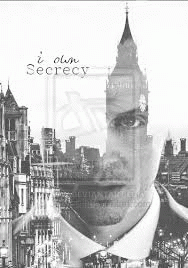
"Suffer us not to mock ourselves with falsehood". T.S. Eliot
Of Smoke 'n Mirrors (In the Wilderness)
It should come as no surprise that from an early age the preeminent espionage storyteller John Le Carre reportedly had "limitless fascination" with the human propensity for secretive behaviour. Given his literary specialty and the fact he was a former British intelligence official, he is someone who knows a thing or three about secrecy's attendant 'pathologies'; these might include stealth, sabotage, subterfuge, subversion, surveillance and sedition (and we might safely speculate, seduction, as it was purportedly he who coined the phrase "honey-trap"), and the inter-connections between all things clandestine and covert.
In short, we're talking here the 'smoke 'n mirrors', 'cloak 'n dagger', Spy v Spy Thing.
In the wake of, and in response to, the Watergate Scandal -- at the time the archetypal manifestation not just of the U.S. government's predisposition for engaging in grand, deceptive political "cloak 'n dagger", but for creating big, ugly secrets and then ruthlessly attempting to preserve their status as such -- le Carre had this to say:
"Until we have a better relationship between private performance and the public truth". We as the public are absolutely right to remain suspicious, contemptuous even, of the secrecy and the misinformation which is the digest of our news."
On April 27, 1961, shortly after he was handed the keys to the White House by a new generation of hopeful Americans (and tellingly, less than two weeks after the calamitous Bay of Pigs invasion in Cuba), the 35th president of the United States John F Kennedy (JFK) presented a speech the oft-cited content of which has never been more significant in its significance. From this address it seems clear that like le Carre's earlier comment indicates, Number 35 -- reportedly a fan of spy novels -- was not completely naïve about the secretive practices of the power elites. Although JFK's address should be read in its entirety to appreciate its full import for the here and now, for our purposes the following extract provides an inkling of his views:
"The very word 'secrecy' is repugnant in a free and open society....We decided long ago that the dangers of excessive and unwarranted concealment of pertinent facts far outweighed the dangers [which are] cited to justify it....there is little value in opposing the threat of a closed society by imitating its arbitrary restrictions....in insuring the survival of our nation if our traditions do not survive with it. And there is very grave danger that an announced need for increased security will be seized upon by those anxious to expand its meaning to the very limits of official censorship and concealment." [My emphasis]
Doubtless the more worldly, disdainful view of secrecy evidenced by the temper of JFK's address derived less from his reading of spy fiction than it did from his recent experience of the catastrophically cocked-up Cuban invasion attempt that was the infamous Bay of Pigs, the pear shaped outcome of which it can safely be said went that way because so many of the planners -- mostly in the Central Intelligence Agency (CIA) -- kept far too many secrets, few of which they shared with the young president prior to his regrettable, and hugely regretted, decision to green-light this ill-fated, game changing mission.
Either way, it appears Kennedy and le Carre were kindred spirits. That the speech was presented before the then American Newspaper Publishers Association -- that august bastion at the time representing the so-called Fourth Estate, whose collective remit was purportedly holding to account those who publicly swear an oath to protect, preserve and uphold the Constitution -- provides us with another layer of substance to its content.
We will return to Kennedy's speech in a follow up piece, and with it more broadly [to] the role of the media -- specifically the role of investigative journalists and whistleblowers -- in "insuring" against "the dangers of excessive and unwarranted concealment of pertinent facts" in the unequivocal support of a "free and open society". But first we need to fast forward to the here and now.
When a "new generation" of terminally hopeful Americans handed Barack Obama the keys to the White House, one of the pre-conditions in doing so was linked to the undertaking his administration would be more transparent and accountable than any previous one. Attendant with this promise was the expectation the U.S. government under Obama would be more protective of citizens' privacy and civil liberties, more inclined to safeguard whistle-blowers and investigative journalists, and reinstate and uphold a greater level of respect for the Constitution and the unalloyed freedom of the press. It was to be expected Obama would in fact 'delimit' "official censorship and concealment"; one might say a New Age of American 'glasnost' beckoned! (That a "New Age" of 'perestroika' might have also been expected is a story for another time.)
After eight years of sleight-of-hand governance, shell-game political expediency, and "excessive and unwarranted concealment" of information by president George W Bush, his vice-president Dick Cheney and their cabalistic caucus of secretive gatekeepers, most democracy-minded Americans were eagerly prepared for a new experiment in transparency and accountability -- a 'de-Bushification' of The Beltway, to coin a phrase -- in the way its government operated and functioned, and candour in the manner it communicated with "we the people" about its activities.
How's that "experiment" going then? By most objective accounts, not very well it would seem. The recent conviction of former CIA man Jeffrey Sterling for alleged offences under the ancient Espionage Act is ample testament to this, a case that we will return to in our follow-up piece.
At this point it is instructive enough to recall here that the recently re-elected Republican National Committee (RNC) Chair Reince Priebus once reportedly declared that Obama was either "exceptionally naive or wilfully disingenuous" when he vowed to change the way Washington works. The way Priebus saw it,
"The very promise of 'hope' and 'change' was rooted in uprooting the Washington modus operandi. But instead of rejecting it, [Obama] embraced it all -- the secrecy, the closed doors, the political favors, the near-criminal negligence."
With a nod of fairness to Obama herein, one is compelled to wonder if the estimable RNC Chair was critiquing the degree of the president's perceived lack of integrity on righteous moral or ethical grounds for, as he defined it, embracing "it all", or that GOP wunderkind Priebus simply preferred the Republican 'embrace' of "the Washington modus operandi". And at all events Obama to a large degree took his cue from those who had already set the bar pretty high, something even Priebus would be hard pressed to repudiate with a straight face.
As it stands though, even a superficial knowledge of George Orwell's classic 1984 would lead one to believe that, in the secrecy and surveillance stakes, Obama indeed would be showing Big Brother -- and one suspects, both 'Dubya' and possibly even his 'Grand Vizier' of Stealth Cheney -- a clean pair of heels. In this Priebus may after all have a point, especially the bit about "the secrecy" and "the closed doors". And like many others he made, Obama's explicit promise in these matters is up there with our most memorable examples such as, "Yes, I will still love you in the morning!" and "Your cheque is in the mail!", to name just two of the three perennial 'family favourites'.
Of course it's not just hard-assed Republicans of the Priebus cast, Tea-Party poopers and Obama haters in general who decry the president's lax track record in open and transparent government, and his abject failure to live up to his 2008 election commitments. Which is to say, this reality has hardly gone unnoticed by some of his most ardent supporters and even dismayed U.S. allies, whose own secrets Washington has sought to 'get the skinny on' whilst insuring its own 'dirty linen' is kept well away from the olfactory senses of the overly nosey. In this case one might contend that Obama, in chowing down on the whole Washington 'enchilada', has inflicted untold harm on Uncle Sam's already amply shop-soiled international reputation as the global go-to good guy.
And few would argue he has visited irreparable damage on the future preparedness of otherwise politically disenchanted and disenfranchised citizens who in response to his "hope" and "change" shill, actually went out of their way to both campaign and vote for him in 2008, many on both counts for the first (and possibly last) time ever. For American democracy, this outcome may be the most unforgivable and tragic aspect of the Obama legacy. Put simply, the 'crypto-statists' are finding ever more reasons under Obama for denying our inalienable right to privacy, and doing so at the same speed and with the same zeal and presumption they are justifying their not so inalienable, yet increasingly presumed and asserted, right to secrecy.
And it does not stop there. As president, Obama has effectively declared an amnesty for the criminally subversive crypto-statist elites who, via their sleight-of-hand intrigues, engineered the War on Terror and wreaked utter havoc on the already faltering Republic in blood, treasure and credibility. On the other hand, he has likewise declared open warfare with extreme prejudice on those true American patriots who have sought to expose the "intrigues" of these very same people and hold them accountable under the Constitution and the rule of international law!
In a Sea of Secrets (Not Waving, Drowning)
With Uncle Sam's aggressive and insidious attempts then to know more and more about what his own citizens and those of other nations are up to (Edward Snowden, William Blinney et al. anyone?) increasing in inverse proportion to what folks purporting to act in his interests want those stakeholders to know about what they are up to and why (Julian Assange/WikiLeaks et al. anyone?), Scott Horton's recently released book, is a timely and necessary expose of the national security, secrecy and surveillance state.
Aptly titled The Lords of Secrecy - The National Security Elite and America's Stealth Foreign Policy, human rights activist and lawyer Horton identifies the "lords" as the national security state elites -- first and foremost the heads of the various law enforcement, surveillance, intelligence and security agencies such as the FBI, CIA, DIA, the Pentagon, the NSA and the Department of Homeland Security (DHS), to name just a few of the better known ones.
Horton makes it clear from the off that one of his primary aims is to zero in on the fundamental question of how "national security decisions are managed in a democratic state on three levels -- the public, Congress, and the executive." Whilst he acknowledges that the president and members of his administration will always be the "formulators" and "implementers" of national security and foreign policy, his key point is to highlight the ever increasing role of "largely anonymous" elites, unelected people who occupy key decision- and policy-making positions mostly within the agencies mentioned. Washington is, in Horton's assessment, drowning in "a sea of secrets".
(This is without considering the role of the corporate mainstream media and increasingly, the so-called national security industrial complex and peripheral actors, plays in decision- and policy-making. In both camps, as we will see in a follow up piece, there is no dearth of "lords".)
After revealing that they seek increasingly to bypass the Congressional oversight required by the Constitution to go to war, he notes somewhat dryly the White House increasingly has to "fish deeply in its reserve of legal talent" to find someone with sufficient chutzpah to "go to Capitol Hill" and argue the case there.
Further, Horton states that the "lords" are the "sources of secrecy", and control, "through classification powers", what they want the American public to know. They use secrecy (in essence, the need to know in extremis) to enhance their own influence, position, power, authority and careers, "both in notorious intra-agency rivalries and at the expense of Congress and the public." One might also say without overstating it, "at the expense of democracy!"
In fact, echoing both JFK's and le Carre's sentiments cited earlier, Horton observes the following:
"Secrecy is highly corrosive to any democracy. When facts are declared secret, decisions that need to be made with knowledge of those facts are removed from the democratic process and transferred to the apex of the secrecy system, where only the lords of secrecy can influence them. What is properly public thus becomes the property of a private and secretive group who claim to hold a proxy for the public. The public may learn of neither the issue that has arisen nor the decisions taken, nor even the lethal steps deployed in their name." [My emphasis].
There are four key elements Horton considers when arguing for a rehabilitation of sorts of what he calls a "knowledge based democracy". Horton defines such a democracy as one where access to information, accompanied by genuine accountability and transparency of the decision makers, reigns over secretive behaviours and belligerent, knee-jerk, need to know responses, especially in matters related to war and peace.
Along with the teachings of the Anglo-American sociologist Edward Shils, all of these elements Horton traces back to the work of Senator Daniel Patrick Moynihan. Moynihan was one of the last of Washington's old school consensus politicians and that rarest of breed, a true intellectual and (later) authentic statesman (itself a species of public figure now all but extinct), and one that was once highly regarded on both sides of the aisle. Moynihan was also very knowledgeable about national security issues and as Horton notes, "deeply engaged in oversight of the intelligence community".
In sum, Moynihan knew a thing or three about security and secrecy, and the power that secrets commanded between and amongst the key players in and around the Beltway. He once wrote that, "Secrecy is for losers. For people who do not know how important the information really is."
In recognition of this "power" then and how it was wielded, he both privately and officially found much to lament. As Horton relates it, this was borne out by his chairmanship of the Commission of Protecting and Reducing Government Secrecy from 1994-1997.
The Moynihan Commission's findings were both profound and disturbing, and can be summed up in four basic conclusions. Secrecy: a) is a form of government regulation; b) keeps information away from decision makers; c) thwarts accountability; and d) undermines democracy. We have already seen in many respects how these findings operate, and we will see more soon enough. Much was also made in Moynihan's worldview of the distinctions and dynamic interplay between secrecy, privacy and publicity, themselves derived from the writings and teachings of Shils. With that "interplay" constantly changing and the "distinctions" blurring almost daily, readers now will begin to get a clearer insight into the importance of Moynihan's work.
One Man's Privacy (Another Man's Secrecy)
As "profound and disturbing" though the Moynihan findings may have been, they were moreso for those standing on the outside looking in, and did little to change the way Washington actually worked. The Potomac power players weren't overcome with righteous concern at the findings much less queuing up to 'embrace' any reforms.
To the extent some progress might have been made in the aftermath of the release of the Moynihan findings, the election some three years later of Bush and Cheney (in Horton's words, the "Dark Overlord of Secrecy"), and the events of 9/11, put paid to any of it. From there on in it was "Back to the future", and again as we will see, with Obama it was "Back to the Future" Redux. Almost two decades 'down the mountain' the four discrete findings articulated by Moynihan are less arguable conclusions than they are now irrefutable reality.
It is also, in feedback loop fashion, infecting U.S. allies such as Canada, Australia, France, Germany and the United Kingdom with the same mindset. All of these countries have experienced "violent events" (one hesitates to label any of them authentic terrorist attacks, however one might define the very words "authentic" or "terrorist" in this day and age) that have been used as pretexts by the respective power elites for increased secrecy, surveillance and curtailment of civil liberties that take their cue from the dystopian visions found in Orwell's 1984. Or more precisely from the crypto-statist cabal in the U.S.
To be sure Horton is a long way from being the only observer of the USG's predisposition for self-servingly blurring the distinctions between secrecy, privacy and publicity. In short, although many are doing so at their own peril, Washington's compulsive-obsessive urge to push the envelope in such matters provides rich fodder for some brave journalists and commentators in both mainstream and alternative media circles.
Revelations of secretive machinations indeed are coming think and fast, with Common Dreams staff writer Nadia Prupis recently reporting on the U.K.'s Government Communications Headquarters (GCHQ), (that wholly owned subsidiary of the U.S. National Security Agency), spying on both British and American journalists "working for some of the largest media organisations", effectively placing them in the same category as terrorists and sundry jihadists by "scooping up their emails".
This analysis arrived courtesy of a Guardian newspaper investigation that examined NSA documents leaked by Edward Snowden and going as far back as 2008. After noting that The Guardian analysis of the NSA files comes following "heated debate" over government surveillance and "its risks to civil liberties", Prupis further reports that British Prime Minister David Cameron personally,
"...has repeatedly called for stronger surveillance power for British intelligence, proposing legislation in the wake of the attacks on Charlie Hebdo that would allow British police to break into encrypted communications of suspected terrorists."
And just recently here in Australia, bouncing back from a recent political near death experience, our own estimable Prime Minister Tony Abbott was using the putative terrorist threat to divert attention way from his own domestic political troubles. After noting that Mr Abbott is dogged by "unresolved questions about his leadership" and "disastrous opinion polling", Matt McDonald and Suzanna Far-Ramirez from The Conversation observed the following:
"[Mr Abbott's] return to the safe conservative ground of national security suggests itself as an obvious diversionary tactic. While a way of refocusing domestic attention, there is also a basis for suggesting that emphasising national security threats and responses serves the government's political agenda more directly."
For Mr Abbott and most Western leaders then it seems there is no end to the benefits to be gained by politicians in stoking terrorist fears, lending ample credence to HL Mencken's adage that "the whole aim of practical politics is to keep the populace alarmed, (and hence clamorous to be led to safety), by menacing them with an endless series of hobgoblins, most of them imaginary."
Meanwhile, back in the "Homeland", James Bovard recently commented on Obama's "sordid" record on transparency and accountability, and is happy to let the math tell the story. After observing that there was an almost thirty-five percent increase in the amount of documents classified "secret" or "top-secret" between 2010 and 2012, he notes somewhat drolly that the amount of information so designated under the Obama administration "is multiplying even faster than congressional ethics scandals."
Moreover he says, the U.S. Justice Department has launched "more than twice as many federal prosecutions" for alleged violations of the Espionage Act as all previous administrations combined.
What makes Obama's security 'initiatives' even harder to swallow than those of the Bush administration is his past history as a constitutional lawyer and much-touted civil liberties enthusiast, the latter attributes something that Bovard in fact underscores with no small measure of irony and dismay. Obama leveraged both of these purported USPs to great effect in his first campaign.
But as any objective observer might be expected to do, Bovard is careful to 'spread the love'. Along with citing the present administration's spurious justifications for bombing Libya and ousting Muammar Gaddafi, and then arming the so-called Syrian "moderates" purportedly to relieve Bashar al-Assad of the burdens of power in that country, he recalls Bill Clinton's depiction in 1999 of the "murderous" Kosovo Liberation (sic) Army as "freedom fighters" (itself reminiscent of Ronald Reagan's impressively euphemistic descriptor of the comparably "murderous" Nicaraguan Contras), and the Bush/Cheney administration's own notoriously bogus rationalizations for invading Iraq and deposing Saddam Hussein.
In doing so Bovard is scathing of all three administrations. The secretive and totally deceptive manner in which each administration justified their respective counterfeit claims he says,
".....paved the way to foreign debacles. If Americans had had contemporaneous access to the information in government files, there would have been far more opposition to launching new military assaults. Naturally, politicians do not want that constraint on their power.....The more information the government withholds, the easier it becomes to manipulate public opinion with whatever 'facts' are released. By selectively disclosing only details that support the administration's policies, government prevents citizens from fairly assessing the latest power grabs or interventions."
Tom Englehardt also weighed in with some recent musings on the themes herein; he notes amongst other things that "this vast world of information overload has been plunged into a world of secrecy in which, if it weren't for leakers and whistleblowers, we would never have any intelligence that they didn't want us to have". For Englehardt, the crypto-state system has become intrusive in ways even totalitarian states of the past couldn't have dreamed of, as well as abusive in ways [that are] degrading "almost beyond imagination".
The crypto-statists have he says, "collected more information about all of us than can even be grasped". Along with being "eternally a step behind" in delivering actionable and useful information to the government on "just about any subject we can mention", he goes on to say that irrespective of whether it "works or not, is legal or not, [or] is useful or not", [it] doesn't make any difference to the disparate power players in Washington because,
".....the intelligence community is unassailable. It emerges from every imbroglio stronger, not weaker. Its leadership .... is never held accountable for any of them and is always promoted and honored....The visibly Orwellian nature of American intelligence is now widely accepted, at least in Washington, as a necessity of our age, of our need for... safety and security. [I]ts bureaucratic expansion, secret wars, global kill lists, and other activities are largely beyond challenge."
Although possibly not in so many words, as my very own Irish grandmother would have been wont to say, it's hard to see any good coming from any of this. To be sure! And when we consider the costs involved for those willing to stand up and be counted when changes such as those highlighted herein are in the offing (which we will do in a follow up piece), it is fitting the final word here should go to Mark Twain:
"In the beginning of a change, the patriot is a brave and scarce man, hated and scorned. When the cause succeeds, however, the timid join him......for then it costs nothing to be a patriot."
Coming Soon (To a Website Near You):
The Inner Sanctuary of the Secret Mind: Malice in Blunderland -- A Sequel of Sorts
Authors Bio:
Greg Maybury is a Perth (Australia) based freelance writer. His main areas of interest are American history and politics in general, with a special focus on economic, national security, military and geopolitical affairs, and both US domestic and foreign policy issues.