| Back OpEdNews | |||||||
|
Original Content at https://www.opednews.com/articles/Intvw-Transcript-Mary-Pip-by-Rob-Kall-Activism_Ecoactivism_Keystone-Xl-Pipeline_Nebraska-141117-619.html (Note: You can view every article as one long page if you sign up as an Advocate Member, or higher). |
|||||||
November 17, 2014
Intvw Transcript: Mary Pipher: Making Change Happen, With Republicans, Without Party Being an Issue
By Rob Kall
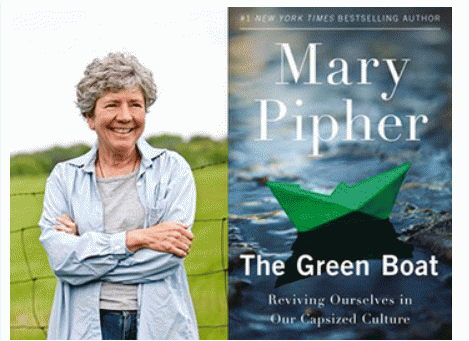
Nebraska is a red state-- a very red state, yet there has been considerable success in dealing with the Keystone XL pipeline. Mary Pipher goes into detail describing how a dedicated group of people who care, from both parties, made a difference.
::::::::
Rob: Now, you talk about group transcendence. Can you discuss that a little bit?
MP: Well, for example, there's a sense, and we all know this, that we will all put our bodies on the line to stop that pipeline. I mean, this pipeline fight isn't over until we give up. It doesn't matter what President Obama says. It doesn't matter what our politicians say. Our local politicians have been bought and paid for. I mean, there are civil suits against our governor and attorney general for taking money from TransCanada off the table. Our politicians, with the exception of a few very principled people, are in the pockets of TransCanada. And that's one reason so many people became activists is they tried the other ways of influencing government and realized they couldn't do it, that no matter what they said, no matter what the scientific arguments were against the pipeline crossing an aquifer in the Sandhills, our politicians had already made up their minds and were not responsive. So that is one thing that turned a lot of very quiet, non-political people into activists...is they had to be activists if anything was going to change.
But our group has had...like, for example, here's a group experience that was really transcendent. Our group decided to build a solar barn on the route of the Keystone XL pipeline and we had a great big old fashioned solar barn raising with a big potluck and fried chicken and pies and quinoa salads for the vegetarians and deviled eggs and so on. But we were out there two whole days, and we were camping and working on this solar barn. And then at the end of the solar barn, when the last panels were up and the last nail was hammered in, we all sang together. We just sat down and sang and it was so beautiful it's just hard to describe. We were so happy and so proud of ourselves and so pleased that we had a solar barn and we were giving TransCanada a lesson in the people of Nebraska and what we thought about their pipeline.
Since that time we've used that solar barn for all kinds of things... we've recorded music out there against the pipeline, the Great March for Climate is coming through Nebraska right now and they're going to be camping at our solar barn and having festivities out there. So that solar barn is a place of great joy and community for all of us.
And the climate marchers, by the way, are going to be in Lincoln next week and we're going to have a big corn roast for them and welcome to our state capital. We're going to have yoga in the parks in the morning with all the yoga teachers in town and probably 3 or 400 people. And we've just tried to do everything we can. Lincoln is their halfway point from LA to DC and they arrive in DC in October, I think, but we have done everything we can to make sure that these marchers, as they walk across Nebraska, feel the love of our state for people fighting climate change. In fact, one thing we did was we organized 300 pies for the marchers. So all the way along their route they have fresh baked pies from the local communities.
Rob: That's great.
MP: It's really been something, Rob, to see what can happen in this state when people work together, you know.
Rob: Now you talk...you have a chapter, "Sailing On: New Healthy Normal," and I really like that idea. You say, "Implied in the term 'new healthy normal' is my assumption that it's not mentally healthy to sit idly by while the human race destroys its mother ship." Tell us more about that.
MP: Well, I think that living in 2014 is a very, very complicated process. I have enormous empathy for people who are in denial because it's so hard not to just want to be happy and love your family and friends and enjoy your life. And if you open yourself to the pain of the world on a regular basis, it can be devastating. And probably you know and I know people who are devastated and are just really clinically depressed. So the trick, I think, for new healthy normal is figuring out a way to bracket and contain that grief and transform it, accept it and acknowledge it and allow yourself to feel it and then transform it into something more positive and wholesome and healthy.
And one way to talk about it is resilience. You know there's a resilient response to trauma whether it's in a concentration camp or after an earthquake. And so new healthy normal to me is really talking about what is a resilience response to trauma. And one of the resilient responses is to be embedded in a community where you have lots of people who you can enjoy and have fun with and work together and share with.
For example, one thing I say in the book is a community can start with one other person. If you're living in a city and don't have very many friends, but, say you're listening to this radio broadcast and think, "Well I really like Mary's ideas, but what can I do? I don't have that many friends." Well, you can meet at a coffee shop with one person and call that a community until you have some more people. It's really not that hard. It's really easy, in fact, to get something good started with one other person. That's what Brad and I did. So part of it is community; part of it is having really reliable ways to destressify...and healthy ways, like sports and exercise and being outdoors and listening to music and creative pursuits, and so on. And then another very strong component of it is protecting yourself from distractional intelligence.
And I don't really see any point in absorbing much more information that you can actually respond to in a useful way. So one thing I've noticed about me is I used to be a big news junkie and I'm not anymore because it just left me feeling so bereft and sad about the world. So I'll do a skim of the newspaper. I'll listen to headlines now and then and I read a lot of real good news magazines, but I tend to skip things that I have absolutely no control over that are going to leave me very dark.
Now, one caveat about that. You can have control over anything you decide you want to have control over. In other words, if I decided my cause was Iraq, I would figure out a way to act on behalf of helping the people in Iraq. But I've decided my cause is climate change in the state of Nebraska. One of the things I believe is iif you work hard on climate change in your local area, other people will work hard in theirs and we can save the planet. It will absolutely be grassroots work because the planet governments are not organized. They're nation-states. They're not organized around communal goals. But people are, actually, easily organized around communal goals. People in Brazil and Australia and Nebraska and Tibet and Manila all want the same thing which is clean air and water and green space and a healthy food supply and a future for their children. So actually, the only organization to fight this is going to be a grassroots organization.
Peter Russell said it very well when he said, "Humanity appears to be approaching the breaking point and there are two possible outcomes -- breakdown or breakthrough."
Now, on my optimistic days, I think we're moving pretty fast for a breakthrough because everywhere I go when I speak about this book, people say, you have no idea how much is going on in our community. And one reason we don't, by the way, is the media, with the exception of you and a few other media source, carries very little on environmental action. Amy Goodman does pretty well on Democracy Now. NPR is terrible on its environmental coverage. Most newspapers hardly touch it. But if we knew how many people on earth felt the way we do and are willing to work as hard as we are to make things better, we would be incredibly heartened and excited, because the structure to change things, I truly believe Rob, is there all over the world. It just is having trouble emerging from under these old morbid systems that are sitting on top of it right now.
Rob: You talk about, in terms of making stuff happen, the structure to change things. You talk about intentional living and everyday activism. Can you talk about that?
MP: Yeah. Well, I think there's been a quite a bit of discussion of that. But, a lot of...like, for example, I had my daughter, who's a teacher and a young mother, over with a bunch of her friends and first of all one of the first things they said is we didn't know if we wanted to come tonight because every time we talk about this we get really upset. And I said, "I promise you guys are going to have a good time." And so we didn't even talk about the issues in terms of how terrible it is. We just right away started talking about what they already are doing. This is a very good question for people -- what are you already doing? And it turns out most people are doing a lot already. They're recycling. They're being very careful with their carbon units. They're trying to eat local food when they can. They're riding their bikes when they can. They're conscious of the miles they drive. They're trying to have a low mileage car if they can afford it and so on. They're wearing sweaters and their thermostats are different. These daily things make a big difference.
Like, for example, one thing I do now when I go to a ... I try to buy local all summer. I just buy everything produce-wise when we have it in Nebraska from our local vendors and I buy all my meat from local vendors and freeze it and save it all year.But when I go to a grocery store, I look at where the fruit and vegetables are from all year long and I don't buy fruit that's shipped in from other countries. And it's not a lot, but it's a little. It's a little bit and I can do it real easily when I go grocery shopping.
Sarah and her friends decided that one thing they could do was have little parties and get-togethers where they trade clothes with each other, as opposed to go out and buy new clothes. And they also decided to do the same thing with books. And so there are all sorts of ways to recycle, repair, share that saves a lot of the consumer purchases that, of course, cost materials, cost energy, cost shipping, and so on and so on. But yeah, I mean, there are just really ways to be thoughtful every day and the good thing about it is not only does it not take much time or energy to be thoughtful, but it feels really good. There's a satisfaction in doing every day what one can to make things a little better.
Another thing that's very important is figuring out a way to talk to people a little bit about these issues. And when I first started to people about the pipeline and so on, they didn't really want to talk about it and nobody wants to talk about climate change. I mean, really, it's probably better if you almost never talk directly about climate change. It's probably better in your local area to approach people and say, "Well, what do you think about the water pollution in the nearby river?" or "Have you heard that we have the highest Parkinson's rate in the country because of fertilizer run-off?"
That's one problem we have in our state, by the way. Lincoln is the Parkinson's capital of the country because we have so many pesticides and fertilizers in our water system. If you talk to people about local issues, they care about those local issues and they also have the resources and community to act locally. One reason I don't choose to do something about Iraq is I don't know anything about Iraq. I don't speak the language. I don't know the culture. I've never been there. I have no local resources to help me deal with Iraq, but I have plenty of people who want to help me deal with this TransCanada pipeline.
So I think it's really important to have people working where they can be effective. And most locally,most logically they're going to be most effective locally.
Rob: Okay. You talk about engaging in altruism. You say...you cite a study that showed that altruistic people actually live longer lives.
MP: Please talk about how that ties in with your work.
MP: Actually, what we found is that older people who are involved in volunteer work or meaningful activity, they live longer and they stay more mentally alert. People whose life has a purpose live much longer than people who don't. In fact rest homes are learning from this and they're starting to give residents, nursing homes I mean, they're giving residents assignments, you know, to keep them...your job in the morning is to come and cut up the fruit. Your job in the morning is to go wake up you know Mr. so and so in room 201,etcetera, to give people a reason to get out of bed in the morning.
The original altruism research was done by Martin Seligman and what he showed is if you give college students in two different groups a $20 bill and you tell one group to spend it on themselves and then report back and keep a measure of their happiness from that $20 and you tell another group to use that $20 to do a good deed and report back their happiness, it turns out people are much happier when they give a $20 bill away than when they spend it. And they're also...that happiness is more sustained than the happiness of, say, a nice meal on the town or a concert ticket. So there's a lot of good research on that and I think that if you just think about yourself, when is one of the times you feel good? You help somebody across the street. You help somebody pick up their groceries when their bag breaks apart in the parking lot of a grocery store. You call up a friend who you know needs support and talk to that person and get them laughing. You feel good after those experiences. It's a natural feeling. We humans are hardwired for empathy and we're hardwired for altruism, so it's just natural to feel good after all that.
Rob: Now, you talk about a difference between altruism and moral...between empathy and moral imagination and you mentioned moral imagination earlier. Can you talk a bit more about it?
MP: Yes, there was just one more study before we move away from altruism and happiness and that was a study that David Brooks reported in the New Yorker that found that joining a group that meets once a month produces the same increase in happiness as doubling your income. Now that's a pretty profound study, you know. I'm sorry I don't have the reference for the study. I read about it in a David Brooks New Yorker article a couple of years ago, but I bet people could find it if they really wanted to look into that particular study.
Yeah, I write about moral imagination as...from my point of view I have a very simple value system- good is that which increases the moral imagination; evil is that which diminishes it. And the moral imagination is the ability to understand the world from another point...person's point of view, to care about that other person's fate and to intelligently and willingly engage in helping that person have a good life or that animal have a good life for that matter or that tree. I contrast it with empathy on the most elementary level and actually Damasio was the neuropsychologist who has done the research on this. There are two different parts of the brain that light up. If you see someone fall down and hurt themselves, skin their knee, you almost feel a twinge in your knee and you feel kind of a knee-jerk empathy with that person. Or if you hear someone called a bad name, you know a racist term or something, you feel a kind of an empathy with that person and you feel bad right away. That's good, of course. That's a very good human adaptive response.
Moral imagination implies creativity on your part, implies an active search for understanding, and it implies active engagement in helping other living beings have good lives. And so, for example, when I talk about what diminishes the moral imagination, in my opinion pornography does because it reduces full and interesting human beings to objects. In my opinion hate speech is evil because it reduces the moral imagination of people to ugly stereotypes and it diminishes their interest in taking care of other people. A good example of that right now is all of these children on the border that have piled up from Central America. And there are two very different conversations about these children going on in this country. One of them is these are children, they're the age of my grandchildren, and they're on a border thirsty and traumatized and alone and they need help. They need people to figure out what they can do for these children and their families so that they're neither in this country illegally with no resource nor sent back to a country where they most likely will be recruited into a gang or killed by different groups that are operating in the area. So there's...that's one conversation. The other conversation is a kind of talking about these children using terms like "illegal aliens," as if they're not really children like our children, but some kind of pestilence that has arrived on our border that must be eradicated. And that kind of conversation about children implies to me a diminished moral imagination.
So all of my writing...if you think about Reviving Ophelia as an example, one of the things I tried to say in that book is I am going to make a big effort to understand teenage girls. When I do feel like I have a really good grasp of teenage girls and how they think and how they see the world, I am going to write about that and explain it to readers so that they too can understand teenage girls in a more nuanced and empathic way and then act on behalf. And that book was really successful by that measure because after Reviving Ophelia, you know, it was a big hit book...I'm very grateful it allowed me to stay....this is my ninth book, The Green Boat, but the other thing I'm very grateful for about that book, I was aware of at the time and still am, is all over the world actually groups formed to help teenage girls. Groups formed in this country. Groups formed in other countries. Everything from older pilots wanting to teach teenage girls to fly airplanes to... I know a pediatrician in the northwest who quit her job to start organizations to empower girls. That's what I wanted that book to do. I wanted it to inspire people to action.
Rob: Now you talk about how the first human rights movement began with a small group of people in England in 1787 and 12 men got together and it ended up leading to the abolishment of slavery in England. Then you mentioned Rosa Parks' story...now she really wasn't alone at all though the story tends to be told that way,she was a part of an organization in a group. And then you say, and I love this quote, "Grassroots groups can foster mass movements, and mass movements can lead to paradigm shifts, which can create systemic changes. If many of us are acting together now, we may have just enough time to transform ourselves into a sustainable world culture." And I'm kind of picking up on what you said about people getting together and really this is such an important part of what you say in your book -- it's about people connecting"
MP: Absolutely.
Rob: ...connecting to each other, connecting to nature. You describe how you love to lie back and look at the stars and just connect with the universe. I mean, it's a really beautiful way that you put the book together in a gentle way, describing very calculated, strategical approaches to...did I just say strategical?
MP: I think you might have (laughs).
Rob: (Laughs). But you do it in such a gentle way that it doesn't feel like you're, in a sense, very much analytic of what you do and how you do it and that's a beautiful part of the book I think. But I...just to come back to my original comment. You're talking about creating mass movements and you were involved in doing that and this book actually tells a story about how a handful of people got together, drinking a little wine, having some fun, turned into something that was very powerful in Nebraska in terms of dealing with this multi-billion dollar operation, buying every politician and all kinds of people.
MP: Yeah, and when I started the book, I didn't think we would succeed. I just...I wrote about our group, The Coalition to Stop the KXL Pipeline and The Apple Pie Brigade, I wrote about them just as an example of how people get together and start working for change. And, by the way, we've moved into all kinds of other areas. We're working real hard on alternative energy. We're starting to work on water in this state and our very compromised water supply. We're also starting to really look into working with divestment and talking to churches, the university and other places about divesting from fossil fuels as investments.
One of the great things that happened is we never made this a political issue. Clean water, healthy food, healthy futures for children and all living beings, good food supply -- these are not liberal or conservative issues, they're human issues. And that's always how I've tried to talk. I mean I have my political views and ,as you can imagine, they're pretty strong, but when I'm writing I try to write as a cultural therapist and talk to people in a way that inspires the least resistance and the most eagerness to act. And I really had to think that through with this particular cause. But my favorite thing, Rob, to come out of this interview would be if people could learn a little bit from The Green Boat and maybe form their own group and start doing some of this work in their local area.
Rob: Now I said it before we started the recording in the interview, but I read this book from cover to cover. And I did because I felt that it was not just picking up a fact here or there, but it was the feel and the thinking and the feelings that went into how you shared this that was so important. I mean frankly, I try to read as much as I can of a book before I do an interview and I'll usually read at least half, but I went through this one from front to back, and I'm really glad I did.
MP: I'm so honored and thank you so much for having me on your show, Rob.
Rob:It's been a real pleasure. You know, what are some final bits of advice that you can give to people who are feeling like they don't know how to fit into making change happen. I'll ask one more question that I had written down. You talk about how you can't tell people to wake up...
MP: No.
Rob: They don't do it. What do you do?
MP: After I read Earth (by Bill McKibben,) I just wanted to run around and shout, "Wake up everybody, wake up. Come out of your trance and help me deal with this." But I'm a mother, I'm a therapist, I've learned after my six decades of life that shouting 'Wake up' never works. So I think the best way to inspire people to act is to be in relationship with them. And if you're loving, if you're in relationship with people, if you're willing to work with them toward common goals, use language that's not political, you can get so much done, you can get so much done. And that's one of the things, I think, Nebraska and the way we have dealt in a very conservative state with our conservative citizens has really been something that other people could learn from because we didn't ever talk about democrats or republicans or ideology, we talked about food and water and pie. And those topics are popular in this state.
Rob: Great, great, great. Thank you so much. The book is The Green Boat. I've been talking to Mary Pipher. This is Rob Kall, Bottom Up Radio WNJC 1360 AM. If you came in the middle of this interview and you want to get the beginning, it'll be at opednews.com/podcasts or go to iTunes and look for my name Rob Kall. Thanks again Mary. Have to have you back sooner than it took this...since the last time.
MP: Thank you so much. It was...a pleasure to talk to you.
Authors Bio:
Rob Kall is an award winning journalist, inventor, software architect, connector and visionary. His work and his writing have been featured in the New York Times, the Wall Street Journal, CNN, ABC, the HuffingtonPost, Success, Discover and other media.
He is the co-founder of the Arc of Justice Alliance a platform designed to help organizations and individuals working for justice and a better world to discover each other and share resources and strategies, with the hopes that this will build their power.Check out his platform at RobKall.com
He is the author of The Bottom-up Revolution; Mastering the Emerging World of Connectivity
He's given talks and workshops to Fortune 500 execs and national medical and psychological organizations, and pioneered first-of-their-kind conferences in Positive Psychology, Brain Science and Story. He hosts some of the world's smartest, most interesting and powerful people on his Bottom Up Radio Show, and founded and publishes one of the top Google- ranked progressive news and opinion sites, OpEdNews.com
more detailed bio:
Rob Kall has spent his adult life as an awakener and empowerer-- first in the field of biofeedback, inventing products, developing software and a music recording label, MuPsych, within the company he founded in 1978-- Futurehealth, and founding, organizing and running 3 conferences: Winter Brain, on Neurofeedback and consciousness, Optimal Functioning and Positive Psychology (a pioneer in the field of Positive Psychology, first presenting workshops on it in 1985) and Storycon Summit Meeting on the Art Science and Application of Story-- each the first of their kind. Then, when he found the process of raising people's consciousness and empowering them to take more control of their lives one person at a time was too slow, he founded Opednews.com-- which has been the top search result on Google for the terms liberal news and progressive opinion for several years. Rob began his Bottom-up Radio show, broadcast on WNJC 1360 AM to Metro Philly, also available on iTunes, covering the transition of our culture, business and world from predominantly Top-down (hierarchical, centralized, authoritarian, patriarchal, big) to bottom-up (egalitarian, local, interdependent, grassroots, archetypal feminine and small.) Recent long-term projects include a book, Bottom-up-- The Connection Revolution, debillionairizing the planet and the Psychopathy Defense and Optimization Project.
Rob Kall's Bottom Up Radio Show: Over 400 podcasts are archived for downloading here, or can be accessed from iTunes. Or check out my Youtube Channel
Rob Kall/OpEdNews Bottom Up YouTube video channel
Rob was published regularly on the Huffingtonpost.com for several years.
Rob is, with Opednews.com the first media winner of the Pillar Award for supporting Whistleblowers and the first amendment.
To learn more about Rob and OpEdNews.com, check out A Voice For Truth - ROB KALL | OM Times Magazine and this article.
For Rob's work in non-political realms mostly before 2000, see his C.V.. and here's an article on the Storycon Summit Meeting he founded and organized for eight years.
Press coverage in the Wall Street Journal: Party's Left Pushes for a Seat at the Table
Talk Nation Radio interview by David Swanson: Rob Kall on Bottom-Up Governance June, 2017Here is a one hour radio interview where Rob was a guest- on Envision This, and here is the transcript..
To watch Rob having a lively conversation with John Conyers, then Chair of the House Judiciary committee, click here. Watch Rob speaking on Bottom up economics at the Occupy G8 Economic Summit, here.
Follow Rob on Twitter & Facebook.
His quotes are here
Rob's articles express his personal opinion, not the opinion of this website.
Join the conversation:
On facebook at Rob Kall's Bottom-up The Connection Revolution
and at Google Groups listserve Bottom-up Top-down conversation