| Back OpEdNews | |||||||
|
Original Content at https://www.opednews.com/articles/Transcript-Paul-Craig-Rob-by-Rob-Kall-130405-913.html (Note: You can view every article as one long page if you sign up as an Advocate Member, or higher). |
|||||||
April 5, 2013
Transcript; Paul Craig Roberts-- The Collapse of the Banking System, and After
By Rob Kall
The second half of the transcript of my recent interview with Paul Craig Roberts.
::::::::
Rob Kall Bottom Up Radio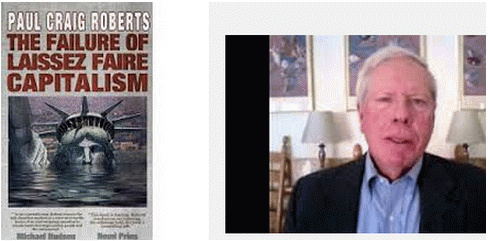
by pcr
Paul Craig Roberts Interview 3-27-2013
I interviewed Paul Craig Roberts on February 23 rd . This is part two of a two part interview.
Here's a link to the first part of the transcript.
And h ere's the link to the audio recording Podcast .
Thanks to Don Caldarazzo for doing the transcript.
Rob Kall: There is a growing discussion of the idea of Public Banking as a potential solution. Do you know much about it, have you paid attention to it, and what do you think about it?
Paul Craig Roberts: I don't know a lot about it, but is it North Dakota or South Dakota? One of them has a -
Rob Kall: North Dakota.
Paul Craig Roberts: Yeah. And that system works very good.
Rob Kall: Just for background, North Dakota has had a Public bank for over fifty years, and North Dakota is the only state that has not had major problems with maintaining their budget. I'll be speaking at a Public Banking conference that is going to be in California this summer. Boy. It would be neat to have you there, but -- I've got to get you looking at this, because Public Banking could really pull the rug out of the banking system that we have now. It does exist in other countries.
Paul Craig Roberts: I don't think it can happen here until the banking system collapses.
Rob Kall: What would that look like, a collapse of the banking system?
Paul Craig Roberts: Well, it'll be, I mean, who knows? (laughs) It'd be horrific. But you have to rebuild and re-create. And so, if people have learned their lessons, and there are any sensible people available to lead, you could rebuild it on public banks, or certainly you would want to modify dramatically the system that is in place now. It's a total failure. See, a lot of people -- Libertarians - keep taking issue with the title of my book. They say, "How can you call this Crony Capitalism we have now 'Laissez-faire?'" "I don't call it Laissez-faire," I said. "It was the failure of Laissez-faire." What is Laissez-faire is deregulation, and we've had twenty-five years of deregulation in the United States; and it's happened in England, and France, and Australia, New Zealand, and (to a lesser extent) Canada. They didn't deregulate the banks in Canada.
Rob Kall: And this is the model that Friedman and the Chicago school of economics talks about, really, isn't it?
Paul Craig Roberts: Well, I don't know. I think Friedman gets a lot of bum raps. As I've said earlier in our discussion, sometimes regulation goes too far, becomes counter-productive. I don't think Friedman ever advocated repealing Glass-Steagall. He was an expert on the Depression and the failure of the Fed. The Great Depression was caused by the Federal Reserve, it made policy mistakes and shrank the supply of money, and that's what caused the Great Depression.
So the government can screw up just as badly as the private sector. Anybody can screw up. This comes back to what we're saying about how the Left always trusts government, and the Right always trusts business. You really can't trust power! So you have to have a system that constrains it, wherever it is. So I think on the whole that Friedman was a man of his time, and he helped us understand things we didn't know, like what caused the Great Depression. I think he was a humane person: he didn't want to throw widows and orphans out into the street. He was Jewish. He had a social conscious.
But, you know, the Left likes to demonize people. Many demonize me: "Oh, he worked for Reagan. We can't believe him." Reagan's rhetoric really did upset the Left. And they still are going on about Reagan! Here's Obama with all his crimes -
Rob Kall: (interjecting) I've just got to say, what the Democrats (not the Left so much as the Democrats) don't understand is Obama is to the Right of Reagan!
Paul Craig Roberts: Right. Exactly. That's exactly the situation. I'll write about something, some new atrocity from Obama, or the atrocities from Bush and Cheney and Wolfowitz, whoever; and they'll come in and just want to talk about Reagan. (laughs) "Oh, it's all Reagan's fault!" There's not too much he can do dead in the grave! (laughs)
Rob Kall: Yeah but, you know, you're not alone. I've had this conversation -- Wendell Potter, who is the guy who used to be the public spokesman for the insurance industry, he woke up and he turned around, and he sees things differently and he talks about them differently; and it's clear that that's exactly what you've done, and these people they get stuck on history, and not on who people are now! I'm proud to have you as a regular contributor to Opednews, and very grateful that you send your articles to us to publish.
Paul Craig Roberts: It's a good site. You know, I always read Opednews, and I'm glad to have 'em there. But you can see, if you look a the comments, and not just my articles, but a lot of the articles, because you have this 'comment' section for people, you can see what I'm talking about. They're still fixated on thirty years ago, or (laughs) and it's all Reagan's fault.
Rob Kall: Well, how do you explain that? What is your response to somebody who says, "Hey! You did this under Reagan, you were the author of trickle down economics." That's the kind of stuff they accuse you of.
Paul Craig Roberts: There's no such thing as trickle-down economics. You know, I've explained it so many times, it's in my book The Supply Side Revolution, which Harvard University Press has kept in print since 1984, which the mainland Chinese have just published in Chinese -- everybody in the world wants to learn new things except these Americans! The problem in the Reagan years originated in the Carter period. It was the result of post-war Demand Management Economic Policy. What that policy did was to pump up consumer demand with easy money and credit, but suppress the response of supply with high marginal tax rates. A marginal tax rate is the rate of tax on additions to income. So what developed was, since after-tax return on additional output was low, corporations just let the prices rise.
And so we had was called 'stagflation.' It didn't pay to invest, increase output. They could make more money by letting the pumped-up demand push up the price of the products! So that caused inflation, but since they weren't producing anymore, there was no employment growth. And so this was known as stagflation. Everybody knew about it. It was the big discussion! I was in the Congressional Staff at the time.
There was no solution, and the supply side of Congress said, "Oh. We have a solution." I'm the one who came up with the solution. And the solution is, you tighten up the monetary policy so it doesn't pump up demand so much. And you takes the brakes of the high marginal tax rates off of output so that more is produced! And we did that. And what happened? We had twenty years of growth without having to pay for it with rising inflation! And when we presented this program, everybody said "Well, that can't work. You can't grow without inflation." And you see, the Fed had gone back to it! What is Bernanke always telling us? "If we could just get the inflation up, the economy would be growing!" So what we did -
Rob Kall: That's not sustainable though, is it?
Paul Craig Roberts: Of course it's -- What's not sustainable? Bernanke's thing is not sustainable. We got rid of the problem. It was called "The Philips Curves tradeoff," which results in stagflation. The supply siders got rid of it. Now, this doesn't mean supply side today is a solution, because in the Reagan years, the economy wasn't offshored! It was still here. ( laughs) And so, if you could remove the barriers to investing and hiring, the economy would pick up again.
And it did! In the 80s, in the 90s under Clinton (basically the continuation of Reagan's policies), we had reasonable - twenty years. It was a lot better than the 70s. Really, Carter was destroyed by the -- he was a good man, he was probably one of the best we've had, and he was destroyed by the stagflation. He didn't have a solution. And that's what Reagan did, he fixed that problem.
But now, you see, we've got other problem; and supply side economics or 'tax cuts,' (as a lot of people like to think of it as, which is a gross-oversimplification), that can't deal with the labor arbitrage problem, and with the fact that innovation and everything else follows manufacturing, offshore. And it can't deal with the deregulation of the financial system!
Reagan didn't repeal Glass-Steagall. He didn't take the position limits off speculation. He didn't say "You can have whatever debt-equity ratio you want." They didn't let people got out and leverage an asset thirty of forty times. None of this would have been possible when I was in the Treasury. So when you have those kind of changes, that just completely goes far beyond the corrections that we were able to make in the Reagan years. It's just too big of a problem: such that the policy we used to fix the policy of that time can't fix the much bigger problems now.
Rob Kall: Would you say that reinstating Glass-Steagall would be a good step right now?
Paul Craig Roberts: Oh sure, sure. Of course it would. But you see, they didn't do it, did they?
Rob Kall: No.
Paul Craig Roberts: They came up with this watered down thing, which I don't think will have any effect. In fact, the regulators are the banks themselves, and so they won't apply it to them, they'll apply it to the little people! They'll go beat up on some little mutual fund, or -- you see what I'm saying? The real villains are running the regulatory agencies. So they're not going to then apply it to them, anyhow. I think you have to bring back Glass-Steagall, you have to bring back the position limits on speculators, you have to have very strict regulation of debt leverage, and what they really need to do is de-financialize the economy.
You see what happens now -- you know what the banks lend for? They lend for takeovers; they lend on real estate to drive up real estate prices, because the real estate prices go up, so do mortgages and interest payments and debt payments. So the whole thing is being run to maximize the cash flow into the financial sector -- away from everybody else. Michael Hudson has made this perfectly clear. So, you can't correct that -
Rob Kall: Paul?
Paul Craig Roberts: Yeah?
Rob Kall: I call my show the Bottom Up Radio Show because I believe that, in one good way, the internet has helped to catalyze a move from a top down to a bottom up culture and way of seeing. I absolutely agree with you that the internet has been incredibly destructive for the economy in terms of off-sourcing of jobs, but I also believe that we have some positive hopes because of this transition from a top down culture to a bottom up one. And I wonder, can you comment on - for example, bottom up is decentralized, and it's less hierarchical. Do you see any positive way that this is happening, or that it could happen, from your perspective?
Paul Craig Roberts: I think the main advantage of the internet has been to get some information flows free of the very strictly controlled print and TV media. That's something else that happened during Clinton: he allowed the concentration of the media. It broke all our rules; it broke our anti-trust rules, and it broke our long tradition of having a very dispersed, independent media. The whole media was bought up by five or six firms, so that's very easy for the government to control: the value of the concentrated firms are the Federal broadcast licenses. So the government has them by the short hairs. The other controlling fact is they're run by corporate advertising executives, and they're concerned with advertising revenues, and so they don't want anything that upsets anybody. All you get from the print and TV media today is propaganda. You get the government's propaganda and the corporation's propaganda. That's it.
So the internet has given people the opportunity to get better information. Of course the problem with the internet is that they're so much on it. So much of it is quackery and all the rest, and it takes a long time to learn what it is you can trust and can't trust. You can't -- you know, it used to be, you could pick up the New York Times, and if there was a major story, it was probably pretty close to the money. And so people kind of got confidence in major news outlets, because they were run by journalists -- I mean, I don't mean that they always told us the truth. They didn't. They participated in a great many shams and wars we didn't need to have that they helped to bring on and all the rest, but still you had some idea what you were looking at.
On the internet, a new person comes in, he doesn't know whether what's on Opednews is reliable, what's on Global Research is reliable; what's on Counterpunch, what's on Information Clearinghouse, what's on wherever! They have no way of knowing. It takes a long time. And of course they all have their own biases and prejudices, and they look for that; they look for something that's going to tell them what they already think.
Rob Kall: But I just want to ask you. Now, the list that you just gave -- those are sites that you trust, right?
Paul Craig Roberts: Well, they are sites where I can get information that's out of the box. It's not the usual baloney, and even if it's not always all right, it at least shows you how to think about it differently. So yes, I trust them in the sense that they are honest sites, and they're trying to give information that helps people have a better grasp on reality than the propaganda that comes out from the mainstream media. So yes, I, in a sense, I trust them. That doesn't mean I think that everything that is said is absolutely true, because people make mistakes. I don't think that very many of the people that publish on those sources are trying to mislead us by printing lies.
Rob Kall: You wrote in an article, When truth is suppressed, countries die, you said "If those who speak truth can not be bought off or shut up, they are ignored or demonized. Almost everything Americans need to know is off-limits in public discussion. Anyone who broaches the truth becomes an anti-American, a terrorist sympathizer or a Commie Socialist, a conspiracy theorist, an anti-Semite, a kook, or some other name that's designed to scare Americans away from the message of truth." But then you also just said a minute ago that there's a lot of quackery out there. How do you separate that out?
Paul Craig Roberts: Well, it's just experience and judgment. You see, the public discussion is from the mainstream media. You don't see them standing up in Congress talking about the good information on the internet or the take on anything that's before Congress that's well-defined in the internet, or an internet source or sources. That's not part of the public discussion. The public discussion is limited to the New York Times, the Washington post, and the main TV news channels. That's the public discussion - and a few magazines that are run by the council on Foreign Relations, and so forth.
So there is not a participation of internet-based information in the so-called' public discussion' of policy that goes on in Washington. They don't really know it exists, and they don't pay any attention to us because they're used to reading about themselves in the New York Times and the Washington Post and not on the internet. And so they're comfortable. And it's the people who are beginning to think for themselves who have gone into the internet and tried to create a reality picture of events, and -
Rob Kall: I guess what I'm asking is, on the one hand you talk about people being labeled as kooks and what have you, and on the other hand the internet has all this quackery -- wouldn't you agree that part of the job of responsible internet publishers is also to provide moderation and content curation as well?
Paul Craig Roberts: I think some sites do that, but there's always a danger in any kind of censorship, even though it needs to be done so that you don't have flat-earthers or something running the show. But there are many things you can't discuss very well even on internet sites. Also, anybody can set up one. And so, somebody who has got some kind of a far out view of things can run a site too, and that never really worked in newspapers except for those things that you would by at the supermarket checkout counter (laughs), you know. I forget, the National Enquirer or some thing. "Movie star abducted by UFO," and those sort of things. But that never really spread into the print media. What we now have in the print media is this government propaganda, corporate propaganda.
Rob Kall: What are some of the issues that are not permitted that need to be discussed?
Paul Craig Roberts: Well -- very few sites will let you just even point out the facts of 9/11. I mean this is one of the biggest hoaxes in human history, but most sites are afraid of it. You have a hard time on many sites saying anything about the War Crimes of the Bush and Obama administration. All of these wars are without any doubt War Crimes under the Nuremberg standard that were applied to the Germans after WWII. Many sites, if you criticize the policies of Israel, they call you an anti-Semite. But you're not an anti-American if you criticize the American policies, but (laughs) if you criticize Israel it means that you hate Jews. All of these, you could go on, so many things like this. If you point out that offshoring is not free trade, that it's labor arbitrage, that deregulation can go extremes and be destructive, then the Libertarian sites won't publish it, because they think capital should be free to do whatever it wants, otherwise we don't have any freedom.
Rob Kall: What do you think about the state of Capitalism now?
Paul Craig Roberts: Well, as we've discussed today, it really no longer exists, because Capitalism is supposed to eliminate failures, but we now have these banks to big to fail and they're kept going with massive public subsidies, which is essentially destroying the currency; destroying the reserve currency role of the US dollar. This is a huge social cost of saving these banks. The social cost far exceeds the damage of letting the banks fail. If Capitalism can't eliminate failures, it's not working.
Another foundation of Capitalism is that profits are a sign that resources were used successfully in satisfying consumer needs or wants. Because if you have profits it meant that you did something that people wanted, if you had losses it meant that you are using resources in a way that don't meet the needs of consumers. So profits are supposed to be a sign that you are successfully serving society. But when the profits come from putting massive numbers of people out of work by moving the economy offshore, that's not serving social welfare.
Rob Kall: And with the help of welfare for corporations as well.
Paul Craig Roberts: There is some of that, but that's not really what's so important. What's important is that they now make profits by hurting the society! And so the profits are no longer a sign that they are doing a good job serving society. Both of the markers of capitalistic success no longer work in American Capitalism. And as I also said earlier, Capitalism has been financialized, and it works now to suck all the surplus out of the economy and direct it into the banks.
Rob Kall: Just to -- we need to wrap up, so I just wanted to get a couple of quick comments from you on two more things. 1) There's a new Pope. What's your impression of the Vatican, what's happening with the Catholic Church and the Pope?
Paul Craig Roberts: Yes, I'm not qualified to speak on that. The only I impression I have is that there has been a long time attack on the Catholic Church; and I think that the reason for this attack is that the Catholic Church, despite all of it's failures and problems, is still about the only thought to morality. It's the only place that there's any moral voice. How real it is, I can't say, but it's evil, closing down the last sort of moral fount, and I think that the Church is losing this battle, and we will all pay for it.
Rob Kall: I wonder though, if part of the reason it's losing is because of some of the positions it's taken that are not moral, like -
Paul Craig Roberts: As I said, with all it's failures, nevertheless, who else ever speaks up for the downtrodden?
Rob Kall: OK. Now the other topic is one that is something you write a lot about, and that's Israel and the Middle East. What's your take on the current situation there? Obama just went there. Impressions?
Paul Craig Roberts: Of the Obama visit -- you know -- you could come to the conclusion that he went there to make Israel apologize to Turkey so that they can get united and take on Syria and Iran. If that's the case, then it's just more duplicity, more deception. The fact that the American president goes to Israel is a sign of the enormous political power Israel holds over the United States government. I mean, the Roman Emperor didn't go to other countries, they came to him.
And so now we've had the President of the so-called Hegemonic Superpower go over to some tiny little country, whose existence is totally dependent on the President of the United States, to go over there to pay his homage and show that, "Here I am." Now, that's got to tell you that things are out of balance, that Israel has far too much power over the United States, and is using that power for it's own purposes in the Middle East. And what we see happening progressively is the breakup of countries. The Americans invasion don't bring freedom and democracy, they bring civil war and permanent chaos.
I mean, Iraq is on the same level of violence that it was in during the worst of the occupation by us. Libya is disintegrated, warring factions. They're trying to do the same thing to Pakistan with all the drone strikes in all the various provinces. Syria is being broken up, why is the United States and Israel supporting Islamists against a secular government? It's the secular government that always sat on the terrorists, that suppressed the Islamists. That's why we say they're dictators. They suppress the Islamists. That's what Saddam Hussein did.
Rob Kall: You know a couple of months ago I interviewed Noam Chomsky and he says pretty much the same thing.
Paul Craig Roberts: Well, he's right. What we're leaving is all these destroyed political entities, none of them whom then can get in the way of us or Israel. And that's what they're doing to Syria, and then it'll be Lebanon. They want to get rid of Hezbollah and Hamas, and then Israel can steal Southern Lebanon and get the water resources. Iran is sitting there waiting, and it really remains to be seen whether the Russians or the Chinese put down a foot heavy enough that we shy away from that, or whether they're not
Rob Kall: Who in the US gives Israel so much power? Israel gets the power from various sources; AIPAC is the obvious first answer, but AIPAC represents a tiny percentage of the Jews in this country, certainly not all of them. Is it just AIPAC that gives Israel such power? Where does it come from? What do you think is the answer to that?
Paul Craig Roberts: I don't know if I know all the answer, but it's the power of campaign contributions. It's also the power of AIPAC's power to demonize people that they think are not sufficiently enough in Israel's camp. Look what they tried to do to Chuck Hagel simply because he said "I'm an American Senator, not an Israeli Senator." They tried to destroy him to prevent him from being confirmed as Secretary of Defense, simply for saying what should be obvious to everybody: if you're an American Senator, you're supposed to be an American Senator, not an Israeli Senator.
So I think that everybody who has ever tried to stand up for the Palestinians, or to make just honest and fair criticism of Israel, gets branded as an anti-Semite; and then the media goes to work on them, and then they lose the next election. And that's why if Israel wants a resolution and they bring it to the Congress, it almost always passes unanimously.
Rob Kall: What about Christian Zionists? What about their role in this?
Paul Craig Roberts: Well, they're part of the Israel lobby. I don't know exactly how it works or why, but we now have - what's tat guy Hagee? Who has that huge church, the pastor?
Rob Kall: Yes.
Paul Craig Roberts: Who has told them that they're supposed to worship Israel not Jesus? I don't know where this stuff comes from (laughs), you know. Who knows, maybe he's on AIPAC's payroll. How would you know? I'm not saying he is, I don't know. I'm just saying there's a whole range of possible answers, but it's for certain that the Israel lobby, however big it is, and whoever all it encompasses, is very careful about demonizing anybody that it thinks is not sufficiently pro-Zionist.
Rob Kall: I agree with that conclusion. I really believe that it's impossible for a member or a candidate for the Congress to speak out or even question the policy of Israel without being attacked with major funding in primaries for somebody who will just go along totally with the party line. I think Ron Paul was a very rare exception who was able to withstand it. There's hardly anybody who can.
Paul Craig Roberts: Right. You're exactly right. That's right, and a lot of them have written books and said that, a lot of the defeated members. Cynthia McKinney has told me that herself. They got her out.
Rob Kall: I totally believe that that happened to her, yes. She was definitely -- she lost her -- she made some mistakes, but I really believe that it was AIPAC and funding of an opposition candidate in a primary that lost her her position in Congress.
Paul Craig Roberts: I think all of this makes Israel very vulnerable, because they cut off all constructive criticism.
Rob Kall: Absolutely. It's bad for Israel. It was nice to see that when Obama spoke to students, he got an applause.
Paul Craig Roberts: Yeah. It's a fatal for Israel, because then you get these nutcases like Netanyahu. I mean this guy is insane! He's running the show! This isn't in Israel's interest.
Rob Kall: I like to characterize Netanyahu as Israel's Dick Cheney.
Paul Craig Roberts: (laughs) Yeah. Or worse! Right.
Rob Kall: Well, on a laugh, let's call this an end to the interview. We're at a point where we've got to call it
Paul Craig Roberts: Well I've enjoyed talking to you Rob, as always.
Rob Kall: It's been great.
Authors Bio:
Rob Kall is an award winning journalist, inventor, software architect, connector and visionary. His work and his writing have been featured in the New York Times, the Wall Street Journal, CNN, ABC, the HuffingtonPost, Success, Discover and other media.
He is the co-founder of the Arc of Justice Alliance a platform designed to help organizations and individuals working for justice and a better world to discover each other and share resources and strategies, with the hopes that this will build their power.Check out his platform at RobKall.com
He is the author of The Bottom-up Revolution; Mastering the Emerging World of Connectivity
He's given talks and workshops to Fortune 500 execs and national medical and psychological organizations, and pioneered first-of-their-kind conferences in Positive Psychology, Brain Science and Story. He hosts some of the world's smartest, most interesting and powerful people on his Bottom Up Radio Show, and founded and publishes one of the top Google- ranked progressive news and opinion sites, OpEdNews.com
more detailed bio:
Rob Kall has spent his adult life as an awakener and empowerer-- first in the field of biofeedback, inventing products, developing software and a music recording label, MuPsych, within the company he founded in 1978-- Futurehealth, and founding, organizing and running 3 conferences: Winter Brain, on Neurofeedback and consciousness, Optimal Functioning and Positive Psychology (a pioneer in the field of Positive Psychology, first presenting workshops on it in 1985) and Storycon Summit Meeting on the Art Science and Application of Story-- each the first of their kind. Then, when he found the process of raising people's consciousness and empowering them to take more control of their lives one person at a time was too slow, he founded Opednews.com-- which has been the top search result on Google for the terms liberal news and progressive opinion for several years. Rob began his Bottom-up Radio show, broadcast on WNJC 1360 AM to Metro Philly, also available on iTunes, covering the transition of our culture, business and world from predominantly Top-down (hierarchical, centralized, authoritarian, patriarchal, big) to bottom-up (egalitarian, local, interdependent, grassroots, archetypal feminine and small.) Recent long-term projects include a book, Bottom-up-- The Connection Revolution, debillionairizing the planet and the Psychopathy Defense and Optimization Project.
Rob Kall's Bottom Up Radio Show: Over 400 podcasts are archived for downloading here, or can be accessed from iTunes. Or check out my Youtube Channel
Rob Kall/OpEdNews Bottom Up YouTube video channel
Rob was published regularly on the Huffingtonpost.com for several years.
Rob is, with Opednews.com the first media winner of the Pillar Award for supporting Whistleblowers and the first amendment.
To learn more about Rob and OpEdNews.com, check out A Voice For Truth - ROB KALL | OM Times Magazine and this article.
For Rob's work in non-political realms mostly before 2000, see his C.V.. and here's an article on the Storycon Summit Meeting he founded and organized for eight years.
Press coverage in the Wall Street Journal: Party's Left Pushes for a Seat at the Table
Talk Nation Radio interview by David Swanson: Rob Kall on Bottom-Up Governance June, 2017Here is a one hour radio interview where Rob was a guest- on Envision This, and here is the transcript..
To watch Rob having a lively conversation with John Conyers, then Chair of the House Judiciary committee, click here. Watch Rob speaking on Bottom up economics at the Occupy G8 Economic Summit, here.
Follow Rob on Twitter & Facebook.
His quotes are here
Rob's articles express his personal opinion, not the opinion of this website.
Join the conversation:
On facebook at Rob Kall's Bottom-up The Connection Revolution
and at Google Groups listserve Bottom-up Top-down conversation