| Back OpEdNews | |||||||
|
Original Content at https://www.opednews.com/articles/Where-are-the-Leaders-of-T-by-Tawnia-Sanford-Amm-110116-782.html (Note: You can view every article as one long page if you sign up as an Advocate Member, or higher). |
|||||||
January 17, 2011
Has anyone noticed that the Tunisian Jasmine Revolution Has Not Broadcast a Victory Speech?
By Tawnia Sanford Ammar
The organization of the Tunisian Jasmine Revolution played out online, galvanizing the frustration of Tunisians and fuelled by a long standing internet network united against the Tunisian internet censorship. Fresh protests called for Sunday, January 16 at 11 am Tunisia time across the country and the protesters have issued fresh demands.
::::::::
January 16, 2010
Let's answer the Question: Where are the Leaders of Tunisia's Jasmine Revolution?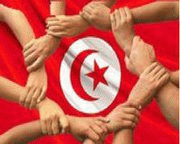
The Online Jasmine Revolution
(Image by Facebook Page Tunisian Riots:English Information) Details DMCA
By now, the images of Tunisia's popular revolution are well known: streets packed with young people calling for the removal of former President Ben Ali, with rocks in their hands, facing down their police officers armed with guns that have killed more than 70 Tunisian citizens, the exact count yet unknown.
In the swift sequence of events beginning January 15, when former president Ben Ali fled the country after weeks of unrest and increasing violence, there is an important question that has hardly been posed yet: Where is this "Jasmine Revolution's" leadership?
Two days after Ben Ali's departure, the streets of Tunisia are relatively quiet. The protesters have gone home, and there remains a remarkable lack of information regarding the Jasmine Revolution's aspirations in the mainstream media, which has focused its reporting almost entirely on the interim government's response and actions.
Most past revolutions have had an easily identifiable leader, or group of leaders, but this one hasn't. There has not been a victory speech - at least not on television. This begs the question: Who orchestrated this revolution, and where are they now?
The answer lies in the catalyst that united Tunisians in revolt: the Internet. It is crucial to understand how this revolution has been conducted. This has been a revolution largely conducted (in the most literal sense) by Facebook status updates and tweets.
The Jasmine Revolution continues to march forward - on the internet -" because little has changed with respect to Tunisians' ability to access information. The state-run TV station has changed its logo, but not its programming: in the midst of this revolution, the formerly named TV7 continues to broadcast cartoons and music shows as of this morning. Tunisian internet activists have been testing the limits of the recently promised "free and open Internet," and they have been posting their disappointing findings online at http://www.tunitech.net.
In actual fact, victory speeches have been made by some of the "conductors," but the mainstream media has simply missed them. Yesterday, this was posted to more than 8000 dedicated followers of the Revolution Tunisienne Facebook page:
Our country is our home! We have made an important step, but do not get excited just yet! The priority now is to save the injured, protect public property and private property. Dear Friends, please calm your friends and call for caution and more importantly, do not be afraid for the future and do not panic, this people is really a Great People!"
So why has the West missed this? Much smaller protests in Iran garnered much more attention and were dubbed, with unabashed sensationalism, the "Twitter Revolution."
The answer lies partially in the West's disconnection from the real leaders of the Jasmine Revolution. Yesterday, pundits on Al Jazeera International's broadcast debated whether Twitter or Facebook or Wikileaks placed the decisive role in this story. They miss the point.
The organization of the Tunisian Jasmine Revolution was an act played out online, galvanized by the frustrations of nearly all Tunisians and fuelled by the vigor of a long standing, Internet-based network of secretive activists who were united in their objection to the government's blatent Internet censorship. This network of activists, in early January, took up the cause of the up-until-then relatively contained protests, grabbing the immediate attention of the Tunisian government which was, of course, monitoring their online activity.
It was the arrests of several of these Internet activists in early January that truly ignited the Tunisian popular protests and propelled thousands onto the streets. Unemployment, high food prices and rampant corruption had been a characteristic of Tunisian life for years, but the straw that broke the Tunisian camel's back was the arrest of well-known and well-loved Internet bloggers who were a tangible symbol of freedom to the downtrodden masses.
Other Tunisians promptly took over their duties, their Websites and Facebook pages, and these deputies began spreading the viral word. Protests and blood drives were organized online, and information about street battles was exchanged between Tunisians over the Internet. Photos and videos were uploaded by outraged citizens, freshly motivated in the hope of getting the world's attention. It was a second wind.
Despite all this activity, the Tunisian events were hardly noticed until the hard news broke internationally last Friday that the Tunisian government had finally collapsed. It wasn't much of a surprise inside the country, but news anchors around the world appeared stunned. How had they missed it? Until then, three weeks of conflict and more than 70 deaths of Tunisian citizens, many shot dead by police aiming to kill not injure, had captured little attention from the Western mainstream press.
The world is certainly aware of Tunisia now. The obligatory front page headlines have indeed been written. However, the Revolution now seems to be in the hands of Tunisian government officials and the army. Until the West acknowledges the real grassroots leadership of the revolution and reaches out to provide them with support in the form of global awareness, there is a huge risk of even greater violence breaking out as Tunisians become further disillusioned in their fight for attention from the outside world that supposedly champions freedom, democracy and human rights above all other values. There is also a great risk that the entire uprising will be hijacked by extremist influences with their own ulterior motives that have little to do with these same values. Is this what the West wants?
It goes without saying that a 23-year-old, entrenched dictatorship cannot be eradicated overnight. Former President (President-for-life) Ben Ali, along with his wife, Leila Trebalsi, controlled Tunisia to the tightest extent possible by stifling all opposition, packing the various branches of government with family members, and maintaining controlling stakes in key sectors of Tunisia's economy. Although Ben Ali has been officially ousted, most of his people remain in their positions. The Ben Ali and Trebalsi families still own large chunks of Tunisia's economy, and this continues to pose a major obstacle to the ultimate goals of the real Jasmine Revolution.
At the time of this writing, the leaders of the Jasmine Revolution continue their battle on Facebook and other online sites. They have posted a manifesto at: http://www.facebook.com/Kaloutcha.Hamadi (among other places) and they are calling for mass demonstrations today, January 16th, at 11 am local time.
ENDNOTES:
The Jasmine Revolution does have leaders and this is what they have to say:
Youth Tunisia".demands:
1. dissolution of the RCD;
2. that all of those involved in the killings, torture, and corruption of RCD party are brought to justice;
3. creation of an independent constituent assembly including various shades of opposition, including unrecognized parties and associations and trade unions;
4. undertake legal declaration of a new constitution;
5. organize elections.
-Creative Commons -" Reprint freely with attribution.
Sources:
Facebook Page , Tunisia Riots: English Information.
Al Jazeera International Television, January 15, 2011
Facebook Page, Revolution Tunisienne
Facebook, nhar3la3ammar
Authors Bio:
Tawnia Sanford Ammar is a Canadian, currently residing in Kiev, Ukraine. She works in the field of international development and has lived in Tunisia. She created and has been administrating the Facebook page: Tunisian Riots: English Information.