




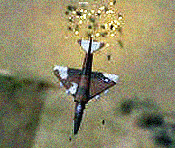
Five-hundred delegates from 122 countries converged on New Zealand this week in a bid to rid the world of cluster bombs. In the end, though only 82 states signed the Wellington Declaration -- the draft of a treaty to ban cluster bombs, sweep lands free of them, and assist survivors -- the conference was a qualified success.
New Zealand Disarmament Minister Phil Goff informed the Associated Press that more progress toward banning cluster munitions was made in the five days of talks than during five years of U.N. negotiations. Even Jody Williams, 1997 Nobel Peace Prize winner for her work leading to the ban of land mines, told ABC in Australia, "We're extremely pleased by the outcome of the conference."
Earlier, though, she accused representatives of Australia Britain, Canada, France, Germany, and Japan of "fronting for the U.S." She feared they might neuter the proposed agreement to make it palatable for the US, which, along with Russia, China, and Israel, shunned the conference.
That leads us to our first question: Doesn't zeroing in on a particular bomb assume that others are acceptable? Why not go to the root of the problem and work to prevent the conflicts -- or even all war?
Because submunitions (miniature bombs nested inside the mother bomb) dropped by the US in Iraq, "some shaped like tiny bottles with short ribbons and others that are yellow with tissue parachutes, litter gardens and roof tops," according to UNICEF. The cute little "bomblets," as they've been called, are child magnets.
Such as 11-year-old Afghan, Soraj Habib, who, after picking one up, lost both legs. Now 16, he offered himself up to the delegates at Wellington as living proof of the need to ban the cluster munitions.
Banning them may only be a stop-gap measure until war can be averted. But any opportunity to reduce the killing of children, their mothers, and all civilians, needs to be seized, like yesterday.
But isn't the campaign against cluster bombs just a cover for those opposed to Israel? While we're at it, why does Israel always get singled out for using them against Lebanon?
Heidemarie Wieczorek-Zeul, a minister in Angela Merkel's German government, was one who felt the sting of being labeled an anti-Semite. After referring to the cluster bomb as "a sort of lethal piñata," she asked the United Nations to investigate its use by Israel in civilian areas of Lebanon.
Israel, in fact, showered Lebanon with four million submunitions, one million of which may remain scattered across the landscape. Live, they constitute what's been called a landmine-like contamination.
Do cluster bombs really pose as grave a danger as land mines?
"There is a common misperception that cluster munitions are sophisticated weapons," writes Stephen D. Goose in the recent Arms Control Today. Representing Human Rights Watch and the Cluster Munition Coalition, he was also an organizer of last week's conference (as well as Jody Williams's husband). Neither the bomb nor the submunitions, Goose explains, are precision guided.
In fact, it's not well known, but, besides Lebanon, they caused more civilian casualties than any other weapon during the NATO bombing of Kosovo in 1999 and our invasion of Iraq.
Just how widespread is their use and manufacture?
(Note: You can view every article as one long page if you sign up as an Advocate Member, or higher).






