


"The idea that there's a military solution is absolutely bonkers."
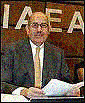
-- Mohamed ElBaradei
When you hear a word like "bonkers" coming from the mouth of a Nobel laureate, you know he's at wit's end.
The head of the International Atomic Energy Agency (IAEA) is not the only one afraid the US will attack Iran. Even some Republicans are on red alert. According to a resolution Representative Walter Jones (NC) has introduced to the House, it's "crystal clear" that the authority Congress granted the administration to wage war on Iraq wasn't one-size-fits-all. If Bush & Co. want to attack Iran, they've got to fill out new forms and go to the back of the line again.
Nor does much of the Pentagon have the stomach for it, as reported by The Times of London, with a handful of admirals and army generals considering resigning in the face of a preemptive strike by the US. But it wouldn't be the first time the military is dragged kicking and screaming into war. Besides, the Air Force, as usual, is down with bombing.
Just for argument's sake, let's give the administration one last benefit of the doubt. Is attacking Iran really all that "bonkers"?
After all, Iran has just received a failing grade from the International Atomic Energy Agency (IAEA) for defying the UN Security Council's demands that it cease uranium enrichment. Though no smoking gun has been found, even David Kay, the weapons inspector who gave Iraq a clean bill of health, affirmed that the "clandestine and very difficult-to-penetrate nature" of Iran's nuclear work "leaves no doubt that it is designed for a nuclear-weapons program." (The Atlantic Monthly)
Then there are the charges it's shuttling "explosively formed penetrators" used in constructing IEDs (improvised explosive devices) to Iraq. It may not be true, but, repeated often enough, it insinuates itself into the good graces of the public. Heck, we've all been wondering what a country that's sitting on a sea of oil needs nuclear energy for anyway.
Why, it's almost as if Iran were invented for Dick Cheney's "one-percent doctrine." You know, the one that mandates US action against a threat even if it's only one percent likely to materialize. Maybe we shouldn't be too hasty to let our horror at the Iraq war poison our minds about an attack on Iran. We don't want to cut off our nose to spite our face, do we?
But if wishes were horses, beggars would ride. Iran may have a dream, but its uranium enrichment program is besieged by technical problems. Since the smuggling operation of Pakistan's dirty old nuclear man, A.Q. Khan, was busted, Iran has no outside help.
Even more damning to the administration's case is that, under Article IV of the Nuclear Non-Proliferation Treaty (to which Iran is a party), Iran has an "inalienable right" to develop nuclear energy for peaceful purposes. This continues to elude the media, to which "uranium" is interchangeable with "the Bomb." But uranium is as integral to nuclear energy as it is to nuclear weapons. In fact, preventing the enrichment of uranium is in itself a violation of that article.
Besides, Iran really does perceive a need for nuclear energy. Turns out its supply of oil is neither endless nor is it making the country rich. Iran sells much of it abroad and instead of using that revenue to fund new drilling projects, it spends it on state-supported firms to employ its restive, young citizens. In addition, the price of gas Â?- 35 cents a gallon -- not only acts as an opiate for the masse, it does nothing to discourage depleting the country's oil supply.
Scenes from a Dysfunctional, Triangulated Relationship
But are nuclear weapons really at the heart of our beef with Iran? After all, the administration is cavalier about the nukes of other states, notably North Korea, which it's trifled with, alternately threatening, ignoring, and using it to score a diplomatic coup. In fact, preventing Iran from developing nuclear weapons is secondary to "regime change" for Bush & Co. Though their motives for that are probably as muddled to themselves as anyone else.
Counted among them, though, must be punishing Iran for funding those Hezbollah upstarts, not to mention paying back the mullahs for the 1980 hostage crisis. Besides, as long as Iran has oil, the administration wouldn't mind a new regime with which it could sign an oil law, as with Iraq, that gives foreign oil companies "national treatment." In other words, they'd be on equal footing with the National Iranian Oil Company. The new regime would also deal all of its oil in dollars, not partly in euros like Iran does.
Ironically, Iran's nuclear program traces its origins back to President Eisenhower's Atoms for Peace program. After the Shah signed the nuclear Non-Proliferation Treaty (NPT), the US offered to sell him nuclear reactors with fuel and lasers capable of enriching uranium not just for peaceful purpse but to the point of weapons grade. Who was the driving force behind that bright idea? Then Secretary of Defense Donald Rumsfeld. But due to the 1979 revolution, the deal failed to materialize.
It wasn't until 2002 that Iran announced a new nuclear power program. It declined, however, to inform the International Atomic Energy Agency that construction of its main plant in Natanz was already underway. Since nuclear material had yet to be introduced, though, no violation of the NPT had been committed.
Still, the State Department reacted to satellite footage of the site shown on CNN by accusing Iran of trying to develop nuclear weapons. In other words, it leapfrogged right over uranium enrichment for peaceful purposes straight to nuclear weapons.
Also, the Safeguards Agreement section of the NPT, intended to ensure nuclear energy was used solely for peaceful purposes, suddenly wasn't enough for the IAEA. While confirming Iran's right to enrich uranium, ElBaradei asked it to sign an "Additional Protocol" that called for inspections both instant and of undeclared facilities.
Thus can we see the IAEA's pattern of placating the US beginning to take shape. In all fairness, though, it didn't want Iran to become another Iraq and compile a nuclear weapons program under its nose.
Predictably, Iran, clinging to its rights to bar inspectors from sensitive military installations, as well as to enrich uranium, chafed. As time went on, it used various techniques to nickel and dime the IAEA. Examples include failing to report uranium which it had obtained from China and weaving and bobbing over its facilities in Kalaye, Lavian-Shian, and Parchin.
In October of 2003, John Bolton accused Iran of engaging in a "massive and covert" effort to acquire nukes. He was also the source of the table-talk, as in: "Every option remains on." Then Israel's Mossad got into the act, claiming that Iran was close to the "point of no return."
ElBaradei responded to US insistence that he use his ambiguous findings to refer Iran to the UN for sanctions by intensifying investigations just to keep the pressure at bay. For example, he began to obsess about the possibility that Iran was extracting polonium, sometimes used in nuclear weapons, from bismuth. However, Iran had informed the IAEA in 2003 that it was intended for use in a nuclear battery, not a weapon -- and the experiment had ended in 1991!
But the IAEA's inability to pinpoint Iran's nuclear program is a minor obstacle to the administration's dream of regime change, according to Scott Ritter in his book "Target Iran." He writes that, as far as Bush & Co. are concerned, "It's up to the Iranians to prove that one doesn't exist." How, Ritter wonders, can Iran, or anyone, prove a negative?
Iran finally agreed to halt uranium enrichment in November of 2004 under the terms of the Paris Agreement negotiated by the EU-3 (the UK, France, and Germany). But it continued to construct a centrifuge "cascade." You may have wondered what that picturesque term means -- especially since the destiny of mankind seems to hang on such technical matters. Imagine sending uranium on a series of whirling Orbitron rides in an amusement park. Each one further distills sediment sifted out in the previous stage.
A Double Standard Times Three
Even though the US already had ElBaradei dancing as fast as he could, it was fed up with his continued insistence on Iran's right to enrich uranium for peaceful purposes. Also in 2004, Bolton ordered communications between ElBaradei and Iran intercepted in hopes of discovering evidence that would incriminate him and block him from a third term in office. Disgracing the US in the process, he came up empty-handed.
Meanwhile, between Bolton and the bunker busters that the US sold Israel at that time, the EU-3 was in no mood to acquiesce to US pressure to refer Iran to the Security Council. The US then proceeded to Plan B -- what nuclear terrorism expert Graham Allison calls "the dog that hasn't barked": proving the existence of a nuclear weapons program outside sites known and inspected.
Again, despite satellites and the help of both Israeli intelligence and the MEK (Mujahideen al-Khalq) -- the Iranian anti-ruling-mullahs group so beloved by the administration -- the US drew another blank. Yet, in August 2005, the IAEA compromised its objectivity by designating Iran a "special verification case." That was a nice way of telling Iran it was being made an example of.
Then Iran's President Ahmadinejad blithely predicted Israel would be disappeared from the pages of history. In turn, Israeli intelligence provided the US with diagrams of an Iranian warhead which the US optimistically spun as nuclear. In February 2006, without hard evidence of a nuclear program, the IAEA referred Iran to the Security Council for sanctions. Two days before Christmas, they were passed.
That the sanctions were fairly toothless might have been a reflection of the weakness of the IAEA's case. In an attempt to shore it up, the US presented the charges about the IED parts. But in another Most Embarrassing Moment (if the administration had any shame, that is), Joint Chiefs of Staff Chairman Peter Pace piped up. He didn't think that just because bomb materials from Iran were found inside Iraq meant that the Iranian government was responsible. Don't these people talk to each other?
Even if Iran were to meddle in Iraq, it would only be following what CIA legend Milt Bearden told Harper's were the "time-honored rules" of proxy wars. For instance, if Russia had disregarded them, it would have attacked the US when Bearden personally outfitted the mujahadeen in Afghanistan. In essence, the US holds Iran to three double standards: no nuclear weapons, no uranium enrichment for peaceful purposes, and no proxy wars.
But Iran has abided by the Additional Protocol, offered to help the US track Al Qaeda after 9/11, and attempted to engage the US in one-to-one talks in 2003. Between the two, Iran is clearly the more rational -- well, less irrational -- actor.
Of course, if Iran responds to our provocative presence in the Persian Gulf by launching a missile at one of our carriers, Congress will likely trample the likes of Rep. Walter Jones in its rush to vote to authorize an attack.
But, aside from the obvious -- allowing Iran to enrich uranium Â?- a Congress less insecure about its defense credentials would ease the sanctions and offer concessions as we did to North Korea. Then, instead of persecuting Iran, as opposed to prosecuting it, which would require real evidence, why not change the law to head future crises off at the pass?
Close the troublesome loophole in the NPT: Write an amendment which forbids members that don't yet have nuclear energy from enriching uranium. Grant them the right to buy enriched uranium for peaceful purposes from nuclear NPT states.
With the advent of Peak Oil, dreams of a world free of nuclear energy are fading. But, just like nuclear weapons, nuclear disarmament looms over us like a specter. They both wreak havoc with our peace of mind -- the first a threat to our existence, the second to our consciences.
Meanwhile, the nation's two leading nuclear laboratories compete for a contract to build the Reliable Replacement Warhead, designed to lower the odds of accidental or unauthorized detonation. Worse, the administration is now armed with the Doctrine for Joint Nuclear Operations, which paves the way for the preemptive use of nuclear weapons -- and it's just itching to try out those tactical nukes.
But, like it or not, nuclear disarmament is the only way to build a foundation for genuine and long-lasting national security. At some point, we have to admit that as long as we flaunt the NPT by failing to draw down our nukes, states like Iran will remain infantilized in a perpetual state of "It's not fair."
Now let's play "find the flaw in the logic." Upon refusing to meet the Security Council's Ash Wednesday deadline for halting uranium enrichment, Ahmadinejad said, "But justice demands that those who want to hold talks with us shut down their nuclear fuel cycle program too." Logic be damned Â?- to the administration, if it's Ahmadinejad, it must be an outrage.
The good will the US would accrue by ratifying the Comprehensive Test Ban Treaty for starters can only be matched by abandoning our designs on the Middle-East. Until then, states will not only be blinded by their fear and envy of our nuclear program, both peaceful and weaponized, but they'll find us too hypocritical to trust.
Meanwhile, we wait to see if the US and Iran go for a compromise proposal tendered by the Swiss to allow "dry enrichment" (suspension of uranium enrichment, but not centrifuge operations). In the interim, let's end where we began, with the words of the embattled ElBaradei:
"We must abandon the unworkable notion that it is morally reprehensible for some countries to pursue weapons of mass destruction yet morally acceptable for others to rely on them for security -- and indeed continue to refine their capacities and postulate plans for their use."


 62 62
  
Greatest Expectations |
|
| Rate It | View Ratings |
Russ Wellen Social Media Pages: 


Russ Wellen is the nuclear deproliferation editor for OpEdNews. He's also on the staffs of Freezerbox and Scholars & Rogues.
"It's hard to tell people not to smoke when you have (more...)
The views expressed herein are the sole responsibility of the author
and do not necessarily reflect those of this website or its editors.




OpEdNews depends upon can't survive without your help.
If you value this article and the work of OpEdNews, please either Donate or Purchase a premium membership.
STAY IN THE KNOW
If you've enjoyed this, sign up for our daily or weekly newsletter to get lots of great progressive content.
If you've enjoyed this, sign up for our daily or weekly newsletter to get lots of great progressive content.
Most Popular Articles by this Author: (View All Most Popular Articles by this Author)
Foxy Knoxy and the Case of the Honorary Missing White Woman
You All Know Hanoi Jane, Now Meet Tehran Todd
What's It Like Waiting Around to Be Bombed?
School, Mall and Workplace Shootings: Why So Many?
Is a Preemptive Strike Ever Justified?
To View Comments or Join the Conversation:
