




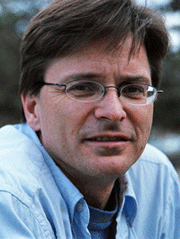

Remarks to the second "Last Sunday" community gathering in Austin, TX, December 29, 2006. http://thirdcoastactivist.org/lastsunday.html
I've been assigned to talk about solutions to the pressing problems we face, but I've never been very good at following orders. So, instead I'm going to talk about the problem with solutions.
The assignment came from our first "Last Sunday" event in November, which we hoped would bring together the secular and spiritual, the political and the social. The standing-room-only audience generated a lot of positive energy that night, but that doesn't mean the event -- or the ideas animating it -- were immune from criticism. And, this being Austin, we heard from lots of folks about what they thought those shortcomings were.
Two consistent themes emerged from the feedback, captured in this suggestion card:
"Don't spend so much of our precious time telling us about the problems. We already know (most of) the problems. Instead, spend more time telling us about solutions that we, as individuals, and as a group, can do. We are looking for HOPE. Show us how we can be part of the solution."
"We already know the problems -- tell us about solutions."
Over and over I've heard that, not just after Last Sunday, but ever since I started doing political organizing. While I understand the sentiment, I want to suggest that the first claim is inaccurate, and the second request is dangerous.
First, we -- not just the so-called "masses" out there, but we in here -- have not yet fully grasped the nature of the problems we face. Second, as we are struggling to come to terms with the depth of those problems, we have yet to face the fact that there are no solutions. In other words: (1) None of us is as smart as we would like to think, and (2) as we start to recognize our own collective ignorance, we will have to face not just what we can do but what we can't.
Perhaps paradoxically, that is where I find hope -- in facing honestly the condition of the world that we have desecrated and the limits of human intelligence to reconsecrate that world. It is only from those realizations, I believe, that meaningful action is possible.
When I say we don't know the problems, I don't mean we aren't aware of what is plainly in front of us: Disastrously destructive wars in Iraq and Afghanistan, a house-of-cards economy, enduring racism and sexism, cascading ecological crises, and a corrosive culture that values profit over people. But how deep does our analysis go? How well do we really understand the inherent pathology of capitalism and patriotism? How many of us have dared to stare down the ugliness and raw brutality at the core of white supremacy and patriarchy?
And have we honestly assessed the tension between those aspects of our human nature (our capacity for greed and violence) that created those problems and those aspects (our capacity for solidarity and love) that make transcending these problems possible? As the song goes, "all you need is love," but the problem is we also have a lot more than love swirling around in each of us.
We have to face the fact that we are a species that has, in the words of Wes Jackson, gotten very good at exploiting the energy-rich carbon in this world's soils, forests, and fossil fuels to enrich ourselves at the expense of others. That's part of human nature. Now we have to do what no other species has had to do -- self-consciously practice restraint at what we do best in such bad ways. That is no small task, but our ability to name that task and imagine accomplishing it also is part of human nature.
If we all really understood the problems in this sense, we might not be so quick to demand solutions -- if by that term we mean clear public-policy choices that can be implemented in the relatively short term. Such a yearning for short-term solutions is, I believe, the best indication that one hasn't come to terms with the depth of the problems.
Take the problem of oil -- both that we are running out and that burning what's left will accelerate rapid climate change. A demand for solutions can lead to the corporate boondoggle of corn-based ethanol or the hazy illusions around biodiesel, instead of helping us face a more troubling reality: There is no viable alternative to petroleum for a car-based transportation system that it is fundamentally unsustainable. What are the possible "solutions" to that "problem," which we all allegedly know about, other than to radically curtail the way we move ourselves about?
This doesn't mean there's nothing we can do. It doesn't mean there aren't things we should do. There are actions we can take, and we have to work hard to make sure we take the best possible actions to try to reverse the direction of a world headed for the cliff. In the realm of portable liquid fuels, economically and ecologically it's clear that corn-based ethanol is a loser that should be abandoned, while biodiesel has limited possibilities that should be pursued, but realistically. But as we pursue those "solutions," we also have to face a fact: There are no solutions that will allow us to continue to live this way. There is only the struggle to find something new, with no guarantees we will find our way.
Why press such a seemingly dour scenario? Because anything else is illusion, and illusions can never carry us home. Illusions inevitably fall away, leaving people feeling abandoned, depressed, and hopeless. Illusions are not practical.
Ruthlessly rejecting illusions is not the same as giving up hope. But we have to be clear that hope isn't something to be found out in the world; it's a feature of our humanity that each of us has to either claim or abandon. It's a state of being, not a function of the state of the world.
When I make this argument, I am often told that illusions are necessary, that people can't handle this level of honesty. I take that to mean that the person making this judgment about other people's limitations actually is really saying "I need my illusions because I can't handle this level of honesty." I say that with no arrogance, knowing how I struggle to handle it.
The only way I can keep up that struggle is collectively, in community, through conversation. That's what Last Sunday is about. We did not create this space to pretend that those of us on stage know all the right questions, let alone the answers. We have no solutions to offer. Instead, we offer an invitation and an invocation, a place and a space -- and, okay, yes, we offer our sense of hope, of what can come from coming together.
But that hope must begin with honesty. Here's my honest statement:
I stand before you in a profound state of grief for the state of the world. For me, Last Sunday is about creating a place to feel that, honestly. Last month, Jim Rigby quoted the anarchist Emma Goldman on the subject of joy in politics, reminding us that we should reject any revolution in which we can't dance.
But just as important, I won't be part of any revolution in which I can't cry. I think we have to recognize this grief. We have to demand that the revolution be one in which we not only can dance, but cry as well.
One of my favorite writers, Wendell Berry, talks of coming to terms with "the human estate of grief and joy." What an apt way to describe the essence of what it means to be human. When we face honestly our place in the world, we recognize the need to cry and to dance. We recognize that each requires the other.
Last Sunday, whatever else it may be, is the attempt to name that estate honestly, to claim that estate responsibly, to remind ourselves of how much work we have to do if we are to live there with hope.
I've been assigned to talk about solutions to the pressing problems we face, but I've never been very good at following orders. So, instead I'm going to talk about the problem with solutions.
The assignment came from our first "Last Sunday" event in November, which we hoped would bring together the secular and spiritual, the political and the social. The standing-room-only audience generated a lot of positive energy that night, but that doesn't mean the event -- or the ideas animating it -- were immune from criticism. And, this being Austin, we heard from lots of folks about what they thought those shortcomings were.
Two consistent themes emerged from the feedback, captured in this suggestion card:
"Don't spend so much of our precious time telling us about the problems. We already know (most of) the problems. Instead, spend more time telling us about solutions that we, as individuals, and as a group, can do. We are looking for HOPE. Show us how we can be part of the solution."
"We already know the problems -- tell us about solutions."
Over and over I've heard that, not just after Last Sunday, but ever since I started doing political organizing. While I understand the sentiment, I want to suggest that the first claim is inaccurate, and the second request is dangerous.
First, we -- not just the so-called "masses" out there, but we in here -- have not yet fully grasped the nature of the problems we face. Second, as we are struggling to come to terms with the depth of those problems, we have yet to face the fact that there are no solutions. In other words: (1) None of us is as smart as we would like to think, and (2) as we start to recognize our own collective ignorance, we will have to face not just what we can do but what we can't.
Perhaps paradoxically, that is where I find hope -- in facing honestly the condition of the world that we have desecrated and the limits of human intelligence to reconsecrate that world. It is only from those realizations, I believe, that meaningful action is possible.
When I say we don't know the problems, I don't mean we aren't aware of what is plainly in front of us: Disastrously destructive wars in Iraq and Afghanistan, a house-of-cards economy, enduring racism and sexism, cascading ecological crises, and a corrosive culture that values profit over people. But how deep does our analysis go? How well do we really understand the inherent pathology of capitalism and patriotism? How many of us have dared to stare down the ugliness and raw brutality at the core of white supremacy and patriarchy?
And have we honestly assessed the tension between those aspects of our human nature (our capacity for greed and violence) that created those problems and those aspects (our capacity for solidarity and love) that make transcending these problems possible? As the song goes, "all you need is love," but the problem is we also have a lot more than love swirling around in each of us.
We have to face the fact that we are a species that has, in the words of Wes Jackson, gotten very good at exploiting the energy-rich carbon in this world's soils, forests, and fossil fuels to enrich ourselves at the expense of others. That's part of human nature. Now we have to do what no other species has had to do -- self-consciously practice restraint at what we do best in such bad ways. That is no small task, but our ability to name that task and imagine accomplishing it also is part of human nature.
If we all really understood the problems in this sense, we might not be so quick to demand solutions -- if by that term we mean clear public-policy choices that can be implemented in the relatively short term. Such a yearning for short-term solutions is, I believe, the best indication that one hasn't come to terms with the depth of the problems.
Take the problem of oil -- both that we are running out and that burning what's left will accelerate rapid climate change. A demand for solutions can lead to the corporate boondoggle of corn-based ethanol or the hazy illusions around biodiesel, instead of helping us face a more troubling reality: There is no viable alternative to petroleum for a car-based transportation system that it is fundamentally unsustainable. What are the possible "solutions" to that "problem," which we all allegedly know about, other than to radically curtail the way we move ourselves about?
This doesn't mean there's nothing we can do. It doesn't mean there aren't things we should do. There are actions we can take, and we have to work hard to make sure we take the best possible actions to try to reverse the direction of a world headed for the cliff. In the realm of portable liquid fuels, economically and ecologically it's clear that corn-based ethanol is a loser that should be abandoned, while biodiesel has limited possibilities that should be pursued, but realistically. But as we pursue those "solutions," we also have to face a fact: There are no solutions that will allow us to continue to live this way. There is only the struggle to find something new, with no guarantees we will find our way.
Why press such a seemingly dour scenario? Because anything else is illusion, and illusions can never carry us home. Illusions inevitably fall away, leaving people feeling abandoned, depressed, and hopeless. Illusions are not practical.
Ruthlessly rejecting illusions is not the same as giving up hope. But we have to be clear that hope isn't something to be found out in the world; it's a feature of our humanity that each of us has to either claim or abandon. It's a state of being, not a function of the state of the world.
When I make this argument, I am often told that illusions are necessary, that people can't handle this level of honesty. I take that to mean that the person making this judgment about other people's limitations actually is really saying "I need my illusions because I can't handle this level of honesty." I say that with no arrogance, knowing how I struggle to handle it.
The only way I can keep up that struggle is collectively, in community, through conversation. That's what Last Sunday is about. We did not create this space to pretend that those of us on stage know all the right questions, let alone the answers. We have no solutions to offer. Instead, we offer an invitation and an invocation, a place and a space -- and, okay, yes, we offer our sense of hope, of what can come from coming together.
But that hope must begin with honesty. Here's my honest statement:
I stand before you in a profound state of grief for the state of the world. For me, Last Sunday is about creating a place to feel that, honestly. Last month, Jim Rigby quoted the anarchist Emma Goldman on the subject of joy in politics, reminding us that we should reject any revolution in which we can't dance.
But just as important, I won't be part of any revolution in which I can't cry. I think we have to recognize this grief. We have to demand that the revolution be one in which we not only can dance, but cry as well.
One of my favorite writers, Wendell Berry, talks of coming to terms with "the human estate of grief and joy." What an apt way to describe the essence of what it means to be human. When we face honestly our place in the world, we recognize the need to cry and to dance. We recognize that each requires the other.
Last Sunday, whatever else it may be, is the attempt to name that estate honestly, to claim that estate responsibly, to remind ourselves of how much work we have to do if we are to live there with hope.






