


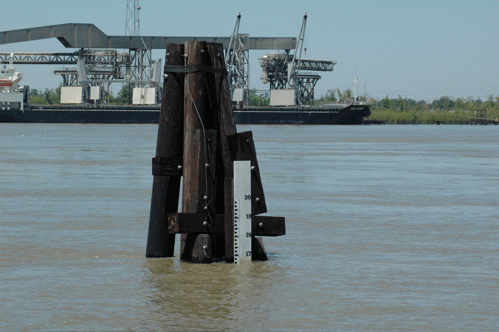
Water stalks southern Louisiana like a panther seeking its prey. Hurricane Katrina was the kill, but the water never relents—always moving, sometimes retreating, forever on the move. This week the National Weather Service issued a flood warning for New Orleans as record snow melts and spring rains flowed into the Mississippi River Basin. Feeding on strong northerly winds that carried record cold into the delta, rapid river crests are expected north of Baton Rouge in Greenville and Vicksburg. The choreography of the hunt reached perfection with a southerly shift in the winds and increased tidal flow in New Orleans, pushing and squeezing the water to “official” flood stages.
On Tuesday April 15, the Carrollton gauge at the Army Corps of Engineers office on Leake Avenue in midtown was inching toward 16.5 feet. New Orleans has an official flood stage of 17 feet, but the floodwalls and levees protect the city to over 20 feet, providing the winds and the rain and the flow cooperate.
In St. Mary Parish where I live today, minor flooding has occurred on the waterfront in Morgan City because of rising water in the Atchafalaya. So far so good, and the floodgates are keeping the worst of the water out of the infrastructure. The Atchafalaya is expected to crest on April 22. We will see. This writer loves this place and the people here make me feel at home. I’m here for the duration to tell their stories. Parts of this article were published in the Huffington Post, but OPED feels like home, so I wanted to share this story with all of you. Plus, these people can use all the help and attention we can muster.
I realize I have written that we should not demonize the river, and that is not my intent. People have lived here for hundreds of years because of the good things the river has to offer. However, our modern society has turned its back on the people and industries that have made a comfortable life in Los Angeles, Chicago, and New York possible. Port Fourchon in Lafourche Parish is the biggest oil port in the United States. The major pipelines that supply all of you readers run smack dab through this area, and South Louisiana is called “cancer alley” for good reasons, which I intend to write about.
There is a “pretty” video about the port, that is industry public relations, available here. Still, use critical thinking when you view this and you will get a good idea of how the United States relies upon this port and how the people here are terribly exploited. I think I like living here because I am in a state of permanent culture shock and it truly reminds me of the third world. To put it simply, I am in love with this area as much as I love Africa.
The Corps of Engineers caught a lot of flack in the aftermath of Katrina, but there is another story of regular men and women doing a day to day job of maintenance and observation that gets overlooked in the flurry of media attention to the disaster—meaning the disaster that was Katrina—an epic victory for the water which will forever haunt this area. Attention spans are short, both in the halls of Congress and in the mainstream media—but the water does not yield.
Chris Accardo’s office overlooks the Mississippi and the Carrollton flood gauge. Forty one percent of the nation’s water flows past his window. Only the mighty Amazon and Congo Rivers have bigger watersheds. It’s his job, as Chief of the New Orleans District Operations to make sure that the spring water flow does not exceed 1.25 million cubic feet per second. For some perspective on what that amount of flow means—it would fill the Super Dome in one minute and forty seconds, according to published estimates. Accardo’s fallback for now is the Bonnet Carre' Spillway, which has an elaborate system of floodgates. As of April 16, 90 gates are open now, with more in reserve.
This is the first time in eleven years that Bonnet Carre’ was asked to do her job. The spillway is located 28 miles above New Orleans in St. Charles Parish. It was designed to manage approximately 1.9 million gallons of water per second. The decision to open Bonnet Carré is the responsibility of Mississippi River Commission.
Major Tim Kurgan, Corps media rep for the New Orleans’ office, joined us for a conversation about the levee system, what’s happening real time with the water flow, and the competing interests, which make flood management a decidedly dicey proposition.
There are actually two levee systems that protect human interests from nature’s predation. The river levees, designed for high river events, held during Katrina, and have always held. They are expected to hold now, during what is expected to be a ten-year very high water event, albeit one that is spooking the area less than three years post Katrina.
Accardo is confident, but not cocky.
“We expect to be able to deal with this high water event and respond to any problems that may arise,” he says.
“Louisiana was given billions for hurricane protection after Katrina, but those funds were for hurricane protection levees. The levees that we are relying upon for high river events are not covered by that money. The river levees are in better shape than the hurricane protection levees, and therefore do not require the amount of funds as the hurricane protection system.”
“Northern Congressmen don’t understand that we have two systems of levees down here. They don’t want to keep throwing money down here when they have constituents up in their districts who have other projects in mind,” Accardo added as his eyes scanned the expanse of river a hundred feet outside of his windows.
Accardo and Kurgan talked about a maintenance budget for the river levees that is essentially “flatlined.” How did this happen?
Georgianne Nienaber is a writer, author, and investigative journalist. She lives in the world. Her articles have appeared in The Huffington Post, SCOOP New Zealand, Glide Magazine, Rwanda's New Times, India's TerraGreen, COA News, ZNET, OpEdNews, The Journal of the International Primate Protection League, Friends of the Congo, Africa Front, The United Nations Publication, A Civil Society Observer, and Zimbabwe's The Daily Mirror. Her fiction exposé of insurance fraud in the horse industry, Horse Sense, was re-released in early 2006. Gorilla Dreams: The Legacy of Dian Fossey was also released in 2006. Nienaber spent much of 2007 doing research in South Africa, Rwanda and the Democratic Republic of Congo. She was in DRC as a MONUC-accredited journalist, and recently spent six weeks in Southern Louisiana investigating hurricane reconstruction. She is currently developing a documentary on the Gulf of Mexico DEAD ZONE.
...is that the "Hurricane Cowboy" and "Fuck you, Dick Cheney" are still in charge this hurricane season. They are no more prepared for this disaster than they were for Katrina. Be prepared to help your fellow American. We are all we have. And remember: You are only as well off, ultimately, as your neighbor. His/her disease becomes yours. His/her decay of property becomes yours. Homage to Spike Lee: Do the right thing.
by
Amanda Lang (22 articles, 13613 quicklinks, 431 diaries, 579 comments)
on Thursday, April 17, 2008 at 9:15:11 PM
This well written article makes it clear - though author Georgianne Nienaber never really states - that those who live and/or operate businesses in the flood basin of the Mississippi River are putting themselves at risk. The question that is rarely ever asked - and not here either - is why don't those individuals pay for the risk themselves rather than expect a "flood rescue, grant or subsidy". Such flood control, rescue and rebuild money coming from government is always taken from taxpayers, many if not most who do not live in the area and do not have property at risk of flooding. The Mississippi may represent 43% of the continental US water flow, but that does not mean that everyone living in the US is obligated to pay to control that water and pay the damages to those who choose to live in its path.
If individuals want to live and do business in an area that is at risk for floods - or any other occurrence of nature - then it behooves them to cooperatively find ways to finance their own potential loss. That is what insurance companies are all about. The higher the statistical risk, the higher the premiums paid by the insured to the insurance companies so that the money is there when and if the risky event does take place. Also, the flood control measures should be paid for by those *in* the flood plain who want to be protected.
If the insurance companies owned the flood control mechanisms, I am confident that they would make sure that these were always in working condition - to not do so would cost the company money. (As it is now, the government has little incentive since taxpayers always exist from whom to get more money....) And if someone did not purchase insurance but, rather, freeloaded for the flood control protection on those who did pay premiums, I recommend that their names be made public for social preferencing purposes. And of course they would not be covered for damages if a flood actually occurred.
Insurance company ownership of the flood control mechanisms would also be an incentive (better than current governments) for minimizing damage as a whole, since the same or different companies would have a market to insure against other risks.
**Kitty Antonik Wakfer
MoreLife for the rational - http://morelife.org Reality based tools for more life in quantity and quality Self-Sovereign Individual Project - http://selfsip.org Self-sovereignty, rational pursuit of optimal lifetime happiness, individual responsibility, social preferencing & social contracting
by
Kitty Antonik Wakfer (19 articles, 3 quicklinks, 7 diaries, 116 comments)
on Friday, April 18, 2008 at 5:15:10 PM
An Ad for your company? I failed as a writer, then
I am not sure where you are coming from, but I notice that your bio photo was taken on the water. You must enjoy the recreational opportunities it provides.
Southern Louisiana culture developed after the Acadian Diaspora, and the native population and Portuguese were here before that. The people who have lived here for generations rely upon the river for a living, and I was trying to get that across in this article. It is a way of life that existed well before you were born and developed your philosophy of "life extension and liberty."
I obviously failed in a big way.
The Army Corps of Engineers wrecked the Mississippi Delta with the Old River Control Flood project. Right now, people are afraid that if they open that spillway, the Atchafalaya will back up to hell and back. It is a separate structure from the Bonnett Carre.
The River control system is separate from the hurricane protection system. The flood now is (hopefully) being held in check by the river control system, which did hold during Katrina. That does not exempt the Army Corps from the environmental disaster that control system has wrought, or from the deaths, destruction and displacement that occurred during Katrina when the hurricane protection levees failed. These are separate and very complicated issues.
I just drove home through a rainstorm and the river and bayous are looking ugly.
This piece was an attempt to provide a snapshot of one day in the life of delta dwellers. It was not meant as an apology for the Army Corps of Engineers, and my previous work would make this obvious, but I should not assume that anyone has read Baghdad on the Bayou.
Then again, perhaps I did my job because comments have ranged (through email and otherwise) from what you read here to "gee, you really abandoned New Orleans."
I gotta think this over, figure out where I have failed and once again try to paint an accurate portrait of the rich culture that is being exploited and depopulated down here.
Please reference click here If I gave anyone an opening to continue the politics of disaster capitalism on the Mississippi Delta I am truly sorry, apologetic, and ready to get the sword arm back in action.
I miscalculated the mission, which was to humanize the situation down here.
by
Georgianne Nienaber (145 articles, 46 quicklinks, 13 diaries, 337 comments)
on Friday, April 18, 2008 at 7:30:37 PM
You didn't fail, you were misunderstood. Anyone who has read your work and knows of your dedication and passion in accurately telling the story of those whose lives have been devastated, can follow your logic and chain of events, and the indisputable facts that surfaced from the bowels of the Katrina catastrophe.
If getting angry, angrier, will get you to keep this tragedy in the light, when by all accounts, it has faded to shameful shadows, then do it. Don't apologize or feel you've failed by a few misinterpretations.
Take your above comments and post it as a follow up article.
by
Jan Baumgartner (52 articles, 136 quicklinks, 10 diaries, 249 comments)
on Friday, April 18, 2008 at 8:24:41 PM
"[T]he mission, which was to humanize the situation down here", is an incomplete one. What good does it really do to simply point out - once again, though maybe in more poignant detail than other places - all the results of "disaster"? These were very graphically shown in actual videos at the time of Hurricane Katrina (and other "disasters"), though different individuals can and often are highlighted other times. What real long run benefit is it to these and others to induce hand wringing and even monetary contributions? Or worse yet, more government spending - obtained via more taxes and/or more government borrowing and/or government just printing more currency, the hidden taxation of inflation.
"How much money would create a perfect world for maintenance of the levee system?
"Accardo absorbs the question as if it makes no sense, and perhaps it doesn’t."
No, the question doesn't make much sense because there is no "perfect world", if that is supposed to mean a world in which there is absolutely no risk of a river like the Mississippi ever overflowing into its flood plain. But Congress will keep putting money into levees and other measures that may be of some benefit in some areas to some people under certain conditions - all coming from taxes taken from people whether or not they want these "services". Somehow the idea of private individuals providing a for-fee service of levees and other flood control measures appears to be anathema, but when its done with money taken under threat of physical force (financing for all government programs) then it's OK.... The aspect not addressed, as I stated previously, is that the people who live in the Mississippi River flood plain (or that of any other river) or in other locations where various destructive acts of nature occur more than rarely are putting themselves at risk. Just because an individual may have been born or moved there does not equate to him/her (hir) being forced to remain or at least to minimize hir risk for life and property loss. A self-responsible person does not take risks s/he is not prepared to cover hirself. (This goes for companies too.) When others simply make a charitable donation to someone who has been the victim of a natural disaster without determining what measures that person is planning to enact to minimize the likelihood of a repeat loss, those charity-givers are not encouraging self-responsibility. The question could be asked why this research isn't done. Do charity-givers derive some sort of feel-good satisfaction from "helping out" a steady supply of those who fall "victim" rather than encouraging the growth of a population of self-responsible individuals who stand on their own two feet?
There is a Chinese proverb, "Give a man a fish and you feed him for a day. Teach a man to fish and you feed him for a lifetime." The person who has learned "to fish" and does so, is being self-responsible. Simply giving hir "a fish" is being "charitable" and does little for the long run, unless accompanied by measures that promote the person getting "the fish" to do hir own "fishing" from that point on. (Social Preferencing is just such a method.)
I did not read anything in this article about measures to be taken by individuals currently living in flood plains to be self-responsible for their own lives and property (outside of filling some sandbags) OR by others to encourage the taking of such measures by current flood plain residents. Such an article would really be helpful because it would make clear to all the consequences of not being self-responsible. Is the fable of the grasshopper and the ant never read anymore??
**Kitty Antonik Wakfer
MoreLife for the rational - http://morelife.org Reality based tools for more life in quantity and quality Self-Sovereign Individual Project - http://selfsip.org Self-sovereignty, rational pursuit of optimal lifetime happiness, individual responsibility, social preferencing & social contracting
by
Kitty Antonik Wakfer (19 articles, 3 quicklinks, 7 diaries, 116 comments)
on Tuesday, April 22, 2008 at 2:28:16 AM
5 comments
How would you rate this?
You must be logged in (if signed up) to do ratings.
It's free to signup! And easy. And takes just a minute or two....

