







Part One:
Wasting America’s Wetlands
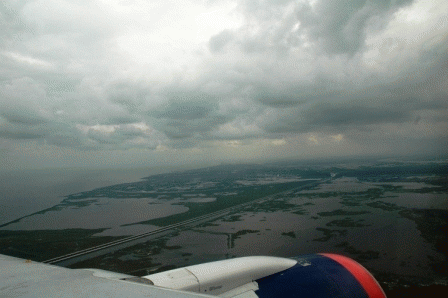
It was not a hurricane named Katrina that wrecked the city of New Orleans. It was, quite simply, a warfare economy and a sold-out government. It was shoddy pumps and levees, barges run amuck, strategic resources of petroleum and natural gas, environmental deregulation, too much rain, and the destruction of sponge-like barrier wetlands that once absorbed the storm surge. The hurricane was an act of nature, but such storms can no longer be separated from the politics and economics of corporate consumption that are driving the American “war on terror.” Katrina created a huge business opportunity for “government,” for multinational corporations and private profiteers.
New Orleans and the Gulf Coast have now joined the ranks of “Third World” countries—Iraq, Afghanistan, Sudan, Guatemala, Haiti, Somalia, Congo—suffering the shocks of America’s permanent warfare agenda. This global apartheid sanctions vicious actions toward subjects who resist. The people of New Orleans join the ranks of the homeless, indigenous people suffering genocide, the refugees and internally displaced and other victims of globalization—millions of people set adrift in a sea of nowhere, with no rights, no possessions, no protection and little prospect for survival.[1]
Disaster capitalism is showing its teeth in America, and the picture isn’t pretty.
It was not a hurricane named Katrina that displaced an entire population from the lower Ninth Ward of New Orleans. It was a flood of biblical proportions and a history of racism and elitism that created poverty and vulnerability in parallel with wealth and privilege. The storm followed decades of business as usual and a “war on terror” that set the stage for a rapid intervention project in urban and social re-engineering.
New Orleans Business Council chairman Jimmy Reiss was quoted in the Wall Street Journal as saying, "Those who want to see this city rebuilt want to see it done in a completely different way, demographically, geographically and politically."
FEMA—the Federal Emergency Management Agency—did not fail. As Louisiana’s local Cajun blues musician Tab Benoit told us, there was a plan and it was followed to perfection.[2] Homeland Security absorbed FEMA in 2001 and Homeland Security is not in the business of rescuing people.
After decades of injustice—born out of American slavery—the victims of the storm fell prey to an all-out military invasion involving aircraft carriers, Boeing Chinook and Sikorsky Blackhawk helicopters, M-1 Abrams battle tanks, M-2 Bradley fighting vehicles, amphibious assault ships, state-of-the-art weaponry, Blackwater mercenaries, U.S. Special Forces, and the special Bollinger “SWIFT”—the U.S. Navy’s interim Mine Warfare Command and Support catamaran.[3] High-tech military command and control centers were set up all over the place, some at Lockheed Martin facilities in the Gulf. [4]
They couldn’t get people out, but had no problems moving troops and weaponry in.
For most black people this was no rescue, it was a roundup, often at gunpoint.
According to the U.S. military, at least 60,000 active and reserve U.S. military troops deployed to New Orleans in response to Hurricane Katrina, “which affected tens of thousands of people in New Orleans and the Gulf Coast. [5]
Hurricane Katrina “affected tens of thousands” of people? Here is the Pentagon’s deceptive information warfare at work. The truth is that Hurricane Katrina affected hundreds of thousands of people in New Orleans alone. According to current numbers, at least 200,000 residents of New Orleans and some 500,000-700,000 people along the Gulf coast became “internally displaced persons”—refugees inside the borders of the United States of America.
Next Page 1 | 2 | 3 | 4 | 5 | 6 | 7 | 8 | 9 | 10 | 11 | 12 | 13
(Note: You can view every article as one long page if you sign up as an Advocate Member, or higher).






