






In November, 2005, in an act even Blackwater officials acknowledged as outright, “random negligence,” a Blackwater-guarded motorcade on its way to an Iraqi Oil Ministry basically demolished 18 civilian vehicles -- six on its way to the ministry, and another dozen during the return trip.
In December, 2006, a deeply intoxicated Blackwater contractor, apparently without provocation, gunned down a guard for Iraqi Vice President, Adil Abd-al-Mahdi and was quickly spirited out of the country by Blackwater.
On September 9 of this year, Batoul Mohammed Ali Hussein, a clerk in the Iraqi customs office in Diyala province, was killed when Blackwater security contractors responded to rock throwing with a barrage of automatic weapons fire into a crowded intersection. Witnesses reported a Blackwater guard shot Hussein repeatedly after she had struggled to her feet. Four other Iraqi civilians were killed in the incident.
In other incidents, each cited in State Department documents, Blackwater forces shot a civilian bystander in the head; sought to cover up a shooting that killed an apparently innocent bystander; and provided no assistance after a traffic accident caused by its "counter-flow" driving protocol left an Iraqi vehicle in "a ball of flames."
Then there was the recent widely publicized incident of September 16 this year, when a Blackwater contingent fired indiscriminately into a crowd killing anywhere between 11 and 17 Iraqi civilians, and wounding an additional 24.
These acts, brutish, savage, indeed violently deviant though they may be, are nevertheless among war's inevitable realities, we're often told. Indeed, it’s also been argued that such acts are perhaps more likely to be expected in wars waged against a guerilla-style insurgency which -- at least among many Iraqi insurgents -- transcends the material vestiges of the here and now. In these "unconventional" wars, the shadowy enemy one faces sees his effort as one of not just ridding his country of its invaders, but also as a means of attaining martyrdom.
Nevertheless, though well aware that the casualties of war accrue in a variety of manifestations, for more than a few Americans, the skittish and malevolent, trigger-happy attitude these incidents depict, come, like the Abu Ghraib scandal, as a complete shock.
Meanwhile, to anyone acquainted with the outré, turgidly cocksure, over-the-top personality type of the former Navy Seals, Special Ops-types, and other gung-ho para-militarists embodying the ranks of private militias wherever found, none of the extremes come as a surprise.
In fact, precisely because war is hell, one such type, Blackwater Worldwide founder and former Navy Seal Erik Prince, would like us to believe that his private, for-profit heavily-armed and equipped adjunct to the U.S. military, serves as a bulwark shielding the "civilized" of Iraq, namely: diplomats; Iraqi or foreign government officials; U.S. politicians; and, of course, well-heeled disaster capitalists, from the unfettered mayhem and the senses numbing carnage reported in places like Baghdad and Fallujah.
Prince insists that we view the role of his Blackwater contingent in Iraq -- none of whom are constrained in their actions by the Uniform Code of Military Justice; and each of whom enjoys complete immunity from Iraqi courts -- as a detachment designed to enable the 160,000 member U.S. force in Iraq to more adroitly damper down the insurgency and stabilize a nation of 27 million packed in an area roughly the size of California.
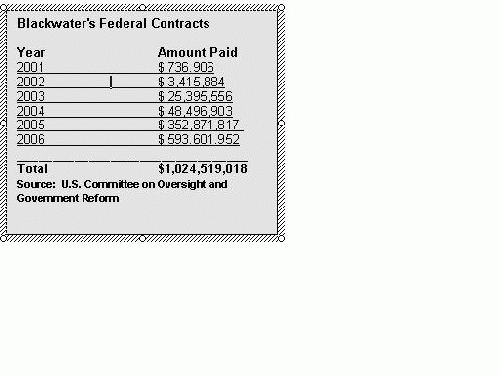
In its own way, Prince would further insist, Blackwater Worldwide is doing its part to help bring "freedom and democracy" (author's quotes) to the volatile Middle East. He'd love us to believe that, by accepting dangerous security assignments -- protecting construction projects, ministries and oil fields; escorting diplomatic convoys; and serving in a wide range of additional life-threatening capacities in the harrowing mise en scene which is Bush-era Iraq, -- Blackwater, rather than a feckless siphon of more than a billion U.S. taxpayer dollars (see graph), is in fact, an invaluable commodity that prevents the siphoning of needed U.S. soldiers from Iraq’s urban war zones.
In his early October appearance before the congressional Oversight and Government Reform Committee, Prince, once an intern for George H.W. Bush, asserted that Blackwater’s contributions have had a positive impact on the war effort.
"Our professionals work to keep American officials and dignitaries safe, including visiting members of congress,” Prince insisted. “In doing so, more American service people are available to fight the enemy."
Defense Secretary Robert Gates' September testimony before the Senate Appropriations Committee seemed to imply that he sees it a bit differently. Gates' testimony included expressions of concern over the practice by Blackwater and other for-profit militias of offering high salaries to entice soldier into leaving the military. Gates said he’d like to see legal barriers imposed against the practice.
(Note: You can view every article as one long page if you sign up as an Advocate Member, or higher).






