




America’s African fads have laws that are often unfathomable for Africans themselves. There was an Ethiopian fad when footages of starving children used to fill the screens of our TV sets. There was an Apartheid fad---with Nelson Mandela’s turning into a household name. There was also a Rwandan genocide fad. Nowadays, there’s a Darfur fad, fuelled by powerful iconic figures like George Clooney and Angelina Jolie. While these fads are by no means detrimental, as they put Africa on America’s psyche, they have a negative tendency however on putting heavy blinders on Americans willing to invest energies on other crucial plights facing the African continent. In this regard, President Bush’s focus on malaria as well as former President Bill Clinton and Bill Gates’s initiatives on this malarial scourge on the African continent are worth hailing as the exception that confirms the general rule of America’s African fads.
As energies are rightfully being mobilized on the Darfur genocide in the Sudan, right next door in the Congo a Darfur-like catastrophe is in the making---involving, amid the ongoing indiscriminate killings of innocent civilians, the destruction of women through “sexual terrorism,” the use of brutal mass rapes as weapons of war, as well as the displacement, this year alone, of more than 350,000 people. There’s scant mention of this humanitarian disaster and of these atrocities in the media beside the recent notable exception of the harrowing report by New York Times’ Jeffrey Gettleman entitled “Rape Epidemic Raises Trauma of Congo War” (http://www.nytimes.com/2007/10/07/world/africa/07congo.html?_r=1&oref=slogin)
with the companion photo slideshow by Hazel Thompson (http://www.nytimes.com/slideshow/2007/10/06/world/20071002CONGO_index.html). One legend of the horrific slideshow reads: “Every day, 10 new women and girls who have been raped show up at the hospital. Many have been so sadistically attacked from the inside out, butchered by bayonets and assaulted with chunks of wood, that their reproductive and digestive systems are beyond repair.”
Beside this kind of occasional reporting, one has to rely on heroic voices in the wilderness of the likes of Georgianne Nienaber or Keith Harmon Snow.
Late in the rainy afternoon of October 24, 2007, Congo’s President, Joseph Kabila, landed at Andrews Airforce Base (AFB) in Maryland, for his meeting with President Bush on October 26.
As if to greet him The Washington Post published the same morning, on its A13 page, a piece entitled “Atrocities in East Congo Attributed to All Parties: Fighters Routinely Terrorize Civilians, Report Says.” The Report the article was referring to is the Human Rights Watch on eastern Congo published the previous day that blames the atrocities on all those involved in the Kivu provinces conflict, including the Congolese regular army. What this report and the Washington Post article failed to mention was that nowadays these atrocities aren’t the norm within the ranks of the Congolese army nowadays and when they do occur, they are met with stiff penalties. And the Washington Post article failed to mention one key finding of the Human Rights Watch report: the active and direct involvement of the Rwandan government in the misery of the Congolese. According to the Report, “Hundreds of Rwandans have joined Nkunda’s units and then become soldiers in the Congolese army (…) Furthermore, according to Congolese and MONUC officers, several soldiers currently active in the Rwandan Defense Forces have been captured in Congo, fighting with Nkunda’s forces” (http://hrw.org/reports/2007/drc1007/). The report has also evidence of forced child recruitment into Nkunda’s militia carried out on Rwandan territory by Rwandan officials collaborating with this war criminal.
Rwanda has been playing all along this card of the victim and of genocide to divert international attention from its terrible enterprise in the Congo---a plunderous venture that some social scientists have called “military entrepreneurship.” Rwanda’s President Paul Kagame for instance has always maintained that his troops invaded Eastern Congo to pursue Hutu militiamen responsible of the 1994 genocide in Rwanda. But what he doesn’t mention today is that it’s in the mountainous forest of the Kivu provinces that these militiamen are entrenched, a territory his troops controlled during the five years of Rwandan occupation of eastern Congo. Were his troops too busy pillaging the place instead of pursuing the murderous militiamen? Does anyone bold enough to confront him and tell him that whereas there were a million victims of the Rwandan genocide, his continued meddling in Congo has cost the lives of upward of 4 million Congolese?
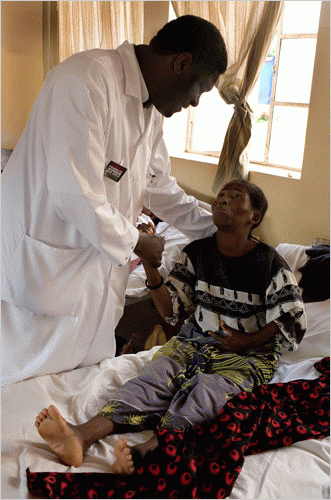
What’s more, Dr. Denis Mukwege, the Congolese surgeon who treats these women victims of “sexual terrorism” and who was also featured in the New York Times piece mentioned above, recently gave an interview to “Radio France Internationale” in which he clearly established the overwhelming responsibility of Nkunda’s forces in the recent atrocities. But by lumping together Nkunda and the Congolese government in these atrocities, the Rwandan government and its ally Nkunda have achieved yet again avoiding the full brunt of their culpability and responsibility in the wanton murders and atrocities in the Democratic Republic of Congo. There’s now talk of granting a way out to exile in South Africa to Nkunda while his surrendering troops are being sent to Congolese army training centers for their retraining and incorporation into the army without first determining their guilt in and prosecuting them for these atrocities.
The rationale of Nkunda for setting up his militia is to defend the Congolese Tutsis. In a country that counts 450 ethnic groups, if this idea is to be taken seriously, then Congo would need to have 450 separate armies---with each defending their own tribes! As every single Congolese keeps repeating ad nauseum to whomever would care to listen: “There are no majority ethnic groups in the Congo; we all are minority tribes.”
In the general official indifference that greeted Congo’s President Joseph Kabila in the American capital, there was one notable exception. On October 26, 2007, as President Bush was hosting the Congolese President, Senator Barack Obama issued a press release that stated in no uncertain terms what the American government needs to do urgently in the Congo: ““It’s time the Administration stops ignoring the call by Congress to appoint a special envoy to the DRC, and strengthen the U.N. peacekeeping force which is working to stabilize the eastern part of the Congo. The seriousness of the situation there was recently highlighted by devastating reports about the escalation of sexual violence against women in the region. I’ve asked Secretary Rice for answers to how our government will help curb this violence, and I urge President Bush to address this issue today.” President Bush met Obama halfway in ordering that an antenna of the American Embassy in Congo be set in the eastern provincial capital of Goma, at the Rwandan border, in order to have a close monitoring of the situation on the ground. Furthermore, there are also plans for the U.S. to train Congolese anti-insurgency units. Until then, Congo is having a hard time shaking a stubborn monkey from its back. It’s about time the American public also see through the smokescreen of genocide that the Rwandan government keeps throwing around to justify its criminal endeavors in the Congo.






