







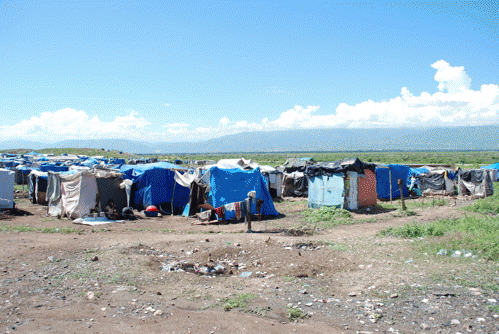
The sign on the dusty plain adjacent to Highway One twelve miles north of Port-au-Prince read, "We Need Help." That was in March;on May 11 the sign was still there, and USAID was reporting that $1,059,050,150 had gone to Haiti since January 2010 through "implementing partners." The people in what we had dubbed the "camp with no name" were still there, too, and the only noticeable difference was that the Irish NGO HAVEN had made good on its promise to install latrines. However one look into the latrines and it was obvious that diarrheal disease was on the rise.
At least the rubber bladder was getting two deliveries of chlorinated water per day now. In a desperate bid for attention, camp leaders had briefly named the IDP settlement "Camp Obama," but had been pressured by "someone" to change the name to "Camp Canaan."
This stretch of arid land is like a desert in the dry season and scattered clumps of cactus are silent sentinels to conditions here. In March, the winds blew so much dirt that we were constantly wiping camera lenses, and our faces and arms were caked with a sticky dust that blackened towels and hand wipes.
But, like the deserts of Arizona, this plain is subject to flooding when the spring rains come and water pours down the ravines of the suitably named Mon Cabrit, or Goat Mountain. We say, "suitably named" because the American taxpayer may end up being the goat in this saga.
In an unbelievable lack of planning and haphazard distribution of "aid," a Potemkin Village of white tents courtesy of USAID's implementing partners, World Vision and OXFAM, now adjoins Camp Canaan. Look beneath the surface of this flagship Haitian government project and one realizes that the residents of "Camp Corail" are really no better off than the residents of Camp Canaan, except for the fact that their tents do not leak--so far. We spent the better part of day examining life in the two camps and it is not a pretty picture; no matter how white the tents in the new settlement, no matter how orderly the rows, or how level the gravel remains--courtesy of UN graders.
We were eager to revisit Camp Canaan to see how they fared since our March visit, so it was the first stop after landing via American Airlines in Port-au-Prince. Colleague Mac McKinney from OEN news was along on this trip, and it was really good to have another set of eyes.
It took nearly and hour to go twelve miles because of a combination of abominable roads and traffic snarls that have to be experienced to be appreciated. Imagine life for camp residents here-- no transportation and no shade from a relentless tropical sun that beats down mercilessly. The displaced Haitians here experience blistering heat in day, and then temperatures drop precipitously at night as the rains come and flood the tattered tents at the base of Goat Mountain.
Camp leaders, led by the familiar face of Joseph Michel, greeted us happily saying that we were the only journalists to return to check on them. There is no way to know if this is true, but they were clearly relieved to see us and update their story.
The women were also eager to reintroduce us to babies we had met on our last visit, but none were thriving. Orange hair on babies is an obvious sign of malnutrition, and an especially frustrating red flag when USAID reports that the World Food Program has been given $69,815,600 to purchase 55,280 metric tons of Emergency Food Assistance since January. There are over 2 million displaced persons in Haiti now. Do the math. At a little over $34 per person, it won't and did not go far. Camp residents report that they pool about ten cents a day per family member (approximately 3,000 families) to purchase food that provides them one meal a day. Camp Canaan receives no "free" food deliveries.
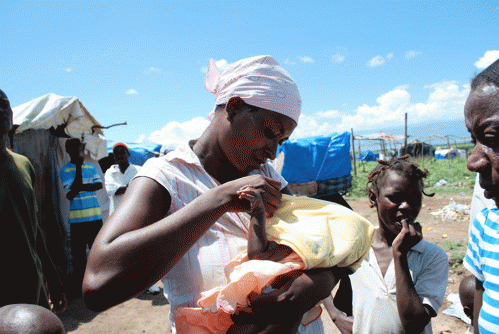
One of our first tasks was to send a photo via our Blackberry of the genitals and bottom of an infant to a family practice doctor in Minnesota. We won't show it here for obvious reasons, but the skin was a blistered, hardened mass of flesh. The doctor got back to us within twenty minutes and said that the problem was chronic severe dermatitis complicated by a secondary yeast infection, and that "malnutrition worsens the problem." Here is Mom and Baby:
The nearest health clinic was in Cite Soleil and the infant needed to get there. But how does a mother with no money and no transportation "get" anywhere. Our Haitian translator, Andre Paultre, immediately gave the women money for transport via "tap tap" (taxi) for a clinic visit. The tap-tap cost 50 Gourdes or about $1.10 US.
Consider that USAID lists "logistics" aid of $460 million, but there is no transportation to and from these rural camps. One regular bus run would be a godsend.
Cite Soleil is 20 minutes away.
Regarding the orange hair--orange hair is just wrong. You feel it when you see it. It is an innate response of revulsion that psychologists have told me is the result of a primal mammalian instinct. Not maternal, but mammalian. I want to be clear. Genetics long ago programmed survival and recognition of disease and impending death into our species. The "normal" reaction is to flee, but mores, thankfully, prevents this. Even if the babies did not have orange hair, one would know something is terribly wrong by the hollowed, glassy expressions in their eyes.
At least the rubber bladder was getting two deliveries of chlorinated water per day now. In a desperate bid for attention, camp leaders had briefly named the IDP settlement "Camp Obama," but had been pressured by "someone" to change the name to "Camp Canaan."
But, like the deserts of Arizona, this plain is subject to flooding when the spring rains come and water pours down the ravines of the suitably named Mon Cabrit, or Goat Mountain. We say, "suitably named" because the American taxpayer may end up being the goat in this saga.
In an unbelievable lack of planning and haphazard distribution of "aid," a Potemkin Village of white tents courtesy of USAID's implementing partners, World Vision and OXFAM, now adjoins Camp Canaan. Look beneath the surface of this flagship Haitian government project and one realizes that the residents of "Camp Corail" are really no better off than the residents of Camp Canaan, except for the fact that their tents do not leak--so far. We spent the better part of day examining life in the two camps and it is not a pretty picture; no matter how white the tents in the new settlement, no matter how orderly the rows, or how level the gravel remains--courtesy of UN graders.
We were eager to revisit Camp Canaan to see how they fared since our March visit, so it was the first stop after landing via American Airlines in Port-au-Prince. Colleague Mac McKinney from OEN news was along on this trip, and it was really good to have another set of eyes.
It took nearly and hour to go twelve miles because of a combination of abominable roads and traffic snarls that have to be experienced to be appreciated. Imagine life for camp residents here-- no transportation and no shade from a relentless tropical sun that beats down mercilessly. The displaced Haitians here experience blistering heat in day, and then temperatures drop precipitously at night as the rains come and flood the tattered tents at the base of Goat Mountain.
Camp leaders, led by the familiar face of Joseph Michel, greeted us happily saying that we were the only journalists to return to check on them. There is no way to know if this is true, but they were clearly relieved to see us and update their story.
The women were also eager to reintroduce us to babies we had met on our last visit, but none were thriving. Orange hair on babies is an obvious sign of malnutrition, and an especially frustrating red flag when USAID reports that the World Food Program has been given $69,815,600 to purchase 55,280 metric tons of Emergency Food Assistance since January. There are over 2 million displaced persons in Haiti now. Do the math. At a little over $34 per person, it won't and did not go far. Camp residents report that they pool about ten cents a day per family member (approximately 3,000 families) to purchase food that provides them one meal a day. Camp Canaan receives no "free" food deliveries.
One of our first tasks was to send a photo via our Blackberry of the genitals and bottom of an infant to a family practice doctor in Minnesota. We won't show it here for obvious reasons, but the skin was a blistered, hardened mass of flesh. The doctor got back to us within twenty minutes and said that the problem was chronic severe dermatitis complicated by a secondary yeast infection, and that "malnutrition worsens the problem." Here is Mom and Baby:
The nearest health clinic was in Cite Soleil and the infant needed to get there. But how does a mother with no money and no transportation "get" anywhere. Our Haitian translator, Andre Paultre, immediately gave the women money for transport via "tap tap" (taxi) for a clinic visit. The tap-tap cost 50 Gourdes or about $1.10 US.
Consider that USAID lists "logistics" aid of $460 million, but there is no transportation to and from these rural camps. One regular bus run would be a godsend.
Cite Soleil is 20 minutes away.
Regarding the orange hair--orange hair is just wrong. You feel it when you see it. It is an innate response of revulsion that psychologists have told me is the result of a primal mammalian instinct. Not maternal, but mammalian. I want to be clear. Genetics long ago programmed survival and recognition of disease and impending death into our species. The "normal" reaction is to flee, but mores, thankfully, prevents this. Even if the babies did not have orange hair, one would know something is terribly wrong by the hollowed, glassy expressions in their eyes.
(Note: You can view every article as one long page if you sign up as an Advocate Member, or higher).
 1
1
 1
1






