

Refresh   Tag(s): ; ; ; ; ; ; ; ; ;
Add to My Group
November 3, 2008 at 11:48:05

View Ratings | Rate It

The Voice of the Wetlands Festival, Part 3: The Cajun and the Lake

FACEBOOK
submit to twitter
submit to reddit
submit to digg

Tell A Friend

By Mac McKinney (about the author)     Page 1 of 3 page(s)

opednews.com     Permalink

For OpEdNews: Mac McKinney - Writer

(To read Part 1, click here

(To read Part 2, click here

Sunday morning, October 12, Houma, Louisiana:

I have been experiencing the Voice of the Wetlands Festival for the last two days, enjoying the music and learning more about the ecology of the wetlands. But now my wife and I have to cut short our visit, even though the festival will resume at Noon, and head on back to New Orleans International Airport to catch a mid-afternoon flight. But the plight of southern Louisiana has not been lost on me, nor hopefully, on you, the reader.


The wetlands of Louisiana are being destroyed by 1) blocking off the annual sediment deposits from the Mississippi River, 2) the building of endless canals crisscrossing the southern Louisiana wetlands that then invite the insidious spread of destructive saltwater intrusion, and of course, 3) by contractors being allowed to bulldoze, fill in and pave the wetlands in the interests of commercial development. But there is another factor that also affects, not only the wetlands, but all the waterways - rivers, lakes, bayous, etc., and that is urban, industrial and agricultural pollution of these waterways. This became clear to me as I was driving back from the festival this Sunday morning.


As we were leaving the outskirts of Houma, first I was able to get a good look at one of the many canals dredged out in Louisiana, canals that have become part of the environmental problem. This one was running under Floyd Duplantis Bridge below: 
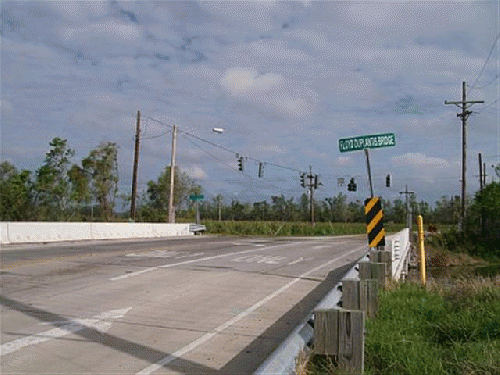


Floyd Duplantis Bridge on the outskirts of Houma, Louisiana 

Here is the canal itself: 


A canal running under the bridge.
Note the large pipes running down into the water. I assume they are suction and discharge pipes connected to a pumping station just to the right in  what I guess you can call a spill-over pond, or even secondary canal, because it runs parallel to the first canal as far as the horizon, as you will see in the second photo after the one of the pumping station directly below:


What must be a pump station for controlling canal water volume.
Note the pollution and heavy surface vegetation that suggests water deterioration, even toxicity.


Looking south at this same "spill" canal, if I can technically call it that, you see that this thick film of aquatic vegetation coats the entire surface, suggesting a stagnant, perhaps even putrid body of eutrophic water. What happens when storms and hurricanes cause this canal to, in turn, exceed its boundaries and flood over the land, soaking into the soil, or even into other bodies of water?


The pea-green "spill canal" that the pumping station dumps water into

Continuing on back toward New Orleans on Highway 90, we eventually passed by the small city of Raceland, situated on Bayou Laforche in Lafourche Parish, and then a few minutes later saw a pier/souvenir shop complex just off the highway to my right. Curious to see if the shop was open, I pulled into the parking lot, grabbed my camera and hopped out. The business itself was closed so I walked toward the pier where a medium-sized, shallow-draft tour boat was moored, with no one about. 


Pierside at Lac des Allemands

When I walked to the water's edge and peered right, I could see the pier wall extending south quite a ways, actually merging into a rather quaint canal adjoining the lake, with houses on both sides, the water level already almost lapping into their yards, creating a sort of mini-Venice between the highway and the lake. And this was likely just as prone to all the flooding problems that beset the good people of Venice, Italy. 

Next Page  1  |  2  |  3


http://plutonianmac.blogspot.com/

Besides contributing to OpEdNews.com, I am also an editor. I am a student of history, religion, exoteric and esoteric, the Humanities in general and advocate for peace, justice and the unity of humankind, not through force, but through (more...)
 

The views expressed in this article are the sole responsibility of the author
and do not necessarily reflect those of this website or its editors.

Contact Author Contact Editor View Authors' Articles

Follow Me on Twitter


Book Recommendations for "Banking Birds"
Supercommunity Banking: A Superstrategy for Success (Bankline Publication)
by Anat Bird

$42.50
Lowest New Price $14.50

Number of pages: 459
Publisher: Irwin Professional Publishing

Supercommunity Banking Strategies: Winning the War for the Customer Relationship
by Anat Bird

$42.50

Number of pages: 398
Publisher: Irwin Professional Pub

Seabird Tissue Archival and Monitoring Project protocol for collecting and banking seabird eggs (SuDoc C 13.58:6735)
by U.S. National Archives and Records Administration


Number of pages:
Publisher: U.S. Dept. of Commerce, Technology Administration, National Institute of Standards and Technology

View All Book Recommendations

Share this page: (what's this?)                   Tell a Friend: Tell A Friend

FACEBOOK      DIGG THIS      Add This Page to Mr Wong!           NEWSVINE      DEl.ICIO.US      Looksmart Furl      NETSCAPE      My Web      Tag!RawSugar      Blink List     (More...)

Comments: Expand   Shrink   Hide  
2 comments
To view all comments:
Expand Comments
 

Great series, Mac, thanks-and here's a Cajun recipe for ya! by Meryl Ann Butler on Monday, Nov 3, 2008 at 12:45:31 PM
Thanks, Meryl by Mac McKinney on Monday, Nov 3, 2008 at 1:33:51 PM


Tell a Friend: Tell A Friend

Copyright © 2002-2010, OpEdNews

Powered by Populum

