




In recent weeks, considerable turmoil has emerged among some elite members of the Civil Rights community.
Publicly aired expressions germinating from PBS's Tavis Smiley and the National Action Network's President Rev. Al Sharpton, in which both parties have accused the other of working against the interests of the African-American community in an effort to garner favor from members of the political class - Former President Bill Clinton in relation to Smiley and the current Head of State Barack Obama with respect to Sharpton - have created a stir within many African-American quarters.
These contentious allegations along with further subtle articulations generated by Sharpton suggesting that perhaps entrepreneurial aspirations partially serve as the catalyst for some of the actions of those within the Civil Rights community - Sharpton's reference to the desire of some activists to boost book sales - have raised questions regarding not only the legitimacy of these claims but implicitly and perhaps more importantly; those with respect to the axioms which undergird the concept of authentic leadership.
In the face of a national economic crisis in which the African-American populace has experienced considerable hardships, as reflected in essentially every statistical category that would signify the social standing of a people, it is of immeasurable importance those individuals - established and emerging - who function under the premise of working to bring forth relief to this population, be in possession of specific intangible qualities if their ascendance to the position of "leader" is to lend strength to the effort to which they profess to support.
Such a circumstance prevails, as the African-American community as a direct result of an extended legacy of state sponsored oppression - slavery, Jim Crow Laws, judicial misconduct etc... - visited upon this group by United States government institutions, in which Black peoples' capacity to experience social affluence by way of gainful employment, property ownership, the right to vote and the partaking in any other number of civic activities that would advance a group's societal position was - and is still to some extent - severely compromised, has not the collective understandings from a philosophical and organizational standpoint that would enable it to produce a movement that would function to improve its status, absent the presence of dynamic leaders who have the ability to direct this ethnic class and its resources to this end.
Indeed, the history of those of African ancestry within the context of the United States reflects the emanation of such figures as Malcolm X and Dr. Martin Luther King Jr. - among others - who were able to galvanize many of the group's members and bring into service the communities' institutional structures in working to obtain greater degrees of prosperity for this population. Additionally, these individuals were able to instill in their followers, a philosophy that would serve to provide the basis by which faith in the group's ability to achieve a desired goal could be fostered.
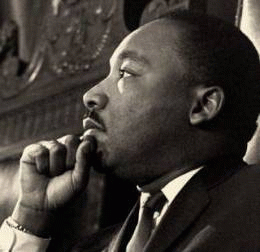
It is through an analysis of the conceptions and actions of such leaders and in applying these attributes within the context of a contemporary movement that would seek redress for African Americans through governmental intervention, the fabric of authentic leadership may be revealed, and in so doing perhaps function to discern the viability of the current reigning leadership within this community.
The authentic leader working within the parameters of any political system, in attempt to amass legislative and or policy results that would ensure greater standings for a disenfranchised people understands the fundamental interest of the politician is embedded in his or her desire to acquire and maintain power. A genuine leader desiring to exact influence upon elected officials, inherently bound and motivated by such a dynamic, comprehends he or she - along with those who follow - must pose a fundamental threat to the political survival of the governing entity if any substantial gains are to be attained by the group. It is almost exclusively under the condition of political loss - which for the politician constitutes a state of emergency - such figures respond to the grievances of those dispossessed populations existing among their constituents.
(Note: You can view every article as one long page if you sign up as an Advocate Member, or higher).






