


Tag(s): ; ; ; ; ; ; ; ; ; , Add Tags
Add to My Group(s)

View Ratings | Rate It

Promoted to Headline (H3) on 11/15/09:     Permalink
View Article Stats      (3 comments)

THE POLITICAL ECONOMY OF SECRECY - a think-piece begun in 1975

Add this Page to Facebook!
Submit to Twitter
Submit to Reddit
Submit to Stumble Upon

Tell A Friend

Become a Fan
Get Embed HTML Code
By (about the author)

Become a Fan Become a Fan  (38 fans)   -- Page 1 of 4 page(s)

opednews.com

Information is power. In a society organized according to principles of rationality and justice, information will be universally available and widely diffused, permeating the social order with power. In a society organized according to capitalist principles, information will be concentrated in the hands of a ruling class and its agents, augmenting and even displacing the force required to maintain capitalist inequities.

The burden of the following essay is to argue that differences in information -- information differentials -- are intrinsic to the capitalist mode of production; and that under free market capitalism this mode of production is reproduced in the post-investment redistribution of profits among corporations, itself largely determined by information differentials; and finally, that in America the corporate sector as a whole maintains its hegemony only by concealing from the public the most basic features of domestic politics, foreign affairs, and the system of criminal justice. In short, information differentials both define and critically conceal the distribution and exercise of power throughout the American political economy.

(Photographs from Flickr -- not surprisingly, there are exactly two "relevant" photographs at Flickr for "Corporate Secrecy" in the Commons, and both of them are irrelevant.)
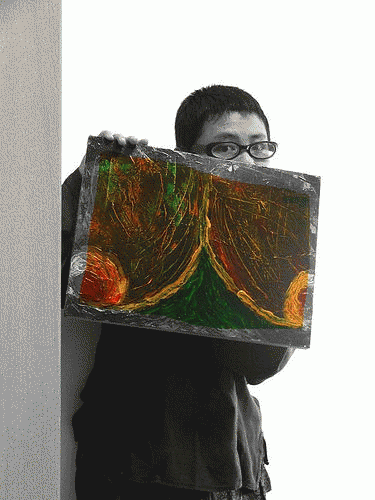

By kakade, Secrecy (2005)


By exothermic, Nashville Skyline is in the Distance (2008)


By Prisoner 159753, Prison Overcrowding (2009)

"Prisoner 159753 text: Inmate Steve Milton, 38, looks out from an inmate shower stall converted into a temporary holding cell at CaliforniaState Prison-Los AngelesCounty in Lancaster, California, Friday, March 2, 2007."


By publik, Untitled (2008)

"At least twelve children in MountIsa still have dangerously high lead levels, but the State Government is still refusing to give details."


Black Project Aurora Space Plane, Photographer's Identity Secret


By Seabamimum, Fatal (2009)


By MarkWallace, Untitled (2008)

Information and the Capitalist Mode of Production. According to Braverman the essence of the capitalist mode of production is its transformation of working humanity into an instrument of capital, a transformation achieved by the separation, within each labor process, of conception from execution. This separation has always characterized the capitalist mode of production and, with the advent of "Taylorism" or "Scientific Management" after 1890, was itself conceptualized and verbalized as a theory of management. Braverman describes the theory of "Scientific Management":

. . .the first principle (of Scientific Management) is the gathering and development of knowledge of labor processes(;) the second is the concentration of this knowledge as the exclusive province of management -- together with its essential converse, the absence of such knowledge among workers -- (;) the third is the use of this monopoly over knowledge to control each step of the labor process and its mode of execution.

"Scientific Management" is predicated on differences in knowledge about labor processes -- information differentials. To the extent industries are managed "scientifically," the role of unemployment in the disciplining of the labor force is subordinated to that of "Scientific Management." And the scale and intensity of the exploitation of labor is increasingly determined by how effectively management monopolizes its "knowledge to control each step of the labor process and its mode of execution." (footnote 1)

Information and the Redistribution of Capitalist Profits. The magnitude of the exploitation of labor under capitalism determines the initial distribution of capitalist profits. Under free market capitalism -- still the predominant form of capitalism -- this initial distribution is only temporary, however, because the dynamics of the accumulation process compel corporations intending to augment profits to invest the fruits of exploitation, most significantly in the financial markets and in technology. (2) And according to how successfully they are reinvested, corporate profits are redistributed. But how successfully corporate profits are reinvested in the financial markets and in technology, under free market capitalism, is a function of information differentials.

Next Page  1  |  2  |  3  |  4


I have a law degree (Stanford, 66') but have never practiced. Instead, from 1967 through 1977, I tried to contribute to the revolution in America. As unsuccessful as everyone else over that decade, in 1978 I went to work for the U.S. Forest (more...)
 

The views expressed in this article are the sole responsibility of the author
and do not necessarily reflect those of this website or its editors.

Contact Author Contact Editor View Authors' Articles


Share this page: (what's this?)                   Tell a Friend: Tell A Friend

Add this Page to Facebook!      Submit to Stumble Upon      Submit to Reddit      Add This Page to Mr Wong!           NEWSVINE      DEl.ICIO.US      Looksmart Furl      My Web      Blink List     (More...)

Comments

The time limit for entering new comments on this article has expired.

This limit can be removed. Our paid membership program is designed to give you many benefits, such as removing this time limit. To learn more, please click here.

Comments: Expand   Shrink   Hide  
3 comments
To view all comments:
Expand Comments
(Or you can set your preferences to show all comments, always)

I have to admit, Bushco changed my thinking in one regard: by GLloyd Rowsey on Sunday, Nov 15, 2009 at 11:45:16 AM
I need more coffee by Dick Thomson on Monday, Nov 16, 2009 at 7:14:40 AM
Thank you for the compliment, Dick. by GLloyd Rowsey on Monday, Nov 16, 2009 at 8:24:53 AM

