




Introduction
I was very happy to be corrected after posting OpEdNews article with a question about microeconomics
h t t p : / / www.opednews.com/articles/Supply-and-demand-by-Ludwik-Kowalski-090216-588.html
click here
This time I want to share observations about macroeconomics; perhaps they will also generate interesting comments. Economics is the most important social science; it should be a required general education course.
Pasted from a draft of my new essay
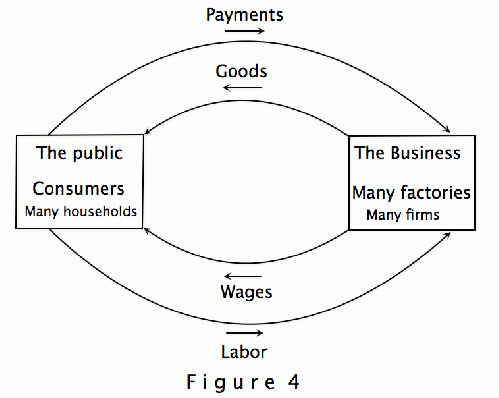
. . . The diagram in Figure 4, is a good beginning. It consists of two boxes (sectors),-- "public" and "business." Lines between boxes represent activities in a functioning economy. The lowest line refers to workers supplying productive services to firms; the line above it refers to total (aggregate) wages they receive. Wages allow consumers to buy goods and services, as represented by the next line. The top line represents aggregate payments for these goods and services. Numerous details, such as stores, banks and the government, are not shown. Consumers supply labor and pay for goods they need; goods and wages are provided by the firms.
A more simplified diagram is shown in Figure 5. Two boxes (two major sectors of economy) are now connected by two pipes; the flow is circular. Households deliver labor and payments to firms and firms deliver wages and goods to households. Note that labor (work) and goods (products of work) can be expressed in dollars. With this in mind, one can say that dollars, like blood, constantly circulate in the body of our economy. A number of dollars passing through the body each year is called GDP (gross domestic product). What goes to the right and what goes to the left must be roughly equal in healthy economy. But our economy grows and the GNP grows with it. It was about 500 billion dollars in 1950 and about 1000 billion (one trillion) in 1965, in terms of 1972 dollars. By now it is said to be 14 trillion (in terms of 2000 dollars).
Except for some wiggles, such as the Great Depression, around 1930, the growth was exponential (straight line on the semi-logarithmic scale, as shown on page 82). Extrapolating toward 2020 and 2040 on gets 20 trillions and 50 trillions dollars, respectively. In terms of today's dollars this would be about 200 and 500 trillion. The US population did not increase as rapidly as the world population, which more than tripled in the last 60 years. That is one of the factors explaining big differences in average standards of living between our lucky country and the entire world. Would the planet be able to provide the entire world population with our standards of living? I am thinking about limited natural resources, about pollution associated with economic growth, and about possible climatic changes. Anticipated global economics can also be described by using diagrams in Figures 4 and 5.
Economy, motivated by self-interest of its participants, converts natural resources (labor, energy, minerals, etc.) into good and services. The author of (1) refers to this process as creation of happiness. Note that the four kinds of flows, in Figure 4, must be in balance. Aggregate consumer demands, based on wages, must be satisfied by the aggregate level of production, based on profits. Ideally, households receive sufficient income to satisfy their needs and firms receive sufficient payments to cover production expenses, and to make profit. Our capitalist economy is driven by consumer's desire to satisfy needs, and by firm's desire to make profits. Big fraction of profits is used to build new and better factories. That is how economy is growing. The diagram in Figure 4 can is used to explain what happens when the necessary balance is destroyed. This can be done systematically, line by line.
Suppose wages are reduced, for some reason (second line from below). That will create a situation in which an average consumer will buy less good and services. The demand will go down and firms will start producing less (reduction of the workforce, less than full utilization of machines, etc.) The wages will be further reduced and more workers will become unemployed. That is called recession, or depression, depending on what fraction of the workforce is unemployed. Suppose that prices of manufactured goods (top line) go up, for example, due to higher energy costs. Firms will adjust prices accordingly. On the average, prices might increase significantly during a short time, for example, 10 % in one year. Such situation is called inflation.
Inflation can also lead to recession. Consumers with limited means will start buying less. Unable to sell as much as before, the firms will start firing workers. This will again reduce the average income and reinforce the unemployment. The bottom line, labeled "labor," reminds brings another topic. What happens when less expensive labor becomes available, for example, in another country? Inflation might also result from excessive buying by consumers, for example, in anticipation of a war. Buying more than before is possible when consumers have money in saving accounts. Unable to match this increased demand immediately, the firms take advantage of the situation and increase prices.
I was very happy to be corrected after posting OpEdNews article with a question about microeconomics
h t t p : / / www.opednews.com/articles/Supply-and-demand-by-Ludwik-Kowalski-090216-588.html
click here
This time I want to share observations about macroeconomics; perhaps they will also generate interesting comments. Economics is the most important social science; it should be a required general education course.
Pasted from a draft of my new essay
. . . The diagram in Figure 4, is a good beginning. It consists of two boxes (sectors),-- "public" and "business." Lines between boxes represent activities in a functioning economy. The lowest line refers to workers supplying productive services to firms; the line above it refers to total (aggregate) wages they receive. Wages allow consumers to buy goods and services, as represented by the next line. The top line represents aggregate payments for these goods and services. Numerous details, such as stores, banks and the government, are not shown. Consumers supply labor and pay for goods they need; goods and wages are provided by the firms.
A more simplified diagram is shown in Figure 5. Two boxes (two major sectors of economy) are now connected by two pipes; the flow is circular. Households deliver labor and payments to firms and firms deliver wages and goods to households. Note that labor (work) and goods (products of work) can be expressed in dollars. With this in mind, one can say that dollars, like blood, constantly circulate in the body of our economy. A number of dollars passing through the body each year is called GDP (gross domestic product). What goes to the right and what goes to the left must be roughly equal in healthy economy. But our economy grows and the GNP grows with it. It was about 500 billion dollars in 1950 and about 1000 billion (one trillion) in 1965, in terms of 1972 dollars. By now it is said to be 14 trillion (in terms of 2000 dollars).
Except for some wiggles, such as the Great Depression, around 1930, the growth was exponential (straight line on the semi-logarithmic scale, as shown on page 82). Extrapolating toward 2020 and 2040 on gets 20 trillions and 50 trillions dollars, respectively. In terms of today's dollars this would be about 200 and 500 trillion. The US population did not increase as rapidly as the world population, which more than tripled in the last 60 years. That is one of the factors explaining big differences in average standards of living between our lucky country and the entire world. Would the planet be able to provide the entire world population with our standards of living? I am thinking about limited natural resources, about pollution associated with economic growth, and about possible climatic changes. Anticipated global economics can also be described by using diagrams in Figures 4 and 5.
Economy, motivated by self-interest of its participants, converts natural resources (labor, energy, minerals, etc.) into good and services. The author of (1) refers to this process as creation of happiness. Note that the four kinds of flows, in Figure 4, must be in balance. Aggregate consumer demands, based on wages, must be satisfied by the aggregate level of production, based on profits. Ideally, households receive sufficient income to satisfy their needs and firms receive sufficient payments to cover production expenses, and to make profit. Our capitalist economy is driven by consumer's desire to satisfy needs, and by firm's desire to make profits. Big fraction of profits is used to build new and better factories. That is how economy is growing. The diagram in Figure 4 can is used to explain what happens when the necessary balance is destroyed. This can be done systematically, line by line.
Suppose wages are reduced, for some reason (second line from below). That will create a situation in which an average consumer will buy less good and services. The demand will go down and firms will start producing less (reduction of the workforce, less than full utilization of machines, etc.) The wages will be further reduced and more workers will become unemployed. That is called recession, or depression, depending on what fraction of the workforce is unemployed. Suppose that prices of manufactured goods (top line) go up, for example, due to higher energy costs. Firms will adjust prices accordingly. On the average, prices might increase significantly during a short time, for example, 10 % in one year. Such situation is called inflation.
Inflation can also lead to recession. Consumers with limited means will start buying less. Unable to sell as much as before, the firms will start firing workers. This will again reduce the average income and reinforce the unemployment. The bottom line, labeled "labor," reminds brings another topic. What happens when less expensive labor becomes available, for example, in another country? Inflation might also result from excessive buying by consumers, for example, in anticipation of a war. Buying more than before is possible when consumers have money in saving accounts. Unable to match this increased demand immediately, the firms take advantage of the situation and increase prices.






