


Tag(s): ; ; ; ; ; ; , Add Tags
Add to My Group(s)

Must Read 2   Supported 1   Valuable 1   View Ratings | Rate It

Promoted to Headline (H3) on 11/12/10:     Permalink
View Article Stats      (1 comment)

Seven Ways Medical Conflicts of Interest are Disguised

Add this Page to Facebook!
Submit to Twitter
Submit to Reddit
Submit to Stumble Upon

Tell A Friend

Become a Fan
Get Embed HTML Code
By (about the author)

Become a Fan Become a Fan  (45 fans)   -- Page 1 of 2 page(s)

opednews.com

"Trust me" used to be the punch line about how a certain obscenity is uttered by Hollywood agents.

It also used to govern the conflicts of interest policies at hospitals, universities, medical schools and scientific journals about doctors' and researchers' financial links.

But conflicts of interest (COI) at Harvard and other universities, medical journals, professional groups and at the FDA itself have ushered in a kind of disclosure fever. In addition to the Physician Payment Sunshine Act which requires drug and device makers to report physician payments yearly, medical schools are starting to reject industry money that traditionally funded Continuing Medical Education (CMEs).
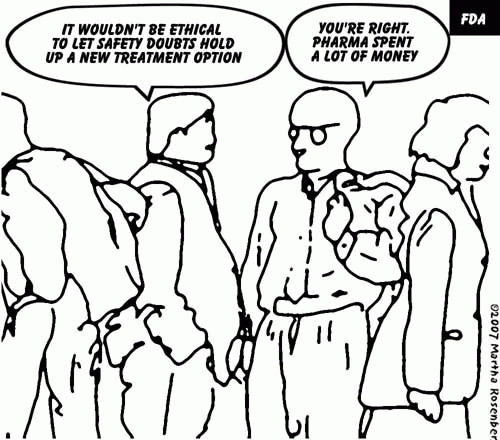
Remembering "sponsors" by Martha Rosenberg

Individual doctors' COIs have also been a problem for medical groups and journals.

The American Psychiatric Association, in its 240 page guide to its May annual meeting, "forgot" to mention the conflicts of interest of its own president Alan Schatzberg, MD. It had to print them on the newsletter circulated the third day of the meeting. Nor were names even alphabetized for easy information retrieval. (Schatzberg is financially linked to Eli Lilly, GSK, Merck, Pfizer, Forest, Takeda, Sanofi-Aventis and eight other companies.)

Joan Luby, MD, a pediatric depression expert says in the Archives of General Psychiatry in March she didn't disclosure lectures she gave for AstraZeneca and other pharma ties "because theywere not relevant to the subject of the article." Maybe that's why the New York Times magazine didn't disclose Luby's links in the August "Can Preschoolders be Depressed?" and five Wyeth links in April's "The Estrogen Dilemma."

And statin investigator, Harvard's Paul Ridker, MD, apologized to JAMA readers in 2006 for an incomplete financial disclosure for an article about cardiovascular clinical trials. He thought he only had to report funding for the "study at hand" and had omitted mentioning funding from AstraZeneca, Bayer, Novartis, Roche, Sanofi-Aventis and five other pharmaceutical companies.

Disclosure is especially tricky for medical journals whose lifeblood is often drug ads and reprints of article for drug companies to pass out to physicians.

Here are some of the ways conflicts of interest are finessed.

1) Omnibus disclosure. All of a study's authors are listed with all the pharma links in one block of solid type. Who goes with whom? You'll never know -- but the author with no links sure isn't happy about shared guilt.

2) Initials. "R.L.T. has consulted for Merck" is set in 8 point type at the end of the article. Will readers return to the study's start, five pages ago where there are eight authors, four with first names that begin with R?

3) Disclosures You Have To Work For. COIs of CME faculty are often given online but the information is tucked away in a pull-down, scroll menu. It is user-unfriendly like the drug side-effects found on the scrolling ads on the same site.

4) One Disclosure is Enough. When a previous article is cited in journal letters sections, the author disclosures are said to "be found with the original article." Surely you have that issue, published four months ago, on your desk.

5) Protective Coloring. Disclosures of drug company links are embedded between government grants and charitable foundations. Government grants and charitable foundations are not conflicts of interest -- though some say taking government money along with industry should be.

6) Paying Customers Only. 20 million citations of medical literature appear on the US National Library of Medicine web site. Many have author's institutions and email. But do the abstracts show COIs? Not unless you're a paid subscriber. Password please.

7) Paying Customers Only...Even When You Are Reading A Hard Copy . In hard copies of the August 5 New England Journal of Medicine, the disclosures of authors of "Suicide-Related Events in Patients Treated with Antiepileptic Drugs" are absent and said to be found with the "full text" of the article at NEJM.org.

Next Page  1  |  2


Martha Rosenberg is a health reporter and commentator whose work has appeared in Consumers Digest, the Boston Globe, San Francisco Chronicle, Chicago Tribune, New Orleans Times-Picayune, Los Angeles Times, Providence Journal and Newsday. She serves (more...)
 

The views expressed in this article are the sole responsibility of the author
and do not necessarily reflect those of this website or its editors.

Contact Author Contact Editor View Authors' Articles


Share this page: (what's this?)                   Tell a Friend: Tell A Friend

Add this Page to Facebook!      Submit to Stumble Upon      Submit to Reddit      Add This Page to Mr Wong!           NEWSVINE      DEl.ICIO.US      Looksmart Furl      My Web      Blink List     (More...)

Comments

The time limit for entering new comments on this article has expired.

This limit can be removed. Our paid membership program is designed to give you many benefits, such as removing this time limit. To learn more, please click here.

Comments: Expand   Shrink   Hide  
1 comments
To view all comments:
Expand Comments
(Or you can set your preferences to show all comments, always)

You really have one choice by Mel Smith on Friday, Nov 12, 2010 at 11:52:44 PM

