





To do nothing is to send a message to the
wrongdoer, and the general public, that the victim has no self-worth and
will not marshal the internal resources necessary to reclaim his or her
honor. Shattered dignity is not beyond repair, but no elevating and
equalizing of dignity can occur without the personal satisfaction of
revenge.
-Thane Rosenbaum, Payback: The Case For Revenge
The one who forgives, far from rallying around evil, decides
instead not to imitate it, not to resemble it in any way, and without
having expressly willed it, to negate it with the sole purity of silent
love.
-Vladimir Jankelevitch, Forgiveness
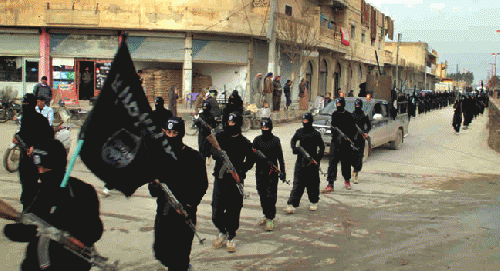
Two months ago polls suggested the American public was weary of war. Then, a group of furious extremists nurtured out of the fertile chaos of our invasion/occupation of Iraq and led by former generals from Saddam Hussein' army went through Anbar Province in western Iraq like Patton went through Europe: Like crap through a goose. They were taking back what the US had taken from them by empowering Iraqi Shiites. Their secret was psychopathic violence -- massacres of men, women and children from hated ethnic or religious factions.
Soon, people from around the world were being recruited to join ISIS. Two brave US journalists were captured in Syria and sold to ISIS in western Iraq. Utilizing 21st century skills with video production, they flaunted their power by brutally beheading the two journalists.
Suddenly, US polls flipped and a majority of Americans now felt it was necessary to race willy-nilly back to war in Iraq. The likelihood that ISIS's goal with the beheading videos was to stir up this kind of fear and blind reaction in America didn't seem to matter. No one is quite sure what any of it really means. Following President Obama's war speech, Lawrence O'Donnell asked, "Exactly how many people do we have to kill to 'degrade and ultimately destroy' this movement called ISIS?" No one knows. More important, no one wants to lose face or appear weak. Being smart didn't seem to matter. Losing even more ground in addressing our huge domestic problems was a fool's concern.
Crime Fiction and Vengeance as Religion
As part of a personal study in the area of crime fiction, I've been reading a lot on the subject of vengeance. One of the classic avenging angels is Mike Hammer, Mickey Spillane's popular Cold War era private detective who followed Dashiell Hammett's Sam Spade and Raymond Chandler's Philip Marlowe. They were real tough guys, but they were detectives. Mike Hammer is about vengeance, generally administrated on the final page with a couple slugs in the guts from his beloved .45 automatic.
Spillane and his persona Mike Hammer had no patience with something like the ethical movement that, for lack of a better term, goes by the label forgiveness. When thinking about crime fiction, I find it useful to place the two -- vengeance and forgiveness -- as extremes on a continuum. It allows the analytic possibility of complexity and dialogue between the extremes when it comes to addressing a mess like the one the nation finds itself in right now.
Andrew Vachss is a popular, self-proclaimed vengeance writer working today. His character Burke is an avenging angel hunting down those who abuse and violate children. Vachss is a lawyer who has had a colorful life working in the area of child protection. "He's not a hit man," Vachss has written of the fictional Burke. "But he shares the same religion I do, which is revenge."
On the first page of his final Burke novel, Another Life, he has Burke express what seems a manifesto:
"Every TV 'counselor,' every self-help expert, every latte-slurping guru -- they all chant some version of the same mantra: 'Revenge never solves anything.'
"Their favorite psalm is Forgiveness. "When you crawl away, you're not being a punk; you're just letting the cosmos handle your business. "Down here, we see it different. We don't count on karma. But you can count on this: hurt one of us, we're all coming for you."
For me, the insulting aspect of this passage nicely characterizes the attitude among the vengeance crowd toward forgiveness as a serious option. No complexity or dialogue is permitted. If too persistent, the forgiveness element becomes identified with the enemy and subject to the same vengeance. Something like this is going on in the current political moment vis--vis ISIS. The fact this example is fictional narrative doesn't make it less apt, since much of the narrative in our political life these days is unhinged from reality. The right is very adept at using sometimes preposterous narratives. That a nation's pulse can go from war weariness to war acceptance almost overnight because of two videotaped murders feels culturally important.
Had journalists James Foley and Steven Sotloff been murdered discretely or simply been "disappeared" the current war fever would not be so intense. The video-taping of the beheadings by a British speaker was intended to, as Rosenbaum put it above, "shatter the dignity" of comfortable Americans and set off a vengeful over-reaction like a bull reacting to a red cape. We tend to forget that the ISIS video-taped beheadings were examples of vengeance themselves.
Referring to the confused politics surrounding the 2000 Bush v. Gore election in Florida, Osama bin Laden wrote, "All this made it easy for us to provoke and bait this administration. All we have to do is send two mujahadeen to the Far East to wave a banner proclaiming 'Al Qaeda,' and the generals run. In this way, they increase their human, economic and political losses without achieving anything of note, apart from some benefits to their private corporations."
(Note: You can view every article as one long page if you sign up as an Advocate Member, or higher).
 1
1
 1
1
 1
1





