






Can purchasing children’s handmade paper cards or soaps for holiday gifts, change your world? You betcha.
In an economy fraught with fears, that is an investment that can’t lose.
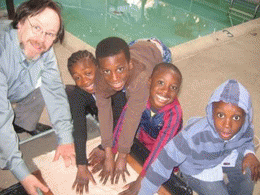
The kids, staff and parents at the very green, Salem, Massachusetts, Greenhouse School—named for the original function of the building—have been quietly plugging away, turning recycled waste paper into beautiful handmade items: cards, bookmarks, invitations, gift tags, journals, ornaments, and decorative wrappers for the school’s aromatic handmade soaps.

Part science project, part recycling, part fundraising, the idea bloomed more than a decade ago. Grinding up old paper to repurpose into beautiful new cards is just one of the many ways this school turns trash into treasure. The handmade cards (a bargain at $4 each; $15/pack of five) are each uniquely speckled with hints of light yellows, greens, and blues on solid-colored backgrounds including muted lime green, sunflower yellow, and salmon pink.

"At one point we were selling these cards in shops from Alaska to Maine to Florida," the school’s director, Daniel P. Welch, says. Even a restauranteur in Virginia comissioned a set of menu covers made from the handmade paper. "There was a neat little store in Boston, where our cards were sitting next to hand carved items being sold for thousands of dollars. It was quite a rush," adds Welch.
But the real goal is to teach the kids about sustainable production issues while raising a little money for the school. The school is again looking to market the cards in upscale shops, and they have a catalog available at http://www.danielpwelch.com/ghs-catalog/
For 25 years, Salem’s quirky but charming Greenhouse School has been changing the notion of what childhood education ought to be.
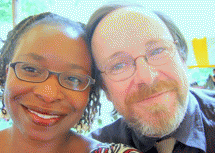
An alternative school rooted in the tradition of experimental programs, it is currently operated by an inspired couple: Welch, a second generation educational visionary, musician, and multilingual Harvard graduate, and his wife, artist Julia Nambalirwa-Lugudde, a native of Uganda who brings an exciting global perspective to the educational offerings.
Their goal is to provide students with an education that is filled with exciting, real life experiences that teach critical thinking, instill problem-solving skills, and inspire excellence and creativity. The school was founded in 1983 by Welch’s mother, Patricia Jennings-Welch, who distilled her vision from an eclectic mix of Piaget, Montessori, Dewey, Vygotsky, Bruner, Gardner, and her own philosophies.
Unlike the bulk of the high-tuitioned, private school movement, the Greenhouse School has chosen to ground itself in the power of the “now,” taking its cues from the local community and current events. Greenhouse serves a culturally and economically diverse range of students from preschool to eighth grade, including many from low-income families.
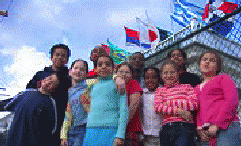
The school’s substantial cultural diversity is honored by a flock of flags flying from the roof: Each of the countries of origin of students, staff and family is honored with a flag. Because there isn’t enough room on the roof to fly all 50 flags at once, they must be flown in rotation.
While the school’s year-round, full-day educational program offers a schedule that generously meets the needs of working parents, the innovative after-school program content is what draws the excited participation of kids from other school systems.
(Note: You can view every article as one long page if you sign up as an Advocate Member, or higher).
 2
2
 2
2
 2
2






