




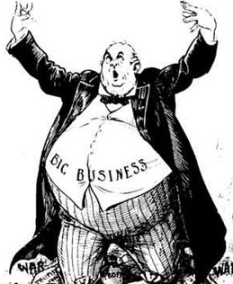
The Supreme Court of the United States will soon announce a major decision on our lightly controlled system of campaign funding. Will it retain some limitations on corporate influence or will the court blow the lid off and cause a perpetual flood of unrestricted corporate contributions?
An additional outcome may surprise and shock the public.
If the Supreme Court overturns the lower court's decision, foreign nationals, corporations, and governments with partial ownership of U.S. corporations will, in effect, end up contributing to and influencing U.S. candidates in federal elections.
The Supreme Court surprised many when it agreed to hear an appeal of a lower court ruling that enforced key sections of the Bipartisan Campaign Reform Act of 2002 (McCain-Feingold) -- Citizens United v. Federal Elections Commission (FEC).
In January 2008, the Federal District Court, District of Columbia upheld an FEC action that barred Citizens United, a right wing nonprofit corporation, from airing an extended attack on Hillary Clinton called Hillary: The Movie. Citizens United is headed by David Bossie, a well known political enemy of the Clintons. Citizens' lead counsel, Ted Olsen, is an alumnus of the infamous 1990's Clinton bashing Arkansas Project.
The lower court found The Movie violated provisions of McCain-Feingold since some funding for the movie came from the general treasury of Citizens United, rather than a segregated account for political action, e.g., a Political Action Committee (PAC). The Movie had the sole purpose of convincing viewers that Clinton was unfit for office, making it an example of electioneering communications -- the overriding purpose of which are to advocate for the election or defeat of a candidate. And The Movie was planned for broadcast both 30 days prior to Democratic primaries and 60 days prior to the general election (had Clinton won the nomination), blackout periods for electioneering communications.
In its appeal, Citizens argued that broadcast restrictions in McCain-Feingold should be overturned to allow unrestricted electioneering communications funded directly from corporate treasuries.
But the appeal also served as a vehicle for lifting virtually any ban on corporate giving. In 1990, the Supreme Court ruled that corporate funding of campaigns from general funds could be restricted. The heart of the decision is found here:
"they
(the Michigan laws) are justified by a compelling state interest:
preventing corruption or the appearance of corruption in the political
arena by reducing the threat that huge corporate treasuries, which are amassed with the aid of favorable state laws and have little or no
correlation to the public's support for the corporation's political
ideas, will be used to influence unfairly election outcomes. Justice Marshall, Austin v. Mich. Chamber of Comm., 1990
Lead counsel for Citizens United, Ted Olsen, argued that "Austin
was wrongly decided and should be overruled." He counters with another
case that claimed,"First Amendment's protection against governmental
abridgment of free expression cannot properly be made to depend on a
person's financial ability to engage in public discussion.Ã ? � Ted Olsen, Merits Brief, p. 30, Sept. 9
This challenge to the Austin decision is the true threat within the Trojan horse argument over broadcast restrictions on political hit pieces. The goal of this appeal is nothing less than the legal treatment of corporations as the equal of individual citizens and lesser groups in the political process resulting in an even greater advantage for corporations to control elections.
(Note: You can view every article as one long page if you sign up as an Advocate Member, or higher).
 2
2
 2
2
 1
1






