




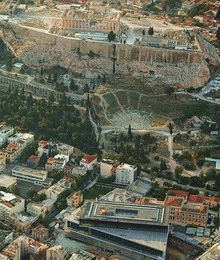
The date has been announced. On June 20th, the New Acropolis Museum of Athens will be inaugurated, opening its gates to the public. Crouching at the foot of the Acropolis rock, the brand new Museum is consisting the forefront of Greece's continual effort for the restoration of the Parthenon Marbles. The opening of the 130 million Euro ultra-modern building, which covers almost 14,000 square meters of exchibition space, dismantles the years-long argument that there isn't a proper place to host the ancient Sculptures in Athens. But, actually, the new Museum isn't the only reason which advocates in favour of Parthenon's Sculptures back to Greece - there are, at least, seven more points:
1. Lord Elgin action's illegality: Thomas Bruce, then British ambassador in Istanbul, did not have the legal right to remove (in 1801) the ancient masterpieces from the Parthenon. Officially, Elgin obtained a 'firman' from the Ottoman authorities but when the British Parliament asked to examine it, he couldn't submit it. What he submitted was an italian translation of the official document. I reproduce from an interesting article of the American Committee for the Reunification of the Parthenon Sculptures, Inc: "Specialists in Ottoman Law point out that the document does not carry the signature and seal of the Sultan or his customary invocation to God, and without them, Elgin and by extention the British Museum have no legal evidence of ownership of the Parthenon Sculptures" (Newsletter, Nov.2008).
Therefore, the argument of the British Museum's administrations that the Sculptures consist "legal property of the museum" is doubted. How proper is to base the 'legality' of Parthenon Marbles' ownership on a translated version of a letter probably produced by a low-ranked Ottoman official?
2. The precedent cases of artifacts restitution: Two years ago, the Los Angeles-based J.Paul Getty Museum returned to Greece a 4th century BC Macedonian gold wreath as well as a 6th century BC marble statue of a woman; eight years ago, in 2001, the same museum had handed back to Italy almost 500 ancient objects. Going back three years ago, in September 2006, the Heidelberg University of Germany handed over to Greece a small piece of Parthenon's north frieze.
In 2008 the Vatican decided to give back a Parthenon fragment, while on the same year a British court ordered the return of a Byzantine icon which had been stolen 30 years ago from a Greek monastery. Furthermore, during last September, in a gesture of meritorious goodwill Italy gave back to Greece a fragment of the Sculptures which had been acquired by a museum in Palermo, Sicily; its worthy of remark that the Italian President Giorgio Napolitano personally presented the restored fragment to his Greek counterpart Karolos Papoulias.
3. Complete view of Parthenon: Almost 99% of what survives of Parthenon's masterpieces is exposed in London and Athens According to Professor A.M Snodgrass of Cambridge University, "among these pieces, the British Museum possesses fifty-five of the fifty-six frieze slabs, all twenty of, the pediment figures and fifteen of the sixteen metopes, nearly 98% in total" (Appendix B, British Committee's submission to the Select Committee of the House of Commons). But the removed Marbles consist core part of the whole architectural environment of the Acropolis and their position is in sight of the building to which they actually belong and not in the hall of a museum in the other side of Europe. As Professor Snodgrass writes "if the aim is to investigate the meaning attached to the original design as a whole, it would be a huge gain to have virtually all the surviving material in one location" - that location is the New Acropolis Museum, in the shaddow of the Parthenon.
The visitor in the renowned British Museum sees some random parts of the Parthenon, along with other ancient masterpieces of other civilizations and historical periods. But if the Sculptures will be exhibited in the modern Acropolis Museum, the visitor will have the great opportunity to appreciate them in their original environment, in sight of the Parthenon and very close to other known ancient Athenian sites (e.g. ancient market, Olympic Zeus Temple etc). of Athens will be inaugurated, opening its gates to the public. Crouching at the foot of the Acropolis rock, the brand new Museum is consisting the forefront of Greece's continual effort for the restoration of the Parthenon Marbles. The opening of the 130 million Euro ultra-modern building, which covers almost 14,000 square meters of exchibition space, dismantles the years-long argument that there isn't a proper place to host the ancient Sculptures in Athens. But, actually, the new Museum isn't the only reason which advocates in favour of Parthenon's Sculptures back to Greece - there are, at least, seven more points:
5. Public Opinion's stance: If the restitution of the Marbles was fully dependent on what people think, then the British Museum should have handed them back to Greece. According to a poll conducted during 2008 by the British Ipsos-Mori firm (2,109 persons in 198 UK locations), 69% of those who were familiar with the issue were in favour of Sculptures' restitution to Greece, while only 13% expressed opposition. In comparison with a poll conducted in 2002, there is a 7% increase in the number of the British people who support the Marbles' restoration.
Previous polls, conducted in the United Kingdom during the 90s, had similar results, proving that the majority of Britons (who are familiar with the issue) are in favour of Sculptures' restitution.
6. International Pressure: The campaign for the restoration of the ancient masterpieces back to Greece has gained international recognition. From Australia to the United States, significant celebrities from the political and cultural scene, as well as distinguished scholars, have favoured the Parthenon Sculptures' Restitution. International organizations such as the European Parliament and UNESCO have formally supported that aim, while politicians from various countries have expressed their keen interest towards the reunification of the Parthenon.
For example, in the UK, the late Robin Cook, MP and Secretary of State (1997-2001), was in favour of Sculpture's restoration. The former Mayor of London, Ken Livingstone, had said that the Marbles "should return home once there is a proper place for them there", while the Labour Euro-MP Alfred Lomas has repeatedly urged the British government to take positive initiatives on the issue. Moreover, in 2000, U.S. Senator Peter Fitzgerald of Illinois introduced a resolution (S.Con.Res 127) in which he expressed the "sense of the Congress that the Parthenon Marbles should be returned to Greece".
7. A European Cultural Heritage Issue: Except from a bilateral issue between Greece and the United Kingdom, the case of Parthenon's reunification is a matter of E.U.'s common Cultural Heritage. On January 1999, the European Parliament adopted a declaration in which it assured its support "for the return of the Elgin marbles to Greece, reflecting the view held by the majority of the British public on this matter and international instruments designating the Parthenon a world cultural heritage site".
According to Professor Francesco Buranelli, the head of the Pontifical Commission for the Cultural Heritage (Vatican), Lord Elgin's act "left a deep wound in European cultural sensitivity". That needed sensitivity on Europe's Cultural Heritage is mentioned in Article 151 of the E.U. Treaty, which stipulates that the Community must support and supplement action by the Member States in order to conserve and safeguard cultural heritage of European significance. The Athens Parthenon is definitely Europe's landmark monument, epitomizing its historical, political and cultural roots.






