




Will contributing time and money to the Obama campaign, or just voting for Obama make any meaningful difference as to how the future unfolds? Conversely, does time and energy spent working for an Obama victory simply detract from applying these assets towards working for real societal transformation? I believe that evaluating these questions from a systems theory perspective provides insight on their resolution.
Global society constitutes a complex adaptive system. All systems possess three fundamental attributes:
1) Interconnectedness. A set of units or elements are interconnected so that changes in any element or elements produce changes in all. A change in any part of such a system causes rippling changes throughout every part of a system.
2) Emergence. The system as a whole possesses collective properties which are qualitatively different from, and not reducible to, the properties of its constituent elements. The wetness of a water molecule is not reducible to the properties of its constituent hydrogen and oxygen atoms. Similarly, consciousness is not reducible to the properties of individual neurons.
3) Boundedness. All systems possess a definite boundary between system and not system. This boundary may be closed or open. For complex systems, it is open.
Complex systems have unpredictable outputs. They process information and transform themselves in accordance with the results of their information processing. This is particularly true for complex systems composed of conscious elements such as human beings.
Because global human society is a complex adaptive system, its configuration is determined by the results of its information processing. All such systems may be said to evolve along a fitness landscape. As such they possess trajectories through this landscape or, as I usually call it, through learning space.
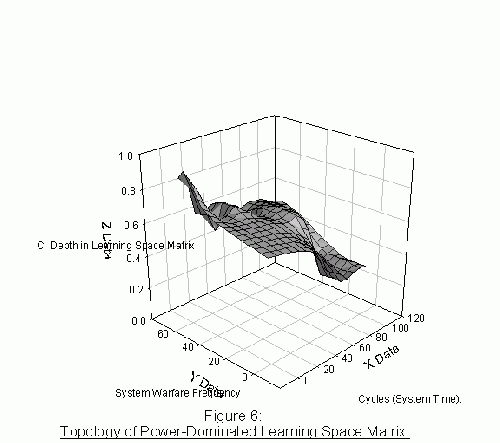
Above, I’ve included examples for a fitness landscape and its associated trajectory for human civilization from a paper I presented in 1997 at a conference on sociocybernetics at the University of Amsterdam. Once a complex system such as human civilization is reduced to a computer simulation, its fitness landscape and trajectory become readily apparent. The full text of the paper is available at: http://www.michaelpbyron.com/SystemicaArt.htm for anyone interested in following this topic up in more depth. [Note: If these images do not appear above, they can be found at: http://www.michaelpbyron.com/image022.gif and at: http://www.michaelpbyron.com/image023.gif .]
Because people learn and have goals, society as a whole has goals and attempts to “learn” its way towards the attainment of these goals. Security, comfort of life, and health are fundamental goals for all humans. Attempts at ordering society through law, fairly and impartially enforced by a government, which is responsive to the citizenry, represent one such goal. Another goal has been the provisioning of public goods. Basically, we have sought both to develop ever greater organizational “software” for governance, in conjunction with ever more powerful “hardware” for the provision of material goods.
In a system everything that happens causes rippling changes throughout the system. Consider our present day world: We have had limited success with developing the “software” needed to create what we would intuitively recognize as a just and humane society. We have recently been somewhat more successful at the provisioning of material goods, thanks primarily to cheap hydrocarbon energy. This material success has led us to the point where nearly seven billion humans are artificially sustained by the rapid release of chemical energy stored in oil and other hydrocarbons. However, availability of these resources must begin to decline ever more precipitously, and beginning soon.
(Note: You can view every article as one long page if you sign up as an Advocate Member, or higher).








