




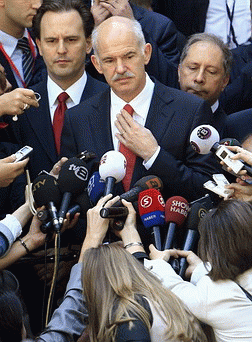
The newly elected Socialist Prime Minister of Greece, George Papandreou, during his recent visit in Turkey.
Some people in Greece believe that the newly-elected government of George Papandreou will exercise an explicit "pro-American" Foreign Policy. They argue that the Prime Minister is going to abandon the energy politics of his predecessor, Costas Karamanlis, who signed the Burgas-Alexandroupolis pipeline project along with Russia and Bulgaria. Nonetheless, Premier Papandreou himself has made clear that his new PASOK government will support the project, renegotiating a few changes regarding economic and ecological reasons. It's furthermore known that a part of local society in the northern port of Alexandroupolis has expressed serious concerns about the effects of the pipeline in region's environment.
The above matter brought the Greek-Russian relations back to the news, as long as energy politics are directly, or indirectly, related with Foreign Policy in South-Eastern Europe. But most importantly, they seem to be closely related with Greece's national issues. The deal of Athens with Moscow and Sofia over the Burgas-Alexandroupolis oil pipeline on April 2007 had created a discontent situation in Washington DC* - moreover, it was probably one of the reasons which led to the strong pressure that the Bush administration exersiced over Athens regarding the naming dispute between Greece-FYROM and the perpective NATO membership of Skopje. Analysts express the opinion that the United States saw the agreement of the Greco-Russian-Bulgarian pipeline as an alternative to their ambitious energy projects in the broader region. The then Greek Premier Karamanlis tried to keep distances from Moscow after the election of Barack Obama, while Athens kept to a "neutrality" situation during it's presidency at the OSCE.
However, it's clear that the Athens-Moscow agenda is not limited only in the energy field. The intention of Russia to strengthen it's relations with Turkey - which was confirmed with the visit of Premier Vladimir Putin in Ankara - and the role of the Kremlin in the Cyprus Issue mainly as a permanent member of the U.N. Security Council create an extraordinary trilateral agenda between Russia, Greece and Turkey.
From it's side, Moscow warns that there are alternative solutions to Burgas-Alexandroupolis and an example of that is the agreed (between Putin and Erdogan) Samsun-Ceykan pipeline. This last project was signed in presence of Prime Ministers Putin, Erdogan and Italy's Silvio Berlusconi.
According to Andreas Theofanous, Professor of Political Economy at the University of Nicosia, "both Russia and Turkey seek a leading role in the region while Ankara makes a serious efforts for the reinforcement of it's regional and international role. [...] "Now Turkey wants to send to both the EU and the US the message that it has a multidimensional Foreign Policy" (Simerini Newspaper, 8.8.2009). But, the Russian message over energy Politics in Eurasia goes to Washington and secondly, to the European Union.
A Cypriot expert in Defense and Strategy Issues and MP, Dr. Aristos Aristotelous, argues that the South Stream agreement "sends the message of how easily Russia can mobilize strategic partners of the broader region (like Turkey or Italy) in order to countermove competitive and rival solutions of Washington or Brussels" (Simerini, 8.8.2009). Indeed, the perspective of Gazprom's investments in Turkey and the plans for Ankara's participation in both South Stream and Nabucco projects urge Greece to find a new diplomatic balance between Russia and the United States in order to serve it's national interests. George Papandreou faces this challenge from the very start of his premiership and has to respond effectively to the situation.
Athens has to strengthen it's international position and role in the crucial sector of energy diplomacy, through the establishment of a multidimensional and multilateral Foreign Policy. It's therefore quite important for Greece's new government to renegotiative (in favour of the country's interests) and accomplish the Burgas-Alexandroupolis project but also to keep fairly equal distances from both the White House and Kremlin. It's time for Athens to send it's own message.
Burgas-Alexandroupolis
The Burgas-Alexandroupolis project is a 279 km-long oil pipeline, starting from the port of Burgas, in Bulgaria, to the city of Alexandroupoli, in Greece, with a total budget of à ? ¬900-1,000 million, and initial annual output of 35 million tons puts Greece and Bulgaria on the regional and international oil map. The pipeline is estimated to be completed on late 2011 and will have a total length of 288 km, 161 of those passing through Bulgarian soil.
An inter-governmental agreement on the project was agreed on 7 February 2007, and it was signed on 15 March 2007 in Athens, by the involved ministers of the three countries, under the presence of their leaders, Vladimir Putin (then Russian president) Sergey Stanishev (then Bulgarian prime-minister), and Costas Karamanlis (then Premier of Greece).
The critics of the Burgasà ??Alexandroupoli pipeline project have raised serious environmental concerns because of oil tankers traffic in the Aegean Sea, which contains numerous submerged rocks and island populations, many of them fully dependent on tourism and fishing industries. They argue that a possible oil spill in the Aegean would be quite devastating for Greece's tourism industry.
 1
1
 1
1
 1
1






