Refresh   Tag(s): ; ; ;
Add to My Group
November 26, 2009 at 10:13:18

View Ratings | Rate It

Promoted to Headline (H4) on 11/26/09:

And Two Centuries Later, the Money-Grubbing Materialists Are Still About Destroying the Planet

FACEBOOK
submit to twitter
submit to reddit
submit to digg

Tell A Friend

By GLloyd Rowsey (about the author)     Page 1 of 2 page(s)

opednews.com     Permalink

For OpEdNews: GLloyd Rowsey - Writer

"Where the little river Liris runs into the Gulf of Gaeta, seventy miles south of Rome, may be placed the natural boundary between central and southern Italy."

Thus begins "Greek Cities in Italy and Sicily," a book written by David Randall-MacIver and published in 1931. This was pretty much square in the middle of the period written about by Paul Fussell in "Abroad," his study of English literary travelogues written between the world wars; and the minor key of "Greek Cities" is indeed the travelogue.

But the major key of Greek Cities is a description of Greek architectural sites in southern Italy and Sicily in the late 1920's, with narratives about the cities where the sites are found including the cities' mythologies and most famous citizens, visitors, and political figures. The book's history, then, spans the period from about the eighth century BC to about the third century BC, when Rome displaced Carthage permanently from Sicily in the Punic Wars, and usurped the Greeks' dominance on the island.

So, I skimmed the book's first eighty pages about the Greek cities in southern Italy and started with Chapter VIII - "From Paola to Syracuse" - which begins in the book's minor key and then modulates effortlessly into its major key; and I paraphrase from Chapter VIII's first paragraphs:

"The majority of my readers in all probability will start for Sicily from Naples."


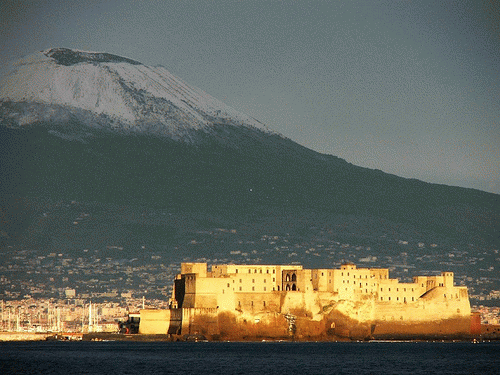
Naples and Vesuvius, by Claudio Vaccaro at Flickr (2006)

"And if I may advise them I would say do not go by sea, which is perfectly uninteresting. Once out of sight of land, one piece of sea is exactly like another, and if the crossing is made at night even the sea is invisible. But the railway journey down the west coast of Calabria and the east coast of Sicily is the experience of a lifetime. There is scarcely a journey in Europe which is so beautiful and so full of historic interest at every moment....If it chance to be in the middle of February, it seems as though snow-clad trees were reflecting the rising sun (in Calabria). These are the almond trees in blossom....At Villa San Giovanni the train is ferried across the straits on a steamer (to Messina), a picturesque proceeding, and more practical than the method by which Herakles once crossed these waters, swimming beside the oxen stolen from Geryones with his arm resting on one horn of the leader. It would seem a very difficult undertaking to swim the straits against the currents even if we ignored Charybdis. And yet it is on record that when Himilkon stormed Messina in 397 B.C., 200 of the city's defenders threw themselves into the waters and no less than fifty succeeded in reaching the Italian shore...."

Commencing with Messina across the narrow straits at the toe of Italy's boot, Randall-MacIver follows Sicily's east coast southerly turning west where the coast does at the island's southeastern point, to touch successively at each of the following principal Greek cities: Messina, Taormina, Acireale, Catania, Lentini (inland), Syracuse, Gela-Kamarina (Terranova), Akragas (Girgenti), Selinus (Sciacca or Castelvetrano), Segesta (inland- Salemi? Calatafimi?), and Enna (inland). Not surprisingly, Randall-MacIver devotes almost as many pages to Syracuse as to the other cities combined.


The Straight of Messina, by Vito Manzari at Flickr (2008)


Taormina, by gnuckx cco at Flickr (2009)


Pietro di Catania, by queelo at Flcikr (2006)

By far the greatest number of Greek architectural sites on Sicily are the remains of Doric temples devoted to gods, but probably the most famous remains are those of the theater at Syracuse. Paraphrasing again -

"(The theater was)...probably built by Hieron I, who reigned (in Syracuse) from 478 B.C. to 467 B.C....(and it was)...certainly enlarged and restored...two hundred years later. It is one of the finest Greek buildings in the whole world..., is hewn out of the native rock, (and) measures 440 feet in maximum diameter. Originally it had sixty-one tiers of seats, divided into nine wedge-shaped blocks. At the back of the theater is the well-known "street of tombs', which leads up to a cemetery on the plateau just behind. This cemetery contains a mixture of tombs of all dates, some of them as late as the Christian period. There is no mixture, however, in the "street of tombs.' The great caverns on either side of the way are all post-Hellenic; they are not Greek, still less are they Sicilian, but they belong to the period of the Roman Empire; and this fact must be emphasized, because even our best writers have been misled by an erroneous interpretation which has been current for half a century."

Regarding some of the "many historic memories" of the theater at Syracuse, Randall-MacIver writes:

"When Aeschylus visited Syracuse we are told by an anonymous commentator that he witnessed in this theater a performance of his own Persae....Plays of Sophocles, Euripides, and many less famous dramatists were performed in this theater before distinguished visitors from Sparta, Corinth, and every part of Greece. Pindar and Plato must have sat at various times in the audience, and Theocritus almost certainly came here...."

Next Page  1  |  2


"Deprived of meaningful work, men and women lose their reason for existence; they go stark, raving mad." - Dostoevsky ** I'm sixty-eight and live in Northern California. I graduated from Stanford Law School in 1966 but have never practiced law. (more...)
 

The views expressed in this article are the sole responsibility of the author
and do not necessarily reflect those of this website or its editors.

Contact Author Contact Editor View Authors' Articles


Book Recommendations for "Books David randall maciver"
Libyan notes. by David Randall-MacIver and Anthony Wilkin ..
by Randall-MacIver. David. 1873-1945.

$23.95

Number of pages:
Publisher: London, New York, Macmillan

Mediaeligval Rhodesia. by David Randall-MacIver
by Randall-MacIver. David. 1873-1945.

$23.95

Number of pages:
Publisher: London, New York, Macmillan and Co., Ltd., 1906.

El Amrah and Abydos, 1899-1901, Volume 23
by David Randall-MacIver

$26.75
Lowest New Price $19.92

Number of pages: 246
Publisher: Nabu Press

The Etruscans
by David Randall-Maciver

$7.50

Number of pages:
Publisher: Cooper Square Publishers, Inc.

View All Book Recommendations

Share this page: (what's this?)                   Tell a Friend: Tell A Friend

FACEBOOK      DIGG THIS      Add This Page to Mr Wong!           NEWSVINE      DEl.ICIO.US      Looksmart Furl      NETSCAPE      My Web      Tag!RawSugar      Blink List     (More...)

Comments: Expand   Shrink   Hide  
4 comments
To view all comments:
Expand Comments
 

As Far by shadow dancer on Thursday, Nov 26, 2009 at 3:58:23 PM
The Christian fanatics, however... by Allan Wayne on Thursday, Nov 26, 2009 at 10:49:21 PM
THE ANT HILL by MARGARET BASET on Saturday, Nov 28, 2009 at 2:33:06 AM
Thank you for this, Ms. Baset. by GLloyd Rowsey on Saturday, Nov 28, 2009 at 5:58:27 AM


Tell a Friend: Tell A Friend

Copyright © 2002-2010, OpEdNews

Powered by Populum