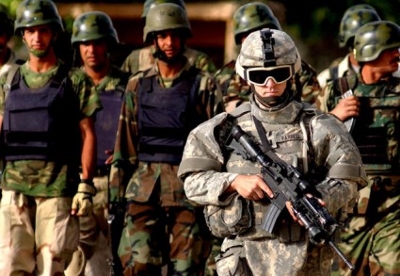

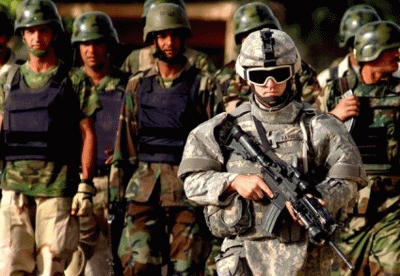
Salvador Option (mass-murder) was applied in Iraq, now coming to Pakistan, compliments of US military (editor) - (source)
Three US Marines were killed and another two injured in a suicide attack in Dir, northern Pakistan on Wednesday. The Americans, disguised in traditional Pakistani dress, were traveling with Pakistani military officers in a five-car convoy to attend the inauguration of a girl school, which had been renovated with the U.S. humanitarian assistance. Four schoolgirls and a paramilitary soldier were also killed in the attack while more than 120 school girls were injured.
To many Pakistanis the most shocking aspect of the latest Taliban suicide bombing the question was: What was a team of American soldiers doing in a volatile corner of North West Frontier province?
According to Pakistan's leading newspaper, The News, the three US soldiers were apparently in the area to train the paramilitary Frontier Corp personnel engaged in the military operations against the Taliban in the area.
The suicide bombing on Wednesday was the first against the US soldiers in Pakistan. And it was the first time
that so many American soldiers were killed and injured in Pakistan. A US
Embassy statement said they were the US
military personnel in Pakistan
to conduct training at the invitation of the Frontier Corps.
The News reported that
the slain US soldiers were
part of a 100-member strong special American military training unit which was
dispatched to Pakistan
in 2008 to raise a 1,000-member strong well-trained paramilitary commando unit
which could conduct guerrilla operations against the Taliban militants active
in the Pak-Afghan tribal belt.
The military training program was never officially announced by Pakistan to
avoid a possible backlash by the masses which are opposed to the American
military presence on the Pakistani territory. Interestingly, the US-funded
training course for the largely under-equipped and under-trained Frontier Corps
included both classroom and field sessions.
The News said that besides dispatching American marines to train the Frontier Corps personnel, the Pentagon had also sent a special team of its Special Forces military advisers, communication experts, technical specialists and combat medics to help establish coordination centers on Pak-Afghan border so that the American and Pakistani officials could share intelligence about al-Qaeda and Taliban elements in and around the tribal areas.
In the beginning, the American military trainers confined themselves to
training compounds due to security concerns in Pakistan. However, they had now started
accompanying Pakistani troops on special guerrilla operations against the
Taliban, eventually leading to the Wednesday incident in Dir Lower which shares
a border with Afghanistan
and with the restive Swat district, where the Army had carried out a massive
military operation last year.
Pakistani press reports indicated that the American soldiers were part of a
$100 million Pentagon-funded training program which is meant to equip the Frontier
Corps with new body armor, vehicles, and surveillance equipment, and plans to
spend $75 million more during the next year. As per the program, the Pentagon
intended to spend around $400 million more in the next few years to train and
equip the Frontier Corps. This is in addition to a 7.5 billion dollars US
assistance for the next five years announced last year under controversial the Kerry-Lugar
Act. But behind the scenes the US is engaged
in other ways. Over the past decade it has given over $12bn in cash directly to
the military to subsidize the costs of fighting the Taliban and al-Qaida. Ominously,
part of the money doled out to Pakistan's
mercenary army by the Pentagon is for what United States Special Operations
Command (USSOC) calls Foreign Internal Defense (FID) a key pillar of Special
Forces' Unconventional Warfare doctrine.
El Salvador Option:
(Note: You can view every article as one long page if you sign up as an Advocate Member, or higher).