







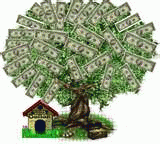
Money Tree
Government can, does, and has, created money without debt. It does this currently every time it produces physical coins, and has done so since 1792, under the original coinage act. The same option exists for paper money. Henry George, writing in The Standard, (December 1889), during the height of the Greenback era, said [1] (emphasis added):
"The constitutional power to issue money comes from the following clauses of the constitution:
Sec. 8.-The congress shall have power:
To borrow money on the credit of the United States.
To coin money, regulate the value thereof, and of foreign coin, and fix the
standard of weights and measures.
As to the nature of money - Gold and silver are not of themselves money, nor yet can money be made by legislative fiat. What makes anything money is the common consent to receive it. Where this exists without it, no intrinsic value is needed, Where this does not exist, governments may stamp and issue and fiat in vain. The history of our own governments, as the history of all governments, proves this.
Gold
and silver, and in a less degree, copper, do possess certain natural qualities
of permanence, portability and divisibility which peculiarly fit them for use
as money so long as intrinsic value is a necessary quality, and which still
give to the first of these metals something of the character of an
international money as a standard of value and in the settlement of balances.
But where there is a credit and confidence behind it sufficiently stable and
wide, paper becomes the most convenient and least expensive material out of
which money can be made.
The general government should be the
only issuer of money, both for the general convenience and the protection (in
the true sense of the term) of those who are most liable to have inferior money
passed upon them, and because the issuing of credit money for general
circulation is a valuable privilege, which ought to be shared by the whole
people and not suffered to enrich a few.
We have at the present time in the United States nine kinds of money in
circulation. Copper coins, nickel coins, silver coins, gold coins, silver
notes, gold notes, national bank notes and direct treasury notes, or greenbacks.
Of these nine kinds of money, only one kind, the gold coins, have an intrinsic
value equal to their current value. But this one kind of money, which alone has
intrinsic value equal to its current value, is not at all preferred by the
people on that account. On the contrary, over the far greater part of the
United States (I do not know how it is now in California, as I have not been
there for some years), silver notes, national bank notes, or even greenbacks, are preferred to gold as
having an equal current value and being more portable; and all these nine kinds
of money, differing greatly in intrinsic value and representative character,
circulate interchangeably at par with one another. The induction is
irresistible that it is not the intrinsic value of the money, or anything that
is pledged for the redemption of the money, or is held by the United States as
its representative, but the credit of the government itself which secures the
common consent by virtue of which our money circulates. Therefore it is a sheer
waste that we should be buying and hoarding up in treasury vaults immense
quantities of gold and silver that might as well be in the mines from which
they are taken for any useful purpose they are serving. One uniform currency,
consisting of paper and subsidiary coins, the direct issue of the government,
and such gold coin as anybody wanted the United States to assay and stamp,
would save an enormous sum annually to the people of the United States.
The real thing which gives paper money its validity is not the government
stamp, but the common consent and general credit which attend it."
George concluded with a warning:
"What
the silver men want are two things, or rather there are two classes of silver
men, each wanting a separate thing, who are uniting their forces:
1. Those who want the government to buy silver for which it has no need, in the
hope that they will get a higher price for their metal.
2. Those who want to depreciate the currency by bringing it to a silver basis.
I am opposed to both these projects. But if we must depreciate our currency let
us at least do it in the cheapest and most manly fashion, by issuing directly
currency enough to do it, without buying hundreds of tons of silver for which
we have utterly no use."
George, then, was a fiat, paper money, advocate.
Pre-Revolution
Paper money, like other kinds of currency, has a long and complex history in the United States. Paper Notes in use before and during the Revolution [2]:
There are two distinct epochs of paper money in America.
The first began in 1690 and ended with the adoption of the U.S. Constitution in 1789. In this first epoch the legislatures of the various colonies (later states) directly issued their own paper money -- called bills of credit -- to pay for their own governments' expenses and as mortgage loans to their citizens, who pledged their lands as collateral. This paper money became useful as a circulating medium of exchange for facilitating private trade within the colony/state issuing it. By legal statute and precedent, people could always use their paper money to pay the taxes and mortgage payments owed to the government that had issued that specific paper money, which, in turn, gave that money a local "currency." There could be as many different paper monies as there were separate colonies and states.
Several colonies -- Massachusetts, New Jersey -- issued paper money, not redeemable in precious metals. [3] Ben Franklin rescued Pennsylvania from depression caused by lack of currency, by issuing state-sanctioned paper money (1723). [4]
Paper money became so popular that the English Crown banned it in 1764, preventing the colonies from paying debts to creditors in paper money [5] despite pleadings from Franklin:
I'll tell the honorable gentlemen of a revenue that will produce something valuable in America: Make paper money from the colonies, issue it upon loan there, take the interest, and apply it as you think proper.
Next Page 1 | 2 | 3 | 4 | 5 | 6
(Note: You can view every article as one long page if you sign up as an Advocate Member, or higher).
 4
4
 2
2
 2
2






