




"Poor is the nation that has no heroes, but beggard that Nation that has and forgets them."
-- Anonymous In America, "support the troops" has been elevated to the status of an eleventh commandment. Whether for or against the Iraq War, we'd never forget our military heroes. Or would we? Quick -- name the two Congressional Medals of Honor it's produced. If you picked Pat Tillman, you're mistaken (though it would have surprised no one if, had he lived, he'd won one). Try Army Sergeant First Class Paul R. Smith and Marine Corporal Jason Dunham, both honored posthumously. According to his presidential citation, Sergeant Smith, "moved under withering enemy fire to man a .50 caliber machine gun mounted on a damaged armored personnel carrier. In total disregard for his own life, he maintained his exposed position in order to engage the attacking enemy force" before he was mortally wounded. Corporal Dunham was attacked at a road check by an insurgent who leaped out of a car and unleashed a grenade. He "covered the grenade with his helmet and body, bearing the brunt of the explosion and shielding his Marines from the blast." The point is not to shame Americans for their lack of both knowledge and acknowledgment of those who made the supreme sacrifice, whether for God, country or just their unit. In fact, broadly speaking, it's been since World War II that medal winners haven't been treated with the acclaim due them. The 50-year trend seems to have reached its apex, however, with Iraq. Neglecting decorated members of the military who served in Iraq might strike a progressive or pacifist as a sign of opposition to our presence there. But lest we become "beggard," it might be worth our while to root out the deeper reasons that military heroism fails to register on our radar. After World War II, America's most decorated veteran, First Lieutenant Audie Murphy, was treated to a hero's reception almost everywhere he went. It was tough to be a boy in the fifties and remain immune to Audie awe, a condition which didn't necessarily fade when we grew up. Such was Murphy's fame that it enabled him to serve as the star of a string of B-movie westerns even though he had little to recommend him as an actor other than his unnerving man-hunter gaze. In his book, No Name on the Bullet: A Biography of Audie Murphy, Don Graham described the incident for which Murphy was awarded the Medal of Honor. Here are some excerpts: "hundreds of Germans swarming from the woods. They all had automatic weapons. . . . all alone out there. . . . he climbed onto the tank destroyer turret and began firing its .50-caliber machine gun. . . completely exposed to the enemy fire and there was a blaze under him. "Twice the tank destroyer was hit by direct shell fire and Lieutenant Murphy was engulfed in clouds of smoke and spurts of flame. . . . He swung the machine gun to where 12 Germans were sneaking up. . . . [and] killed all of them at 50 yards." Murphy's Medal of Honor citation attributed 50 Germans killed or wounded to his actions that day. In less than three years in the European theatre, thanks in part to the hunting skills that became second nature to him during his dirt-poor childhood in Texas, he was credited with killing a total of 240 Germans. Another Medal of Honor winner who accumulated a high body count was oft-injured Lieutenant Colonel Matt Urban. His exploits didn't go unnoticed by the Germans, who called him "der geist" (the ghost) because it seemed like he kept coming back from the dead. Meanwhile, the war's top fighter "ace," Major Richard Bong, shot down 40 Japanese aircraft. It's hard to believe there was a time when our pantheon of personalities wasn't too rarefied to accommodate decorated members of the military along with its usual deities from the worlds of entertainment, society and sports. In fact, during World War II, service in the war was a prerequisite to prevent an athlete from becoming a pariah and for a movie star to retain his fan base. For instance, pitcher Warren Spahn won a Purple Heart and a Bronze Star. Among Hollywood's most decorated representatives were character actors Neville Brand, who won a Silver Star and Purple Heart, and Charles Durning, the recipient of a Silver Star and three Purple Hearts. Come Korea and the status of decorated soldiers began to wane. Hitting great Ted Williams was justifiably lauded for flying 37 combat missions, but who remembers any of that conflict's 132 Congressional Medals of Honor? With the advent of the Vietnam War, the public paid less attention to decorated soldiers (by which we also mean members of the Navy and Air Force) than ever. It's hard to imagine that the exploits of those like First Lieutenant Stephen Karopczyc failed to make an impression. According to his citation, he "dashed through the intense enemy fire into the open. . . . exposed himself as he ran from man to man to give encouragement and to direct their efforts. "A shot from an enemy sniper struck him above the heart but he refused aid. . . plugging the bleeding wound with his finger. . . he leaped up to cover the deadly grenade with a steel helmet. . . weakened by his multiple wounds, he continued to direct the actions of his men until he succumbed 2 hours later." There were 245 other such stories. The obvious reason for our distinct lack of enthusiasm for decorated soldiers after World War II is the absence of both clear-cut goals for a war and of victory shorn of ambiguity. First evident in the "Forgotten War" (Korea), the pattern was carved in stone with Vietnam. Furthermore, we weren't fully convinced that those we fought were actually our enemies. At least with the Koreans, who resembled the oft-merciless Japanese, lingering racial hatred from World War II could be summoned. But the Vietnamese were like third-generation Japanese. While still Oriental, most were too slight of build to invoke fear in the hearts of our corn-fed continent. To put a kind face on it, we may have been suffering from a hint of shame over bullying a smaller enemy. In the same vein, our reluctance to honor decorated veterans is further complicated by a vague uneasiness about civilians killed along with insurgents. We may have condoned or even cheered it on in a "total war" like World War II. But, perhaps because we soon determined they weren't direct threats to us, going all Rambo on the Vietnamese and Iraqis didn't seem called for. The public may not be motivated to lobby en masse for an end to Iraq. If only out of a subliminal guilt over civilian deaths, though, neither do we wish to honor it. Awards aside, we sometimes wonder how any of our enlisted men and women justify fighting such a war to themselves. By nature, many service persons are not inclined to the kind of interior life that addressing a question like this requires. But Shannon E. French, a philosophy professor at the US Naval Academy, has thought it through for them. In a 2003 article in The Chronicle Review, she wrote, "Individuals can fight for an objectively bad cause or a corrupt regime and still be warriors, as long as they have a warrior's code that requires them to observe the rules of war." Speaking of playing by the rules, it would be much simpler if those Iraqi militants who actually are Al Qaeda would brandish banners or even arm bands announcing their affiliation. Then Americans could keep a body count scrubbed clean of uncertainty over whether those killed weren't civilians or just Iraqi nationalists. In the interim, we remain uncomfortable honoring our troops. For additional insight, we approached Paul Woodward, proprietor of WarinContext.org, which assembles the most astute articles on war in the Middle East. He's also the managing editor of another widely read site, ConflictsForum.org, which aims, in part, to engage proponents of political Islam. Woodward expanded on the theory that muddled goals and the unlikelihood of unadulterated victory fuel public apathy about war heroes. "Ever since World War II, the United States has fought wars of choice," he wrote back. "Military action has become an instrument of foreign policy rather than an unavoidable means of national defense. "Individual acts of military heroism that symbolically represent the defense of the whole nation have gradually lost that symbolic power. War has come to reflect the goals of America's political leadership rather than the conviction of a national consensus. There is a split between the nation's civic life and its military endeavors. [Emphasis added.] "We talk about soldiers dying for their country but instinctively understand that they are really dying for their government. While some Americans still retain unwavering faith in the righteousness of their political leaders, many others increasingly understand that valor is now tarnished by the uncertainty that hangs over what we are fighting for." Ironically, whether or not they're honored by the public may not be as critical for members of the military as for the nation as a whole. It's often just as well to enlisted men and women to see the bitterness of their us-against-the world, unit-centric worldview confirmed. Also, elite troops, like a member of the Special Forces I know, are likely to hold the public in contempt for its naivete about how dangerous the world is. Still, with our appetite for television, movie and video game violence, you'd think we'd feast on the feats of decorated veterans. After all, they often border on the fantastic. In fact, while filming his own story, To Hell and Back, Audie Murphy expressed concern the audience wouldn't buy the scene depicting the firefight for which he won the Medal of Honor unless it were watered down. Maybe, though, decorated veterans' stories fail to engage us because they don't pack that present-day prerequisite for TV viewers' and film-goers' pleasure -- "24"-style torture porn or slasher-type "gorenography." Another reason the public takes a flyer on them might be that it finds the stories too corny. Commandeer an abandoned machine gun and mow down the enemy? Throw yourself on a live grenade? "Done to death," we think, rolling our eyes. Also, a Vietnam vet I know, perhaps reflecting the prevailing sentiment of the time, conjectures that the public sees war heroes, like all members of the military, as "suckers" for enlisting or, during Vietnam, failing to find a way out of the draft. In a nation as divided as ours, a consensual hero of any kind -- from Audie Murphy to Martin Luther King -- may no longer be possible. But, Don Sterner, the proprietor of Website HomeofHeroes.com (both a clearinghouse for and data base of medal winners), refuses to accept that. "First, no matter who YOU are," he writes, "there is bound to be a Medal of Honor recipient YOU can identify with. You can find your heroes on the sports field, but deep in your heart you know you can never be like them. . . . Medal of Honor recipients are ordinary people. . . [who] come in all shapes, sizes, ages. . ." The deeds of medal winners, as well as their commemoration, seem to run in a universe parallel to ours. Sterner, who has dedicated his life to their merger, and his wife, Pam, authored the Stolen Valor Act, subsequently passed by Congress. It expedites prosecution of those who impersonate decorated soldiers on occasions like Memorial Day with medals they've collected. You can be forgiven for thinking: "Sounds like flag burning. Does anybody actually do that?" But imposters are surprisingly prevalent, which would seem to indicate that decorated veterans are, in fact, heaped with laurels. More likely, it's just a reflection of the imposters' complexes. Now Sterner is working with Senator James Webb (D-Va.) to secure passage of the Preservation of Valor Act. This bill would mandate that records, currently scattered, of decorations from all wars be aggregated into one digital database. Who better to tell us why decorated veterans slip under the public's radar? "My answer might surprise you," Sterner replied. Turns out, in light of how traditionally patriotic this Vietnam vet is, it did. He continued. "Everybody wants to think the media ignores war heroes for celebrities. But it's the military itself that doesn't take the steps needed to focus our attention on them. Since Vietnam, it doesn't publish or publicize their deeds like it did during World War II and Korea. "Worse, when you approach it for information, it's like pulling teeth. It uses the pretext of national security to stonewall you. That's hogwash. You can't obtain a copy of a citation even if it's to help the military by creating a national database? How can we expect the public to celebrate our heroes when the military doesn't even honor its own?" Finally, we solicited the opinion of John Robb. He's best known for his "open-source warfare" concept, on which he discourses at his influential blog, Global Guerillas, and in his new book, Brave New War (Wiley, 2007), the sleeper of the season. He cited two reasons for the public's apathy. "One is that war is now marginal to the existence of most Americans. We don't sacrifice, it's voluntary and it's remote. Wars appear optional." Then, in unwitting agreement with Woodward, he wrote, "This is in line with the idea that soldiers fight for the government and not us." "Second, recognizing heroics makes people uncomfortable given the lack of attention, effort or sacrifice they have put towards our wars. They would rather not see that deficit in themselves." [Emphasis added]. "And finally, we live a post-heroic age. Anyone that ascends to that post is immediately put into context (usually aggressively)." Today, "post-heroic" is a business term that attempts to consign to history the age of star CEOs, fund managers and financiers. Collaboration and corporate politics are supposedly the operative words these days. (To the cynical, the term might sound like a smokescreen behind which anonymous hedge fund managers amass fortunes even larger than the "heroes.") It's hard to fault elevating the team above the individual, whether or not one thinks that's borrowing a page from Communism. But, at the most practical level, has anyone heard of the Army in recent years using the name of a military hero like Audie Murphy as a recruiting tool? Whether it assumes kids can't relate to the past or the Army's legal department prohibits it from dealing in body counts, the lack of role models can only make a recruiter's difficult job harder. To once again give the public the benefit of the doubt, there may be another reason lodged deep within our psyches that keeps us from showering decorated soldiers with honors commensurate with their deeds. Could it be that defending our country and rallying the public are not their primary functions? What if their courage under fire is only a trial-run for another role? In his biography of Murphy, Don Graham writes: "He symbolized the American GI who had endured combat and returned home unscathed by it all. The country needed to believe that our boys could be sent into violent encounters with death, dispatched from the safe haven of American homes. . . into the bloody, war-ravaged, ancient cesspools of human iniquity in Europe, be trained and praised for the act of killing, and return unaffected by it all, remaining psychologically innocent." Towards that end, Shannon French advocates transitional techniques to head post-traumatic stress disorder off at the pass. In an article entitled, "Warrior Transitions: From Combat to Social Contract," she writes that transitional practices, whether sacred or psychological, "that involve some kind of confession or purification. . . allow warriors to release any guilt or shame with which they may be burdened." Obviously we don't want veterans, decorated or not, bringing the war home with them, pulling the guns from under their pillows during drunken flashbacks and terrorizing their families. Recent wars have transformed many of them into living, breathing improvised explosive devices timed to go off in our midsts. Besides the families, as Graham pounds home in passage after passage, the nation as a whole harbors a deep-seated need for vets to return with their psyches intact. PTSD often results from guilt over killing non-combatants. Imagine you're fighting for your country after it's been invaded, the most justifiable of all possible causes for war. In one of those inevitable rage- or fear-filled moments, you kill a civilian. You may never forgive yourself. However, the degree of guilt you experience is less likely to reach the self-destructive level than if you killed a civilian during a war in which you're not defending your country, but, instead, another country is defending itself from an attack by you. If only soldiers -- foremost among them, decorated veterans -- would return PTSD-free. Failing that, they could at least have the courtesy to stifle those unsightly mood swings and the pride to bypass a touchy-feely transition process. Maybe then we'd honor our military heroes with six-figure publishing contracts and appearances on top talk shows. Furthermore, we'd have fewer reservations about allowing a future administration like the current one to fright-wig us into committing soldiers to revivals of the Vietnam and Iraq Wars. Many of us are only too glad to delude ourselves into thinking that every war our government wages is a just war and that war crimes are as rare as murders in small towns. But there's no putting the genie we uncorked during Vietnam back in the bottle. The state of mind of our veterans, decorated or not, is a barometer for the justness of a war. The extent to which we ignore them is, to some degree, a sign of how guilty we are that we haven't done more to prevent or end a war we started of our volition.
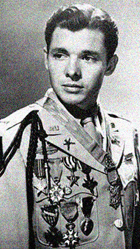
-- Anonymous In America, "support the troops" has been elevated to the status of an eleventh commandment. Whether for or against the Iraq War, we'd never forget our military heroes. Or would we? Quick -- name the two Congressional Medals of Honor it's produced. If you picked Pat Tillman, you're mistaken (though it would have surprised no one if, had he lived, he'd won one). Try Army Sergeant First Class Paul R. Smith and Marine Corporal Jason Dunham, both honored posthumously. According to his presidential citation, Sergeant Smith, "moved under withering enemy fire to man a .50 caliber machine gun mounted on a damaged armored personnel carrier. In total disregard for his own life, he maintained his exposed position in order to engage the attacking enemy force" before he was mortally wounded. Corporal Dunham was attacked at a road check by an insurgent who leaped out of a car and unleashed a grenade. He "covered the grenade with his helmet and body, bearing the brunt of the explosion and shielding his Marines from the blast." The point is not to shame Americans for their lack of both knowledge and acknowledgment of those who made the supreme sacrifice, whether for God, country or just their unit. In fact, broadly speaking, it's been since World War II that medal winners haven't been treated with the acclaim due them. The 50-year trend seems to have reached its apex, however, with Iraq. Neglecting decorated members of the military who served in Iraq might strike a progressive or pacifist as a sign of opposition to our presence there. But lest we become "beggard," it might be worth our while to root out the deeper reasons that military heroism fails to register on our radar. After World War II, America's most decorated veteran, First Lieutenant Audie Murphy, was treated to a hero's reception almost everywhere he went. It was tough to be a boy in the fifties and remain immune to Audie awe, a condition which didn't necessarily fade when we grew up. Such was Murphy's fame that it enabled him to serve as the star of a string of B-movie westerns even though he had little to recommend him as an actor other than his unnerving man-hunter gaze. In his book, No Name on the Bullet: A Biography of Audie Murphy, Don Graham described the incident for which Murphy was awarded the Medal of Honor. Here are some excerpts: "hundreds of Germans swarming from the woods. They all had automatic weapons. . . . all alone out there. . . . he climbed onto the tank destroyer turret and began firing its .50-caliber machine gun. . . completely exposed to the enemy fire and there was a blaze under him. "Twice the tank destroyer was hit by direct shell fire and Lieutenant Murphy was engulfed in clouds of smoke and spurts of flame. . . . He swung the machine gun to where 12 Germans were sneaking up. . . . [and] killed all of them at 50 yards." Murphy's Medal of Honor citation attributed 50 Germans killed or wounded to his actions that day. In less than three years in the European theatre, thanks in part to the hunting skills that became second nature to him during his dirt-poor childhood in Texas, he was credited with killing a total of 240 Germans. Another Medal of Honor winner who accumulated a high body count was oft-injured Lieutenant Colonel Matt Urban. His exploits didn't go unnoticed by the Germans, who called him "der geist" (the ghost) because it seemed like he kept coming back from the dead. Meanwhile, the war's top fighter "ace," Major Richard Bong, shot down 40 Japanese aircraft. It's hard to believe there was a time when our pantheon of personalities wasn't too rarefied to accommodate decorated members of the military along with its usual deities from the worlds of entertainment, society and sports. In fact, during World War II, service in the war was a prerequisite to prevent an athlete from becoming a pariah and for a movie star to retain his fan base. For instance, pitcher Warren Spahn won a Purple Heart and a Bronze Star. Among Hollywood's most decorated representatives were character actors Neville Brand, who won a Silver Star and Purple Heart, and Charles Durning, the recipient of a Silver Star and three Purple Hearts. Come Korea and the status of decorated soldiers began to wane. Hitting great Ted Williams was justifiably lauded for flying 37 combat missions, but who remembers any of that conflict's 132 Congressional Medals of Honor? With the advent of the Vietnam War, the public paid less attention to decorated soldiers (by which we also mean members of the Navy and Air Force) than ever. It's hard to imagine that the exploits of those like First Lieutenant Stephen Karopczyc failed to make an impression. According to his citation, he "dashed through the intense enemy fire into the open. . . . exposed himself as he ran from man to man to give encouragement and to direct their efforts. "A shot from an enemy sniper struck him above the heart but he refused aid. . . plugging the bleeding wound with his finger. . . he leaped up to cover the deadly grenade with a steel helmet. . . weakened by his multiple wounds, he continued to direct the actions of his men until he succumbed 2 hours later." There were 245 other such stories. The obvious reason for our distinct lack of enthusiasm for decorated soldiers after World War II is the absence of both clear-cut goals for a war and of victory shorn of ambiguity. First evident in the "Forgotten War" (Korea), the pattern was carved in stone with Vietnam. Furthermore, we weren't fully convinced that those we fought were actually our enemies. At least with the Koreans, who resembled the oft-merciless Japanese, lingering racial hatred from World War II could be summoned. But the Vietnamese were like third-generation Japanese. While still Oriental, most were too slight of build to invoke fear in the hearts of our corn-fed continent. To put a kind face on it, we may have been suffering from a hint of shame over bullying a smaller enemy. In the same vein, our reluctance to honor decorated veterans is further complicated by a vague uneasiness about civilians killed along with insurgents. We may have condoned or even cheered it on in a "total war" like World War II. But, perhaps because we soon determined they weren't direct threats to us, going all Rambo on the Vietnamese and Iraqis didn't seem called for. The public may not be motivated to lobby en masse for an end to Iraq. If only out of a subliminal guilt over civilian deaths, though, neither do we wish to honor it. Awards aside, we sometimes wonder how any of our enlisted men and women justify fighting such a war to themselves. By nature, many service persons are not inclined to the kind of interior life that addressing a question like this requires. But Shannon E. French, a philosophy professor at the US Naval Academy, has thought it through for them. In a 2003 article in The Chronicle Review, she wrote, "Individuals can fight for an objectively bad cause or a corrupt regime and still be warriors, as long as they have a warrior's code that requires them to observe the rules of war." Speaking of playing by the rules, it would be much simpler if those Iraqi militants who actually are Al Qaeda would brandish banners or even arm bands announcing their affiliation. Then Americans could keep a body count scrubbed clean of uncertainty over whether those killed weren't civilians or just Iraqi nationalists. In the interim, we remain uncomfortable honoring our troops. For additional insight, we approached Paul Woodward, proprietor of WarinContext.org, which assembles the most astute articles on war in the Middle East. He's also the managing editor of another widely read site, ConflictsForum.org, which aims, in part, to engage proponents of political Islam. Woodward expanded on the theory that muddled goals and the unlikelihood of unadulterated victory fuel public apathy about war heroes. "Ever since World War II, the United States has fought wars of choice," he wrote back. "Military action has become an instrument of foreign policy rather than an unavoidable means of national defense. "Individual acts of military heroism that symbolically represent the defense of the whole nation have gradually lost that symbolic power. War has come to reflect the goals of America's political leadership rather than the conviction of a national consensus. There is a split between the nation's civic life and its military endeavors. [Emphasis added.] "We talk about soldiers dying for their country but instinctively understand that they are really dying for their government. While some Americans still retain unwavering faith in the righteousness of their political leaders, many others increasingly understand that valor is now tarnished by the uncertainty that hangs over what we are fighting for." Ironically, whether or not they're honored by the public may not be as critical for members of the military as for the nation as a whole. It's often just as well to enlisted men and women to see the bitterness of their us-against-the world, unit-centric worldview confirmed. Also, elite troops, like a member of the Special Forces I know, are likely to hold the public in contempt for its naivete about how dangerous the world is. Still, with our appetite for television, movie and video game violence, you'd think we'd feast on the feats of decorated veterans. After all, they often border on the fantastic. In fact, while filming his own story, To Hell and Back, Audie Murphy expressed concern the audience wouldn't buy the scene depicting the firefight for which he won the Medal of Honor unless it were watered down. Maybe, though, decorated veterans' stories fail to engage us because they don't pack that present-day prerequisite for TV viewers' and film-goers' pleasure -- "24"-style torture porn or slasher-type "gorenography." Another reason the public takes a flyer on them might be that it finds the stories too corny. Commandeer an abandoned machine gun and mow down the enemy? Throw yourself on a live grenade? "Done to death," we think, rolling our eyes. Also, a Vietnam vet I know, perhaps reflecting the prevailing sentiment of the time, conjectures that the public sees war heroes, like all members of the military, as "suckers" for enlisting or, during Vietnam, failing to find a way out of the draft. In a nation as divided as ours, a consensual hero of any kind -- from Audie Murphy to Martin Luther King -- may no longer be possible. But, Don Sterner, the proprietor of Website HomeofHeroes.com (both a clearinghouse for and data base of medal winners), refuses to accept that. "First, no matter who YOU are," he writes, "there is bound to be a Medal of Honor recipient YOU can identify with. You can find your heroes on the sports field, but deep in your heart you know you can never be like them. . . . Medal of Honor recipients are ordinary people. . . [who] come in all shapes, sizes, ages. . ." The deeds of medal winners, as well as their commemoration, seem to run in a universe parallel to ours. Sterner, who has dedicated his life to their merger, and his wife, Pam, authored the Stolen Valor Act, subsequently passed by Congress. It expedites prosecution of those who impersonate decorated soldiers on occasions like Memorial Day with medals they've collected. You can be forgiven for thinking: "Sounds like flag burning. Does anybody actually do that?" But imposters are surprisingly prevalent, which would seem to indicate that decorated veterans are, in fact, heaped with laurels. More likely, it's just a reflection of the imposters' complexes. Now Sterner is working with Senator James Webb (D-Va.) to secure passage of the Preservation of Valor Act. This bill would mandate that records, currently scattered, of decorations from all wars be aggregated into one digital database. Who better to tell us why decorated veterans slip under the public's radar? "My answer might surprise you," Sterner replied. Turns out, in light of how traditionally patriotic this Vietnam vet is, it did. He continued. "Everybody wants to think the media ignores war heroes for celebrities. But it's the military itself that doesn't take the steps needed to focus our attention on them. Since Vietnam, it doesn't publish or publicize their deeds like it did during World War II and Korea. "Worse, when you approach it for information, it's like pulling teeth. It uses the pretext of national security to stonewall you. That's hogwash. You can't obtain a copy of a citation even if it's to help the military by creating a national database? How can we expect the public to celebrate our heroes when the military doesn't even honor its own?" Finally, we solicited the opinion of John Robb. He's best known for his "open-source warfare" concept, on which he discourses at his influential blog, Global Guerillas, and in his new book, Brave New War (Wiley, 2007), the sleeper of the season. He cited two reasons for the public's apathy. "One is that war is now marginal to the existence of most Americans. We don't sacrifice, it's voluntary and it's remote. Wars appear optional." Then, in unwitting agreement with Woodward, he wrote, "This is in line with the idea that soldiers fight for the government and not us." "Second, recognizing heroics makes people uncomfortable given the lack of attention, effort or sacrifice they have put towards our wars. They would rather not see that deficit in themselves." [Emphasis added]. "And finally, we live a post-heroic age. Anyone that ascends to that post is immediately put into context (usually aggressively)." Today, "post-heroic" is a business term that attempts to consign to history the age of star CEOs, fund managers and financiers. Collaboration and corporate politics are supposedly the operative words these days. (To the cynical, the term might sound like a smokescreen behind which anonymous hedge fund managers amass fortunes even larger than the "heroes.") It's hard to fault elevating the team above the individual, whether or not one thinks that's borrowing a page from Communism. But, at the most practical level, has anyone heard of the Army in recent years using the name of a military hero like Audie Murphy as a recruiting tool? Whether it assumes kids can't relate to the past or the Army's legal department prohibits it from dealing in body counts, the lack of role models can only make a recruiter's difficult job harder. To once again give the public the benefit of the doubt, there may be another reason lodged deep within our psyches that keeps us from showering decorated soldiers with honors commensurate with their deeds. Could it be that defending our country and rallying the public are not their primary functions? What if their courage under fire is only a trial-run for another role? In his biography of Murphy, Don Graham writes: "He symbolized the American GI who had endured combat and returned home unscathed by it all. The country needed to believe that our boys could be sent into violent encounters with death, dispatched from the safe haven of American homes. . . into the bloody, war-ravaged, ancient cesspools of human iniquity in Europe, be trained and praised for the act of killing, and return unaffected by it all, remaining psychologically innocent." Towards that end, Shannon French advocates transitional techniques to head post-traumatic stress disorder off at the pass. In an article entitled, "Warrior Transitions: From Combat to Social Contract," she writes that transitional practices, whether sacred or psychological, "that involve some kind of confession or purification. . . allow warriors to release any guilt or shame with which they may be burdened." Obviously we don't want veterans, decorated or not, bringing the war home with them, pulling the guns from under their pillows during drunken flashbacks and terrorizing their families. Recent wars have transformed many of them into living, breathing improvised explosive devices timed to go off in our midsts. Besides the families, as Graham pounds home in passage after passage, the nation as a whole harbors a deep-seated need for vets to return with their psyches intact. PTSD often results from guilt over killing non-combatants. Imagine you're fighting for your country after it's been invaded, the most justifiable of all possible causes for war. In one of those inevitable rage- or fear-filled moments, you kill a civilian. You may never forgive yourself. However, the degree of guilt you experience is less likely to reach the self-destructive level than if you killed a civilian during a war in which you're not defending your country, but, instead, another country is defending itself from an attack by you. If only soldiers -- foremost among them, decorated veterans -- would return PTSD-free. Failing that, they could at least have the courtesy to stifle those unsightly mood swings and the pride to bypass a touchy-feely transition process. Maybe then we'd honor our military heroes with six-figure publishing contracts and appearances on top talk shows. Furthermore, we'd have fewer reservations about allowing a future administration like the current one to fright-wig us into committing soldiers to revivals of the Vietnam and Iraq Wars. Many of us are only too glad to delude ourselves into thinking that every war our government wages is a just war and that war crimes are as rare as murders in small towns. But there's no putting the genie we uncorked during Vietnam back in the bottle. The state of mind of our veterans, decorated or not, is a barometer for the justness of a war. The extent to which we ignore them is, to some degree, a sign of how guilty we are that we haven't done more to prevent or end a war we started of our volition.






