




Is this what actually happened?
According to the final National Exit Poll, there was a lot more to the 2004 election than Red versus Blue.
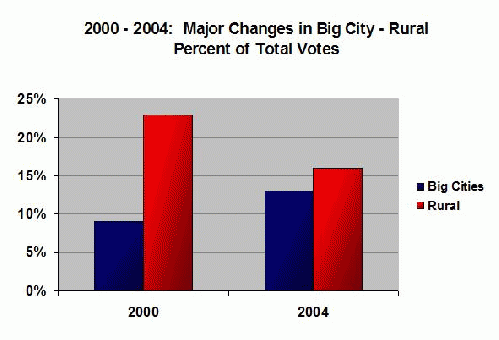
FIGURE 1. The 2004 rural vote must have alarmed the Bush camp. It was less as a percentage of the overall vote, dropping from 23% to 16%. Bush’s total rural vote went from 14 million in 2000 to just short of 12 million in 2004. These totals added up to a devastating loss of 2 plus million votes from his base instead of an increase by the 3 to 4 million the campaign needed. This was very bad news for the White House. Their core rural base was absent without leave.
Bush scored a huge victory margin in 2000 in rural America. The 2004 narrative was that the Red versus Blue contest was also the basis for the 2004 victory. But in 2004, rural America provided fewer voters and fewer votes for Bush. Sure, he won the rural segment of the population but this was hardly a victory in comparison to 2000. What happened to the wave of born again Christians supposedly so loyal to Bush? Did they stay home? Did they vote by not voting, a time honored American practice? Did they sit out this most critical of elections despite their spirited performance in 2000 and the exhortations from pulpits, televisions, and over the phone?
We need to put our narrative on pause for a moment and interject a note of ugly reality. In a high turnout election, a presidential candidate who loses a big chunk in his base constituency loses the election. This is axiomatic. There are no exceptions in modern election history. The loss of his core constituency through a drop from 23% to 16% of total vote share was bad enough. In addition, according to the NEP, Bush lost expected votes. At 23% of the vote in 2000, Bush had 14.1 million rural votes. At 16% of the vote in 2004, the rural segment provided only 11.6 million votes. This is an absolute loss of 2.5 million votes in an election that had a 16% increase in turnout compared to 2000.
We are now faced with an incredible situation. Bush won the election according to the declared vote count. Yet he did so with his core constituency on strike: fewer votes from his core constituency in actual terms and fewer votes as a percentage of total votes. It is important to keep this in mind as we move forward because the novelties compound one upon another to present an outcome that is simply not believable.
Bush also lost significant ground in the “small towns,” the other element of his values coalition. Small towns are defined as towns of 10 to 50 thousand residents.

FIGURE 2. In 2000 Bush owned small town America. In small towns, he beat Gore 60% to 40% and walked off with a 1.0 million vote margin. In 2004, turnout increased dramatically, but the race evened with the Bush margin at just below 0.2 million votes. Were these the real values voters? This shows even further erosion of the Bush 2000 base.
The small towns were the other significant part of the Bush “base”. While many rural voters expressed their disenchantment, according to the Exit polls, by staying home, the citizens of small towns increased their turnout by 88% in 2004 and evened the playing field by voting in near equal numbers for John Kerry. Bush had 4.9 million small town votes to Kerry’s 4.7 million for a total of 9.5 million. Small towns had given 2000 to Bush over Gore by 3.1 to 2.0 million votes.
The suburbs were only somewhat better for Bush in 2004 than in 2000. His victory margin there was 5% over Kerry, where it had been just 2% above Gore’s 2000 effort. The suburbs comprise nearly half of the total votes.
Bush took 28.3 million to Kerry’s 25.6 million votes. But, it was not nearly enough. Given the decay in the rural and small town margins and the historical Democratic margin in the cities (the “blue” on the election maps), the 2004 Presidential contest was as good as lost for Bush.
Now, however, the exit poll narrative changes. According to the polls, Bush made very surprising gains in the smaller cities, those with populations between 50 and 500 thousand. There Bush trailed Gore by 17 points in 2000, 8.4 million to 12.0 million respectively. In 2004, the smaller cities were almost even with Kerry at 11.36 million and Bush at 11.39 million. Turnout was up just 9%. It is very difficult to explain such a “trend”. Nevertheless, taking the rural voters, the suburbs, and the break even smaller cities as a group, we see that Bush was still in real trouble heading into the larger cities. Had Kerry just held Bush close to the Gore big city margins for 2000 in these Democratic friendly venues, he would have won the election.
Why not expect a strong Kerry showing? Bush had not been a city-friendly President and he had not gone out of his way to help large cities with any initiatives of note. In our largest city, New York, things looked particularly bad. A 2003 poll showed that over 50% of the residents thought that the administration had foreknowledge of the 911 attacks and did nothing, hardly a predictor of great success in that largest of large cities.
But something very unusual happened, as Charles Cook pointed out. According to the NEP, Bush made incredible gains in the cities over his 2000 vote share. These gains were large enough to offset his drop in core support in rural areas and give him a 3% victory.
Next Page 1 | 2 | 3 | 4 | 5 | 6 | 7 | 8 | 9 | 10 | 11
(Note: You can view every article as one long page if you sign up as an Advocate Member, or higher).






