| Back OpEdNews | |||||||
|
Original Content at https://www.opednews.com/articles/Part-Two--Talking-with-Af-by-Joan-Brunwasser-091012-662.html (Note: You can view every article as one long page if you sign up as an Advocate Member, or higher). |
|||||||
October 12, 2009
Part Two: Talking with"Aftermath" Playwrights Jessica Blank and Erik Jensen
By Joan Brunwasser
"Aftermath" includes stories of people who were affected by sectarian militias,by religious persecution, by the military;it includes stories of Sunni,Shi'a,Christian and non-religious individuals,it includes stories of wealthy,middle-class and working-class individuals. Eventually,we come up with a group of stories that balance each other out, are individually compelling & dramatic,& that each tell a piece of the larger story
::::::::
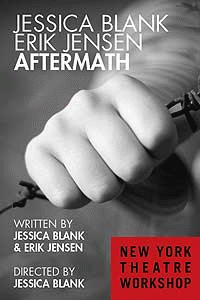
Narrowing the stories down is one of the hardest parts of doing this kind of work. The play has nine characters (including the translator) but it really tells six stories--some of the characters are couples, and each of the two couples in the play tells one shared story. Every single one of the 37 people we interviewed in Jordan was incredibly compelling--and unfortunately, every single one of them had lived through something almost unbelievably harrowing. It was very difficult to narrow the stories down, because they were all so important.
As with "The Exonerated," we narrowed the stories down in stages, trying to keep an eye on the larger story the piece was telling as well as the individual, personal accounts.
Nearly everything our interview subjects said to us in the room was compelling and interesting in the interview setting--but that doesn't mean it's necessarily going to translate to the stage. Hearing actors read the words out loud, we can immediately hear what material is potentially theatrical, what is "act-able" (and active) as opposed to simply texturally or factually interesting. We do edits in the room, enter them into the computer at night, come back to the actors with a condensed version the next day, have them read that aloud edit again, come back to them the next day with a further condensed version, and so forth---repeating the process until monologues begin to emerge organically. At the same time, we begin to hear which stories double each other, which are similar in tone, which characters have similar personalities, etc., and we start winnowing down the number of characters.
In addition to telling the individual stories, we are also trying to convey the larger story that we heard in all the interviews--so we think about the repeating themes and content that arose in multiple interviews and try to make sure that we have at least one character in the play who addresses each of those themes or facts. (For example, "Aftermath" includes stories of people who were affected by sectarian militias, by religious persecution, by the military; it includes stories of Sunni, Shi'a, Christian and non-religious individuals, it includes stories of wealthy, middle-class and working-class individuals (though most of the people we met were middle-class, in part because Iraq used to be a largely middle-class country). Eventually, we come up with a group of stories that balance each other out, are individually compelling and dramatic, and that each tell a piece of the larger story.
Thanks for that fascinating peek inside the process. The run was extended until October 18th. That's good. What kind of reactions are you getting from the audience? You've had a few panels and post-show discussions. Does it get heated and partisan?
With "Aftermath," it's a bit different--while the personal stories and perspectives of Iraqi civilians have been grossly underreported and are often brand-new to our audiences, everyone has done some thinking about the larger issue of Iraq. It's been fascinating to watch how that has informed the way people watch the play---how sometimes they hear every word and are stunned, or sometimes they miss entire chunks of content that the play addresses, because that content doesn't line up with things they've already heard or read on the subject.
The responses from the audience range from being enormously moved, to inspired by the strength and resilience of the refugees, to sometimes contentious--but they are always deeply engaged with the stories they are watching unfold onstage. The play raises many, many different kinds of questions for its audiences--which we think is great. We believe deeply that our job as playwrights isn't to provide answers or prescriptions--it's to raise questions. To that end, we've been incredibly happy with the amount of dialogue the play has raised, and the enormous diversity in people's responses.
How are the reviews so far?
The reviews have been very kind, for which we are, of course, enormously grateful. We've been heartened to see that all the major critics picked up on and appreciated what we were trying to do structurally and artistically with the play, and more importantly, gained a deep and personal understanding of the individual human experience of the people portrayed in the play. They seem to have walked away from the play with an experience not unlike the incredibly moving experience that we had in the interview rooms with the real subjects of the play, which tells us that hopefully, we've done our job.
With all our documentary theater, we work very, very hard to keep our own political opinions out of the piece. To our minds, our own personal political viewpoints are so much less compelling than the real human stories we've heard; our job is to serve as a conduit, and to provide a structure; not to insert our own ideas.Your play is undeniably political even if it's not partisan. What are you hoping your audience will take away from it?
Whatever anyone thinks of the fact that we went into Iraq in 2003--and we certainly have our own opinions about that--the fact is that it happened, it had a profound effect on the regular people of Iraq, and most importantly it is continuing to have an effect. It's a luxury for us here in the U.S. to have ongoing ideological arguments about what led to the war, and to rehash what we wish politicians would or would not have done.
The fact is that the human impact of what did happen continues to be felt, on a massive scale--as it does with any war--and we feel that it's our job as people to grapple with what that means on a human, non-ideological level. Here in the U.S., most individuals who have not served in the military don't have a direct experience of what it's like to live in a war zone. It's a much more common experience in the rest of the world--it's a part of the larger human story---and we believe that it's imperative for us to at least try to understand what that experience is like.
A lot of the damage that gets done in the world happens because we are encouraged, culturally, to see people who are different from us as "other"--to abstract them, to put them somehow in a different category from ourselves. Theater asks the audience, just for an hour or two, to put themselves in another's shoes; to identify and empathize with the characters on stage. If we want our audiences to walk away with anything, we want them to walk away with that experience--the experience of walking in the shoes of someone they may have thought of as "other." We believe that experience raises questions and asks us to grapple with things in a more powerful way than any abstract ideological debate ever could.
We hope it will be! We're currently working on several possibilities and would love for the play to have a long, healthy life in many American cities and hopefully, internationally as well. We're currently open to all potential opportunities to have the play performed as widely as is possible.Do you plan to have "Aftermath" performed in other cities?
If we can go back to "The Exonerated" for a minute... Before you put on that play in 2002, you were both actors, directors, screenwriters, and Jessica, you had a novel under your belt. But your lives have really taken off professionally since then. ["The Exonerated" deals with former inmates released from Death Row.] Hugely successful, it had an 18-month NY run, a national tour, and a made for Court TV movie.
It's since had sold-out runs in both London and Dublin and has been translated into a number of foreign languages. You also got some unusual awards and accolades - including from the NAACP, Amnesty International, the American Bar Association of Criminal Defense Lawyers, Court TV, and Death Penalty Focus. That must have been satisfying. Were you expecting it to be such a hit?
Not at all! When we started work on "The Exonerated," we expected that maybe it would wind up running in a 99-seat theater somewhere for a week or two. We never could have dreamed that it would have had the life it did; so many incredible people came in throughout the process of "The Exonerated" and contributed to its life--actors, producers, our director, attorneys, politicians, non-profit organizations, exonerated individuals themselves--and for that we are incredibly grateful.
When we first began work on "The Exonerated," in 2000, both of us actually were not professional writers or directors. Jessica had graduated college and come to NYC to go to acting school less than a year before we got the idea for the play; Erik had been living in NYC for nine years, making a living as an actor. We'd both tried our hand at writing a bit, but nothing on a professional scale--basically, we taught ourselves how to write a play--and how to get a play produced--specifically so that we could create "The Exonerated," simply because we believed that the stories were so important that they needed to get out there. "The Exonerated" had an incredible life, and when it finally started to quiet down, we suddenly found that as well as being actors, we were both also now writers and directors---and married!
We wrote a book together about the making of "The Exonerated," Living Justice, which was published in 2005, and Jessica started working on her first novel Almost Home after "The Exonerated" opened Off-Broadway; Almost Home was published in 2007. Last year, it was optioned for feature film by Jon Bon Jovi's production company, and we adapted the screenplay together; our producers are planning to shoot in 2010. Jessica's second novel, Karma for Beginners, was published this summer, and we both continue to act regularly in film and television. Somehow, we both manage to keep ourselves employed in one medium or another at any given time.
As little as possible! I'm looking forward to enjoying our daughter a lot and continuing to work as an actor, writer and director. This summer, I acted in an episode of HBO's "Bored to Death," directed "Aftermath," and my book Karma for Beginners came out. After all that, I'm in my third trimester, so I'm being forced to slow down a little bit, and both of us are planning to take a month or two off after our daughter is born.Your first child is due very soon, Jessica. Will you slow down,take some time off so you can enjoy your new role?
After that, we'll return to juggling both our careers equally with parenting. We're incredibly lucky to have a very flexible work schedule, made up of numerous short-term jobs in several mediums, so we're both looking forward to being able to spend time with our daughter, share the parenting 50-50, and balance that with our individual and joint careers as actors, writers and directors. We're used to juggling already, so we're looking forward to continuing that with a new collaborator on board!
Well, you certainly have a lot going on in your lives. And it doesn't sound like you're going to slow down much any time soon, either! Thank you so much for taking time out to speak with me. I really hope that "Aftermath" comes to Chicago so I can see it for myself.
***
Part one of my interview with Jessica and Erik
Authors Website: http://www.opednews.com/author/author79.html
Authors Bio:
Joan Brunwasser is a co-founder of Citizens for Election Reform (CER) which since 2005 existed for the sole purpose of raising the public awareness of the critical need for election reform. Our goal: to restore fair, accurate, transparent, secure elections where votes are cast in private and counted in public. Because the problems with electronic (computerized) voting systems include a lack of transparency and the ability to accurately check and authenticate the vote cast, these systems can alter election results and therefore are simply antithetical to democratic principles and functioning.
Since the pivotal 2004 Presidential election, Joan has come to see the connection between a broken election system, a dysfunctional, corporate media and a total lack of campaign finance reform. This has led her to enlarge the parameters of her writing to include interviews with whistle-blowers and articulate others who give a view quite different from that presented by the mainstream media. She also turns the spotlight on activists and ordinary folks who are striving to make a difference, to clean up and improve their corner of the world. By focusing on these intrepid individuals, she gives hope and inspiration to those who might otherwise be turned off and alienated. She also interviews people in the arts in all their variations - authors, journalists, filmmakers, actors, playwrights, and artists. Why? The bottom line: without art and inspiration, we lose one of the best parts of ourselves. And we're all in this together. If Joan can keep even one of her fellow citizens going another day, she considers her job well done.
When Joan hit one million page views, OEN Managing Editor, Meryl Ann Butler interviewed her, turning interviewer briefly into interviewee. Read the interview here.
While the news is often quite depressing, Joan nevertheless strives to maintain her mantra: "Grab life now in an exuberant embrace!"
Joan has been Election Integrity Editor for OpEdNews since December, 2005. Her articles also appear at Huffington Post, RepublicMedia.TV and Scoop.co.nz.