| Back OpEdNews | |||||||
|
Original Content at https://www.opednews.com/articles/ASEAN-must-support-Aung-Sa-by-Zin-Linn-090521-140.html (Note: You can view every article as one long page if you sign up as an Advocate Member, or higher). |
|||||||
May 22, 2009
ASEAN must support Aung San Suu Kyi
By Zin Linn
The Burmese people feel that the military regime has been using membership in ASEAN as a shield to protect itself from international pressure over its dismal human rights record. Yet ASEAN's prestige has been tarnished because of the military regime's membership. To strengthen itself, ASEAN should insist on the release of Aung San Suu Kyi, who is guilty only of pursuing a peaceful and democratic Burma.
::::::::
The political climate in Burma is gloomier than ever as pro-democracy leader Aung San Suu Kyi, general secretary of the National League for Democracy and winner of the 1991 Nobel Peace Prize, is in grave danger. Suu Kyi, known affectionately as "the Lady,"- is the hope of the Burmese people; her bad fortune will be the fate of her poor people and country.
The Lady was transferred to Insein Prison in Rangoon on May 14 from her home, where she had been under house arrest. The dishonest junta started a closed-door mock trial of the Lady on Monday inside the notorious Insein Prison. She has been charged with violating the terms of her house arrest and could face a prison sentence of up to five years. But the people see the trial as a farce and a conspiracy by the junta.
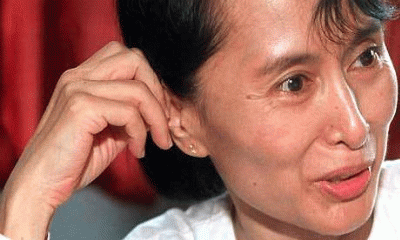
Even though a few diplomats and journalists were allowed to attend the third day of the trial on Wednesday, most of them still expect her to be found guilty on trumped-up charges.
The Association of South-East Asian Nations has been criticized for its lack of practical efforts to tame its rogue member. Releasing statements and rhetorical comments are not enough. The leaders of ASEAN may remember "Black Friday,"- the premeditated ambush of the Lady near the town of Depayin in military-ruled Burma.
In the hours of darkness on May 30, 2003, Daw Aung San Suu Kyi and her National League for Democracy convoy were fiercely attacked, leaving numerous dead and injured. Hundreds of democracy supporters were taken into custody, including Suu Kyi.
According to local estimates, more than 100 NLD members and supporters were arrested, killed, wounded or missing on that May 30. Another report says that as many as 282 people were killed that night in Depayin. A total of 256 democracy activists were arrested in relation to the Depayin Massacre.
There was convincing evidence that the attack was a premeditated assassination attempt on Suu Kyi and members of the NLD. A report by the special rapporteur on human rights to Myanmar, Professor Paulo Sergio Pinheiro, said, "There is prima facie evidence that the Depayin incident could not have happened without the connivance of state agents."-
This brutal attack was the regime's response to the people's support of the NLD during Aung San Suu Kyi's various trips throughout the country, following her release from 19 months of house arrest in May 2002. In response to the Depayin bloodbath, there was a remarkable outcry from ASEAN and unique pressure on the regime, including calls for Suu Kyi's release.
Nonetheless, the regime mollified ASEAN by offering a seven-step "roadmap to democratization"- in response to the pressure. However, the roadmap has not led to democratic reform in Myanmar.
Six years later the voice of ASEAN has diminished. There should have been an independent investigation into the Depayin attack and Aung San Suu Kyi and fellow activist U Tin Oo should have been unconditionally released. But the military regime has endlessly made empty promises to the people of Burma and ASEAN.
At the U.N. General Assembly meeting on Sept. 29, the junta's Foreign Minister Win Aung misled the international community by saying, "We don't call this house arrest "- We are helping her to overcome health problems."- Unfortunately, this move has reduced pressure within the region for the release of Suu Kyi.
ASEAN should keep in mind that at Depayin, Than Shwe, the chieftain of the junta, was the key criminal and Aung San Suu Kyi was the victim. But when the junta declared that it had put Suu Kyi under "protective custody,"- ASEAN did not stand with the Lady. Hence, the Burmese people thought ASEAN supported the criminal against the victim.
As international pressure mounted, in a departure from its noninterference policy, ASEAN issued a statement calling for the early release of Aung San Suu Kyi and other NLD members during the 36th ASEAN Ministerial Meeting in June 2003 in Phnom Penh, Cambodia. It also urged Myanmar to seek reconciliation and dialogue "leading to a peaceful transition to democracy."-
But ASEAN's statement was all for naught. People have been deeply disappointed by the group's lack of collective will to take a strong position against Burma's military dictators. Instead, the group seems to be going along with the dictators and opposing democratic norms. This makes a mockery of the ASEAN charter, which asserts that the region be more responsive to human rights issues.
The charter was intended to transform ASEAN into a systematic institution similar to the European Union, entrusting its members to strengthen democracy, to enhance good governance and the rule of law, and to promote and protect human rights and fundamental freedoms. ASEAN should be recognized internationally not only as a cohesive alliance of economically developed nations, but also as a regional body that is ethically and politically responsible.
ASEAN is supposedly committed to accelerating economic growth, social progress and cultural development in the region in order to strengthen the foundation for a prosperous and peaceful community of Southeast Asian nations. Yet one of its members is a military-ruled country that ignores the norms of the group. How can the association overlook the disobedience of its rogue member?
ASEAN aims to promote regional peace and stability through respect for justice and the rule of law and adherence to the principles of the U.N. Charter. Yet it shuts its eyes while extrajudicial killings and violence against women and children take place daily in one of its member countries. There is no law and order at all under Burma's military dictators.
In one of her speeches Aung San Suu Kyi urged the people to work for democracy, but reminded them that democracy requires personal responsibility. "The rule of law means a system that provides security for the country and the people where everybody is equally protected within the framework of the law. But we must try hard to obtain democracy. Remember, nothing is free and nothing is easy. Democracy is not only for your rights but there is also responsibility. Economics and politics are inseparable. A bad political system contributes to a bad economic system."-
Suu Kyi was scheduled to be freed on May 27 after six consecutive years under house arrest. The accusations against her are commonly seen as a pretext for keeping her in detention during elections set for 2010--the conclusion to the junta's roadmap to "disciplined democracy,"- which has been condemned for maintaining military rule.
ASEAN members rarely criticize one another, yet they at least expressed "grave concern"- over Suu Kyi's current trial, adding that "the honor and the credibility of the Burmese regime are at stake."-
The Burmese people feel that the military regime has been using membership in ASEAN as a shield to protect itself from international pressure over its dismal human rights record. Yet ASEAN's prestige has been tarnished because of the military regime's membership.
With such a lawless country as a member, how can ASEAN implement its aims? The group's "constructive engagement"- policy toward the dictators has been a complete failure. To strengthen itself, ASEAN should distance itself from Burma's tyrannical regime. Instead it should support the people of Burma and insist on the release of Aung San Suu Kyi, who is guilty only of pursuing a peaceful and democratic Burma.
Authors Bio:
Zin Linn was born on February 9, 1946 in a small town in Mandalay Division. He began writing poems in 1960 and received a B.A (Philosophy) in 1976.
He became an activist in the High School Union after the students' massacre on 7th July 1962. He then took on a role as an active member in the Rangoon Division Students' Union. He Participated in a poster-and-pamphlet campaign on the 4th anniversary of 7 July movement and went into hiding to keep away from the military police. He was still able to carry out underground pamphlet campaigns against the Burmese Socialist Programme Party ( BSPP). However, in 1982, he fell into the hands of MI and served two years imprisonment in the notorious Insein prison.
In 1988 he took part, together with his old students' union members, in the People's Democracy Uprising. In November of that year, he became an NLD Executive Committee Member for the Thingangyun Township and later became superintendent of the NLD Rangoon Division Office.
In 1991, he was arrested because of his connections with the exiled government, the National Coalition Government of the Union of Burma (NCGUB), and sentenced to 7 years imprisonment in the notorious Insein Prison. In last week of December 1997 he was released.
Zin Linn was an editor and columnist and contributed articles to various publications, especially on international affairs, while in Burma.
He fled Burma in 2001 to escape from military intelligence and worked as information director for the NCGUB from 2001 to 2012. He is also vice president of the Burma Media Association which is affiliated with the Paris-based Reporters Sans Frontiers. Zin Linn is still writing articles and commentaries in Burmese and English in various periodicals and online journals on a regular basis.