| Back OpEdNews | |||||||
|
Original Content at https://www.opednews.com/articles/opedne_liza_per_080315_what_s_wrong_with_th.htm (Note: You can view every article as one long page if you sign up as an Advocate Member, or higher). |
|||||||
March 16, 2008
What's wrong with the USA? It is really very simple...Updated
By Liza Persson
I have taken some time off from blogging about the agents and actions of political conspiracies, and instead searched for one common root to the most urgent and immense problems I see in the political landscape of the USA today.
::::::::
I took this article down for a short while, to add some details and elaborate on some things.
I have decided to put it back up again, after only some minor changes. I will modify errors in grammar and spelling continually, and hope you accept my explanation that most of them are due to English not being my first language and only one of a number of second languages.
What’s wrong with the USA? It is really very simple…
I have taken some time off from blogging about the agents and actions of political conspiracies, and instead searched for one common root to the most urgent and immense problems I see in the political landscape of the USA today.
First about the scope of my little research.
I do not see as immense problem narrow political issues such as health care, or the rights of gay marriage – precisely because these issues are, no matter how worthy they are of being addressed, narrow.
Instead I have focused on underlying common causes for such things as the militarization of foreign policy and relations, the alteration of the protective legal framework restricting the US government from infringing upon the liberties and rights of foreign and domestic individuals, the obscene national budget deficit which takes out an unequal mortgage on present and future generations, and the growing insecurity and distrust among domestic and foreign publics regarding what actions and views might be subjected to punitive measures from the US government.
I have found a few interrelated changes. The efforts behind them are not exclusive to the present time, any particular party affiliation or the current political leadership in the USA.
But it seems very likely that during the last 8 years they have been intensified and are probably unprecedented in both intensity as well as degree of success.
No more unprecedented or novel is the complacency of the Congress, which through non-action as well as positive action has been part of bringing about these changes.
I have made an effort to make this a brief and comprehensive description of the problem and the responsibility, while still having objective evidence to back up my claims.
I have referenced very sparingly, to sources which in their turn use many credible sources and have conducted the extensive leg work I piggy-back ride.
I will be willing to provide additional sources and references if anyone wants to dig further.
In US today we have a situation in which there has been a shift in the relationship between the branches of government, and in extension in the checks and balances supposed to safeguard the governed.
Riding the wave of “national security” in the wake of the manifestation of a “national threat” there has been a successful effort by the Executive branch – often facilitated by non-action and positive action of Congress - to codify through action and precedence: exclusive power of the Executive to define threats, and to define and execute appropriate counter-measures[i]
Under this enhanced capacity to act with little need to engage and subject itself to the scrutiny and will of other branches, the Executive Branch developed a paradigm of preventive and preemptive action against such defined foreign and domestic threats[ii].
Note that the preventive and preemptive policy made suspicion, prediction and presumption basis for counter-measures, rather than the requirement of international and national law of needing to have objective after-the-fact evidence (crossing the line between Minority Report and LAPD: Life on the Beat).
In effect, the principle of evidence of action taken to legitimize use force and restriction of rights, was replaced by suspicion of intent.
Subsequently, interrogation would be used to find projective evidence about future planned events, as we could not afford reasonable certainty of “The Mushroom Cloud”.
Last, the presidency has amassed a vast Executive paramilitary force operating outside Congressional and public oversight and awareness. Private firms and intelligence agencies provide personnel that can carry out acts falling within and between law enforcement and military operations, only subjected to will of, and accountable to, the President.
This provides the Executive branch of the last component needed to become able to both define what acts to prevent, methods to prevent them and execute actions at home and abroad without need for involvement of any other branch.
The fallout is dangerous and affects many areas, of which only a few are mentioned here.
When intent is incriminating, suspicion basis for surveillance and restrictive actions, and prevention a policy for counter-measures it follows that the rate of actions to gather intelligence, detain and restrict the freedom of movement of individuals as well as counter suspected planned actions increases massively. This has been the case, both domestically and internationally.
The legal framework requiring of federal agencies adherence to certain processes and standards on presentation and quality of sufficient evidence before actions are taken, is not just something intended to be a pain in the butt of the Executive Branch – even though it might seem that way, judging from the way the current administration has treated these regulations.
More importantly, these regulations and requirements are based upon a presumption that humans are fallible. When the government spend the resources of the governed, there need to be some checks to ensure that the resources are not spent on the wrong things and that efforts are undertaken with competence and adequate consideration, limiting errors due to bad intent or basic flaws of thinking of individuals and groups.
Had USA not constantly been so unwilling to “lock back” and learn from history, instead of repeatedly declaring that a “new era” changed everything, people might have found that the quite extensive historical record of similar preventive measures based on suspicion made a return to such measures unlikely to be successful.
I can mention here the McCarthy era of persecution of suspected communists, the rounding up of Japanese immigrants in US following the Pearl Harbor attack and the fact that preventive attacks was one of the justifications evoked – and rejected - at the Nurnberg trials in defense of Nazi Germany’s aggressions.
Now we have a situation in which huge resources are spent to cast and recast a wide net of surveillance, detention, interrogation and use of force at home and abroad– sacrificing precision by acting only when there is reasonable certainty, and instead acting when there is “actionable suspicion” (i.e “If there's a 1% chance…we have to treat it as a certainty in terms of our response”)[iii].
The budget deficit of the USA is largely directly and indirectly the result of such imprecise and sweeping actions, and it is in effect an unequally distributed mortgage of present and future generations of both Americans and – indirectly – people of other countries.
The sweeping and imprecise “actionable suspicion”- driven actions to prove and counter intended actions, has led to campaigns in which people were rounded up for detention, had their communication secretly monitored, or were subjected to counter-measures because of suspicions of bad intent. The lack of precision led to huge numbers of errors in which innocent people were swept up .
These people have very little ability to seek legal remedy, or even have their freedoms and rights restored.
The most extreme case is the US invasion of Iraq, which was an act of aggression not justified by international law since no pre-emption of imminent threat or retaliation for suffered attack motivated it.
Because of this, there has been an immense and growing legal uncertainty about what protections exists for domestic and foreign individuals and groups against such measures. The moral standing of the USA in the world amounts to a bankruptcy equal to the one of the national budget. This in turn makes acts of aggression against Americans and US infrastructure, both within and outside the national territory, more likely as frustration and anger grows.
This is especially serious if the measures to prevent attacks on the security of the US people is not just leading to increase in likelihood of such attack being attempted, but are not effective prevention methods either.
One argument in defense of the sweeping wide net of counter measures following 9/11, has been that there has not been any more terrorist attack inside the US national territory.
However, it should be noted that 9/11 followed seven years without any such terrorists attacks. It might be that the “success” of the counter-terrorism measures is just luck of the dice
The immense and growing legal uncertainty about what protections exists for domestic and foreign individuals and groups against harsh and unregulated measures of detention, surveillance and deprivation of rights, have other serious consequences. One being the hampering of public efforts to remedy a renegade government which has cut itself loose from its need for active consent of the governed.
Fear and insecurity about legal protections discourage any persistent and effective effort for change or remedy especially since suppressive preventive measures are coupled with psychological operations to create public vigilance and suspicions against any views and actions which can be perceived as disturbing the internal peace and order[iv]
The Bill of Rights and the US Constitution, along with statutory laws, are often evoked as providing protection of rights, liberties, of the relationship that the government depends on the consent of the governed and protection from arbitrary rule. However, nobody can be protected from illegal acts unless these acts are challenged and found illegal by the system of justice, ultimately the Supreme Court which provides the ultimate interpretation of the constitutionality of all actions, decisions and “lower level” laws.
There are many ways in which the Executive Branch, as well and the Legislative, can take measures to prevent a case from coming before a court and influence how the court will decide[v]. Part of the reason why there was such a fuzz over whether there were “improper” political reasons behind the firing of several US Attorneys[vi] in 2006-2007, following what appears to be elaborate political plotting and planning, was the power US Attorney’s hold in deciding when and if to bring criminal charges, and what charges to bring, in cases where the evidence would justify charges[vii].
Those who do refer to the Constitution, the Bill of Rights and the Declaration of Independence for protection, should be aware of a crucial fact.
The governing documents for the US government place the ultimate responsibility of ensuring government compliance with it, squarely on the people.
There are times more forceful action is needed, and Thomas Jefferson explained such circumstances in the Declaration of Independence he authored..
"We hold these truths to be self-evident, that all men are created equal (and) endowed....with certain unalienable Rights, that among these are Life, Liberty and the Pursuit of Happiness. - That to secure these rights, Governments are instituted among Men, deriving their powers from the consent of the governed, - That whenever any Form of Government becomes destructive of these ends, it is the Right of the People to alter or to abolish it, and to institute new Government....to effect their Safety and Happiness."
Try doing that today, and it's called treason, a capital offense.
The foresight of the Founding Fathers is impressing, as was their ability to acknowledge that even such a thought through system of government they laid out could fail to protect the inalienable rights of the governed.
Jefferson, Madison, Franklin and the others thought were not just saying but obligating all future generations of Americans that we must act in our own defense when government will not do it for us.
In the case of Executive overreach, it is first the Congress and the judicial branch to check the Executive.
If that fails, the people must act as a check on Congress.
If that too fails, and Congress fails to represent the people and act upon its constitutional duties, then it is clear that the public has the duty and right to take whatever means necessary to alter or dispose of the government and replace it with a new – unless it wants to depart from constitutional governing..
However, even if the ultimate security check on government’s adherence to the public good, rights and freedoms is codified in the constitution, the powers accessible to the executive are such that it takes a lot of guts from a lot of people to actually act upon it.
The Constitution, the Bill of Rights and the Declaration of Independence were written before a huge standing army was amassed and placed under the control of a presidency with more powers and less oversight and accountability than ever.
Where and how do conspiracies figure in?
Most conspiracy theories deal with whose and what interests are driving these changes, and how these interests are being acted upon.
The matter of what and whose interests are being represented in acts of abuse and misuse of power, I think, is of less importance than to focus on how to correct the system and practice of government to make it less susceptible to abuse its power regardless of in whose interests it is being done.
The fact is that once one branch has the capabilities and powers described above, any representative of any interest would find it beneficial to make use of it and most likely multiple interests are benefiting from it at any one time.
No matter how fascinating and how educating for future actions conspiracy theories might be, the Founding Fathers of the US system of Government made sure that in the end the bucket always ends up with the people when it comes to changing bad governance.
Focus on the “how:s”, “who:s” and “why:s” of political conspiracies risk fueling the human tendency to perceive themselves as powerless and victims when it comes to large scale politics. It would be both dangerous and wrong to create a “Them” on expense of personal responsibility.
Few people today is willing to publicly advocate armed and violent rebellion. Implicitly most people are aware that the next national security threat to be defined and sold to the public will be the one of domestic and homegrown dissent regardless of the agent or motive. The powers of the Executive, and the leniency of the checks and balances restricting it, are such that any view or form of expression can be subjected to the aforementioned exclusive power of the Executive to define threats, and to define and execute appropriate counter-measures.
There is little that says it does not have the ability, left to see is whether or not it will act upon it and get away with it.
It seems that the government as a whole already has done this.
The Animal Enterprise Terrorism Act of the U.S. was created with the goal of targeting people involved in violence, arson, threat or any other forms of terrorism by prescribing several punishments, but it has also has had what has been described as 'a chilling effect' on free speech, because several activists working legally for animal rights have been prosecuted under the law.
As the U.S. Justice department now labels these groups as "terrorist organizations" [viii], under the USA PATRIOT ACT, donations to them are federal crimes and punishable by substantial criminal penalties[ix].
Overall, the definition of what constitutes terrorism, as well as who is to be defined as an organization or agent of terror, has in the practice of the US Government been a matter of using whatever definition suits the purpose at hand while avoiding using a definition that would incriminate oneself or one’s own actions[x]
“Retail terrorism — like abduction or suicide bombing — is a tactic of the hardware have-nots. It gets all the attention. Wholesale terrorism — invasion and aerial warfare, for example — is the strategy of the haves…By some magic consensus wholesale terrorism never, never gets called terrorism.
In the U.S. we assume only the other guys use terrorism — never our side. Judging by our media and our politicians, terrorists are only those who oppose powerful military machines. Even if those terrorists are defending their land”
'Islamists' come late to a practice West has long justified for itself
To quote Robert Fisk, the longest-serving Western journalist in the Middle East. "[Terrorism] is not a definition. It is a political contrivance. 'Terrorists' are those who use violence against the side that is using the word."[xi]
As the lines change so that acts of protest involving no violence or threat of violence are punished and defined more harshly, people need to start thinking and talking about when and under what circumstances different measures of resistance and rebellion should be a public duty. It is still possible, and I think it is always healthy, to have such a public debate. In the end, individuals will be more willing to risk the consequences of violent or non-violent means of rebellion, if they feel that there is a silent agreement in the general public that such actions are both needed and will be followed by others.
Acts of rebellion involving violence and/or coercion should never be used unless all other viable means have been tried.
One of the most disgusting failures of both the US public, Congress and Administrations is the rejection of giving an international court jurisdiction to bring in, try and convict political leaders for crimes against international law. Had this not been the case, there is a high probability that many US political officials could have been tried and found guilty of such crimes.
Any fear that subjecting US laws to international laws and US political institutions to international jurisdiction would facilitate the rise of a malign One World Government, need to be weighed against the fact that what we are seeing now is the unfettered rise of a US run world – none the less likely to be judged unfavorably by history.
With no other venues left to try, it might become necessary to use acts of force, coercion and violence to secure the freedom and rights of the US people. Should this occur such acts must to be carried out FOR and BY the people - not AGAINST it.
That will make sure people stay on the right side of the line between freedom fighters and terrorists.
Is This The Way It is?
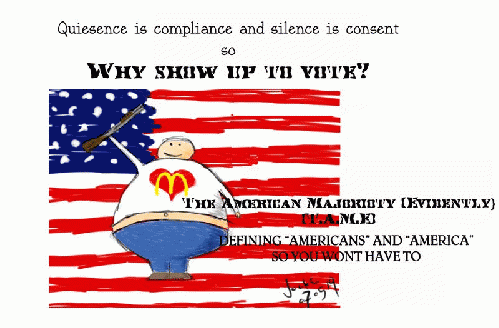
If Not – Stand up and let the world know of Your dissent, Americans.
Or else You will all be judged along with that which You allow to be done in Your name.
Let us not let it go so far that the world will have to make the walls along the us borders the walls of an asylum for a society that could not respect the rights of humanity, or make Americans so despised that they will chose never to leave their land.
According to one of my friends[xii] – who left US precisely because of the poverty and oppression of the American society – Americans have already past the point were resistance and rebellion regardless of means can be legalized as act of self-defense.
And if they wont defend themselves, it will become the duty of everyone everywhere to defend their freedom and rights from a renegade USA.
[ii] Less Safe, Less Free, part 1 of 2 , Less Safe, Less Free, part 2 of 2, The War on Free Expression by Stephen Lendman
[iii] from an excerpted story in which Vice President Dick Cheney describes the Bush administration's doctrine on dealing with terrorism
[xi] From "Pity the Nation: Lebanon at War" by Robert Fisk page 439
Authors Bio:
I am a Political and Behavioral Scientist with Psychology as my main subject and people as my main interest. As thoughts are the source of all human accomplishment I hope to be part of the exchange of them
Also see:
http://wildwickedwonderfulupfront.blogspot.com/