| Back OpEdNews | |||||||
|
Original Content at https://www.opednews.com/articles/genera_georgian_071111_misery_continues_in_.htm (Note: You can view every article as one long page if you sign up as an Advocate Member, or higher). |
|||||||
November 11, 2007
Misery Continues in DRC: Cholera, More Refugees, FARDC Abuse, and Radioactive Ore Dumping
By Georgianne Nienaber
The Misery Continues in DRC: Cholera, More Refugees, FARDC Abuse and Radioactive Ore Dumping
::::::::
I pray for the day when the news from the Democratic Republic of Congo is not as grim as it is today. Conflict in eastern Kivu province is forcing more people from their homes than at “any time since the end of the civil war in 2003,” as reported by MONUC today. In addition, here is a cholera outbreak in northern Kivu, reports of more army atrocities in Ituri, and confirmation of a dump of radioactive ore into the water supply.
The United Nations High Commission for Refugees (UNHCR) reports that since 375,000 Congolese were forced from their homes in December 2006, an additional 160,000 are newly displaced in the last two months. The refugees are a result of continued fighting between regular government forces, renegade troops, and local militias and police forces.
"With sharpening inter-ethnic divides and a continuous build-up of military forces, UNHCR remains deeply concerned about the risks of severe human rights abuses and violence against civilians," MONUC reports.
On Friday, a heavily armed clash took place between government troops (FARDC) and the army loyal to Tutsi General Laurent Nkunda. The fighting was reported northwest of Goma, which is the provincial capitol.
"After a lull in the fighting it started again at the end of the afternoon 30 kilometres (19 miles) outside of Goma, this time with heavy artillery," MONUC spokeswoman Sylvie van den Wildenburg said.
Cholera Still a Threat
Meanwhile, in a development directly related to the refugee situation, efforts continue to combat the spread of cholera in Kivu Province.
This week, UNHCR and it partner ASODE, a non-governmental organization (NGO), distributed soap to nearly 20,000 internally displaced persons (IDPs) in two camps in Mugunga west of Goma in North Kivu, according to MONUC.
There is concern that lack of sanitary facilities at a camp at at Lac Vert hosting more than “10,000 internally displaced persons (IDP’s),” in the lexicon of relief agencies, could contribute to the further spread of cholera. Refugees would be a better, simpler word. UNCHR is transferring some of the refugees to a newly constructed camp, Buhimba, which has necessary health, water and sanitatin facilities for 10,000 people.
Cholera broke out in early October in five camps hosting some 45,000 refugees in the Mugunga area. According to health workers, by the end of October there were a total of 439 suspected cases of cholera. A spokeman said the number of cases is “slightly dropping.”
FARDC Abuse
Mainstream media has been very critical of rebel troops under Laurent Nkunda, but a buried fact remains that abuse by regular government troops (FARDC) is a serious threat to refugees in northeastern DRC.
Kirhero was referring to 2,890 displaced households, some 14,450 people, from Lalo, Dhera, Doi and Du villages in the Djugu district, identified when a team of several UN agencies investigated events in the area.
In an unreported development, the investigators found the army (FARDC) was forcing civilians to work as porters for long distances and was extracting "taxes" at roadblocks on market day. Many people reported being prevented from reaching their fields and young men said soldiers frequently accused them of supporting the militia groups.
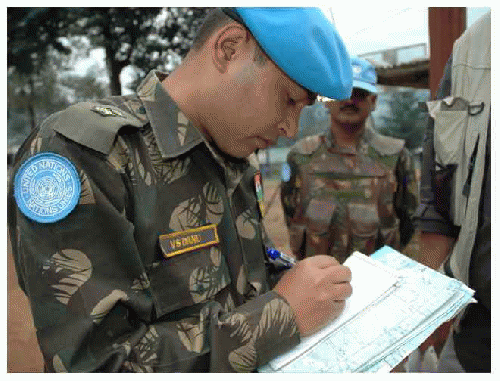
A FARDC spokesman downplayed the UN allegations. "It's true that abuses happen, especially when a group of soldiers is cut off from superior officers, but I think these reports are exaggerated," responded Captain Charles Boyeka, who serves as a liaison officer with the UN mission in DRC.
In a stunning statement, Bokeya accused the refugees of “idleness,” blaming them for their own misery, a misery perpetrated by his own army.
Ituri has for years been the centre of a struggle over power and land between rival groups, and erupted into widespread violence in 1999. Since then, a number of armed groups from each side have killed and maimed thousands in a bloody adjunct to the main civil war fought in DRC between 1998 and 2002.
Radioactive Ore Dumping
Congolese authorities arrested six people in connection with the dumping of “tons of highly radioactive minerals” into a river near the southeastern town of Likasi.
A quarantine zone was also set up around the site, just 10 km (6 miles) from the mining town of 300,000 people, where tests on Thursday revealed radiation levels nearly 50 times the limit for mineral exports from Democratic Republic of Congo.
Congo launched an inquiry on Wednesday after officials in the southeastern province of Katanga said radioactive copper and cobalt ore appeared to have been dumped into the Mura River, a source of drinking water for Likasi.
Authorities in Likasi had seized nearly 19 tons of radioactive minerals due for export in October and ordered their disposal at a nearby abandoned uranium mine last week.
The load never made it to the mine and the government says at least some of the ore was dropped from a bridge into the river.
OpEdNews has received reports from our own investigators in the area that there are hidden underground storage vaults of uranium located in Virunga Park, right under the noses of so-called “conservation” groups. We reported as much to US investigators in the area three months ago and are reporting it now to our own audience. Where are the stolen materials going?
Authors Website: http://www.georgianne-nienaber.com
Authors Bio:
Georgianne Nienaber is an investigative environmental and political writer. She lives in rural northern Minnesota and South Florida. Her articles have appeared in The Society of Professional Journalists' Online Quill Magazine, the Huffington Post, The Ugandan Independent, Rwanda's New Times, India's TerraGreen, COA News, ZNET, OpEdNews, Glide Magazine, The Journal of the International Primate Protection League, Africa Front, The United Nations Publication, A Civil Society Observer, Bitch Magazine, and Zimbabwe's The Daily Mirror. Her fiction expose of insurance fraud in the horse industry, Horse Sense, was re-released in early 2006. Gorilla Dreams: The Legacy of Dian Fossey was also released in 2006. Nienaber spent much of 2007 doing research in South Africa, Rwanda and the Democratic Republic of Congo. She was in DRC as a MONUC-accredited journalist, and was living in Southern Louisiana investigating hurricane reconstruction and getting to know the people there in 2007. Nienaber is continuing "to explore the magic of the Deep South." She was a member of the Memphis Chapter of the National Academy of Recording Arts and Sciences and is a current member of Investigative Rorters and Editors.