| Back OpEdNews | |||||||
|
Original Content at https://www.opednews.com/articles/opedne_georgian_070730_dian_fossey_and_the_.htm (Note: You can view every article as one long page if you sign up as an Advocate Member, or higher). |
|||||||
July 30, 2007
Dian Fossey and the Gorilla Killings
By Georgianne Nienaber
It is time to go back to Dian Fossey's story and consider how she would handle the recent senseless gorilla killings juxtaposed with the unspeakable atrocities committed against women and children in the Democratic Republic of Congo.
::::::::
A respected editor contacted me the other day and suggested that it would help my accounts of atrocities perpetrated against the Congolese people if I reminded readers that I was also, indeed, a friend and advocate of animals. I responded that “I knew who I was,” and that it really made no difference whether or not I cared about gorillas. Perhaps I was hasty in making that decision.
I am a biographer of Dian Fossey, and consider her to be my mentor, even though I never met her. It occurred to me to go back to Dian’s story and consider how she would handle the recent senseless gorilla killings juxtaposed with the unspeakable atrocities committed against women and children in the Democratic Republic of Congo.
One of Dian’s last diary entries was that she recognized “When you realize the value of life, one dwells less on the past and concentrates more on the preservation of the future.” Additional random notes and jottings said that Fossey felt “relief (meaning aid dollars) was a cottage industry,” “tragedy a growth industry,” and the end result would be that “helping hands help themselves.” Her final notes trail away into ruminations about the role of the butterfly and what was “God’s plan for God’s creatures.” Perhaps by looking to Fossey’s life and work for some answers in this terrible time for all life in Africa, we can learn something of value.
Dian Fossey brought the mountain gorilla to the world stage and she was murdered in service to them. But make no mistake that Dian Fossey was a bleeding heart animal lover. Read Farley Mowat’s Biography, Woman in the Mists, to get a true picture of the complex woman who gave up everything to learn about gorilla society. The movie, Gorillas in the Mist, is a fabrication. It will tell you nothing.
Fossey wrote often to friends and family that she believed her African staff to be “the backbone” of her research station at Karisoke, located deep in the saddle region between Mounts Karisimbi and Visoke in tiny Rwanda. She would be outraged at the current headlines, but she presciently predicted the current situation would happen in a conversation she had with an ex-patriot friend, Alyette DeMunck.
Dian and Alyette were on an afternoon's stroll when the sight of a poacher's camp interrupted their idyll. Dian tells the story in her own words:
We were walking along a beautiful, isolated river, which flowed deep within the jungle's grasp of wild orchids, liana and senie. Alyette was a Belgian woman who had known Africa since her birth. She lost her husband, and had her son and nephew brutalized and murdered by rebel soldiers, yet she still managed to love the land. In fact, “love” is a trite word to describe her affinity with the continent. As I stood there, breaking bamboo snares one by one, our previously harmonious association was punctuated with a heated argument. My friend stood apart from me and very firmly asked what right I had, as an American living in Africa for only fourteen months, to invade the hunting rights of the Africans, since by birth, they owned the country. I kept on breaking traps, but at the same time I could not agree with her more. Africa did belong to the Africans, but I felt that written orders, whether they pertained to man or animals, should still prevail. If I could enforce the written rules of a supposedly protected park and prevent the slaughter of animals, then I should do so. As I continued breaking the bamboo, the reliable and flexible death trap of the last wild game of Africa, Alyette continued to plead her argument.
“These men have their right to hunt! It’s their country! You have no right to destroy their efforts!”
Perhaps she was right that a destitute African living on the fringes of the Parc had no alternative but to turn to poaching for a living. At the same time, why should we condone a man who openly breaks the law; why shouldn't we take whatever actions we can against him? The man who kills the animals today is the man who kills the people who get in his way tomorrow. He recognizes the fact that there is a law that says he must not do this or that, but without the reinforcement of this law, he is free to do as he chooses.
Fossey struggled with this conundrum until the day she died, but at least she faced it.
By the time of her murder, one day after Christmas in 1985, poaching had been all but eliminated from the Virungas. Fossey learned to make peace with the inhabitants of the forest and even delivered a Batwa baby at her annual Christmas bash for the Africans in 1984.It is most likely that it was Fossey’s knowledge of gold and mineral smuggling rotes through the Virungas which led to her murder. It is doubtful that the myth of vengeful “poachers” led to her death.
Dian’s true battles were with the minions of USAID, the conservation organizations which misappropriated the Digit Fund, corrupt local officials, and mis-guided “tourism” interests.
It seems we are fighting the same battles once more as history repeats itself in the killing fields of DRC. Perhaps we should all reflect upon her legacy and revel in her strength. It will not be an easy battle in the war against greed and corruption—from whatever the source.
Ironically, considering the headlines coming out of DRC today, Dian Fossey is buried in the gorilla graveyard at Karisoke. One can only hope that her death was not in vain and that human decency will prevail.
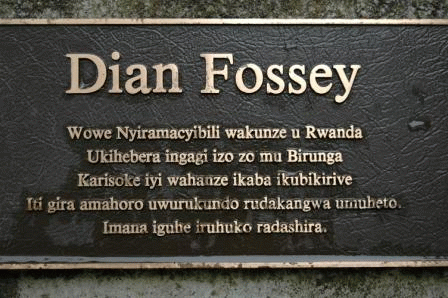
TRANSLATION OF KINYARWANDAN MARKER
You, Nyiramacyibiri, that loved Rwanda. You gave your life to the gorillas in Virunga. This Karisoke that you created has reserved for you peace and love that cannot be threatened by a spear. God give you an everlasting peace.
Authors Website: http://www.georgianne-nienaber.com
Authors Bio:
Georgianne Nienaber is an investigative environmental and political writer. She lives in rural northern Minnesota and South Florida. Her articles have appeared in The Society of Professional Journalists' Online Quill Magazine, the Huffington Post, The Ugandan Independent, Rwanda's New Times, India's TerraGreen, COA News, ZNET, OpEdNews, Glide Magazine, The Journal of the International Primate Protection League, Africa Front, The United Nations Publication, A Civil Society Observer, Bitch Magazine, and Zimbabwe's The Daily Mirror. Her fiction expose of insurance fraud in the horse industry, Horse Sense, was re-released in early 2006. Gorilla Dreams: The Legacy of Dian Fossey was also released in 2006. Nienaber spent much of 2007 doing research in South Africa, Rwanda and the Democratic Republic of Congo. She was in DRC as a MONUC-accredited journalist, and was living in Southern Louisiana investigating hurricane reconstruction and getting to know the people there in 2007. Nienaber is continuing "to explore the magic of the Deep South." She was a member of the Memphis Chapter of the National Academy of Recording Arts and Sciences and is a current member of Investigative Rorters and Editors.