| Back OpEdNews | |||||||
|
Original Content at https://www.opednews.com/articles/opedne_stephen__070730_lying_under_oath_for.htm (Note: You can view every article as one long page if you sign up as an Advocate Member, or higher). |
|||||||
July 30, 2007
Lying Under Oath for Dummies
By Stephen Pizzo
Truth can be a cruel mistress. Sometimes a Lorrena Bobbit kind of cruel mistress. As such truth must be treated with both care and suspicion.
::::::::
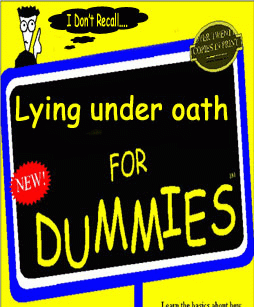
Truth can be a cruel mistress. Sometimes a Lorrena Bobbit kind of cruel mistress. As such truth must be treated with both care and suspicion.
I know this runs contrary to what your parents, teachers and ministers may have taught you, that telling the truth is always the right thing to do.
Not so.
You should, of course, always tell any truths that are either harmless which benefits you. That's a no-brainer.
But there are circumstances when telling the truth can get you and/or your friends in a lot of trouble. At times like that it's perfectly logical to do whatever is necessary to avoid telling truth.
That's the purpose of this primer. Think it as, “Truth-telling 2.0 – A Guide For Adults and Public Officials.”
In our nitpicking times you may someday find yourself in legal jeopardy. Say you've done something wrong (as in “illegal”) and you are about to be put oath and asked about it. You've going to have to swear to “tell the truth, the whole truth and nothing but the truth.”
But you know that if you live up to that oath there's going to be hell to pay for it. Only a fool would voluntarily step up, tell the truth and himself or herself in jail. (Okay, you may be a crook. But you're no fool.)
So what to do?
I am happy to report that there are ways out of this jam. But you have to employ them skillfully and without a hint of hesitation or embarrassment.
Under such circumstances, the last thing you want to do is to start coughing up the unvarnished truth. Still, the worst thing you can do though is just cook up a bunch of outright lies. Lies can be disproved with stuff called “evidence.” So you need to avoid concoction lies.
While lying is your only way out, it's how you lie that will make the difference between getting away or getting a bunk above some guy with “Mad Dog” tattooed on his forehead.
There are four basic techniques to address your little problem:
1) Try to avoid taking the oath
Say, Congress wants to question you under oath about something they think you did.
Pretend to be offended by the implication that, unless put under oath, you may lie. (How dare they! etc. etc.)
Tell them you'd be happy to talk to them any time they want, at their convenience, at your office. Your secretary will provide coffee and pastries and they can ask as many questions as they want about anything they want. (Make sure the press knows about this "offer.")
But – and this is critcally important – besides not being put under oath, you also don't want a transcript made of your answers. Explain that you want the conversation to be open, frank and relaxed, and feel and that a transcriber would cause people to “pull their punches,” and stifle the kind “openness that can put all these groundless accusations to rest once and for all.”
The real reason, of course, is that the last thing you want is a transcript of your answers, since you know you're guilty and that it's almost certain your answers won't exactly jive with subsequently discovered “facts” and the testimony of others.
When such “contradictions” materialize – and you know they will -- you need to be able to “deny ever saying anything like that,” and be able to accuse your interrogators of “twisting” your words and “taking them out of context.” Without a certified transcript of your original testimony, they'll be screwed. (Better them than you.)
To review:
- No oath means no perjury.
- No transcript means not having to “amend” your earlier answers to fit newly revealed “facts.”
2) Seek refuge in “The Fuzz Zone.”
If gambit #1 doesn't pan out, and you are forced to testify under oath, prepare well ahead of time. In particular spend some quality time with your attorney going over what “facts” are okay to remember and which you need to “forget.”
Stephen Pizzo has been published everywhere from The New York Times to Mother Jones magazine. His book, Inside Job: The Looting of America's Savings and Loans, was nominated for a Pulitzer.
But you must deploy this tactic selectively to avoid damaging your credibility.
For example, let's say you are asked this kind of question:
Consider softball questions like that as an opportunity to prove your truthful nature by answering them honestly. Doing so will show that “you're not afraid of the truth.”
But, there are questions that you cannot answer truthfully without putting yourself in legal jeopardy.
For example, say you are confronted by a document key to the allegations against you:
Here is where to dive for cover in the “Fuzz Zone.”
The Fuzz Zone, you see, is where memory “fails” you. It's your ultimate legal redoubt, a safe place where you can lie under oath with near complete impunity.
When asked a question that requires forgetfulness you gain entry to the Fuzz Zone with answers like this:
“I don't recall that conversation.”
“I have no independent recollection of that.”
“I do not believe I said that.”
“I don't recall making that remark.”
“I have no memory of seeing that memo.”
Shouldering Responsibility without Shouldering Guilt
If you were the head of an agency or organization at the time of the matter being investigated you can still enter the Fuzz Zone, but must do so with greater care. In particular you need to avoid answers that make it appear you are trying to avoid responsibility for things that happened under your command. When faced with a question where forgetfulness may lead to such suspicions, be proactive -- assume responsibility first, then “forget.”
Terms like “no independent recollection” are particularly useful when the questions center on matters in which you suspect confirming evidence may exist or is likely to surface later in the investigation.
When confronted with proof of prior knowledge, you can go back to your original answer;
If asked who told you, you reply, “I don't recall.” If you want to get fancy you can throw that question back at the questioner;
Such a reply, while appearing pretty checky under the circumstances, is actually a safe gambit, since you know that no one told you, that you knew all along – something your questioner can't prove.
How sweet is that? “I don't recall” -- the lie that cannot be proven. No one can look inside your head and prove or disprove the state of your memory. So say it as often as you must to keep your ass out of jail -- “I don't recall.” It's a dodge that, while it may wear thin with prosecutors, is the gift that keeps giving for the guilty.
3) The “You know I am precluded from answering...” Gambit
This technique only works if you can credibly claim to be in possession of state secrets or privileged executive matters.
When using this technique it is extremely important that you appear “pained” that you cannot simply answer the question. As you “struggle” with your response be sure to insinuate that your answer, were you free to provide it, would fully support your claim of innocence.
This technique, if properly deployed, not only protects inconvenient truths, but can recast you from suspected perp to hostage of circumstances beyond your control. (“If only I were free to answer...”)
A variant on this gambit is the “I can't answer that because it involves a matter that part of a pending investigation,” technique. This can be used by those of you involved some way in law enforcement or law enforcement agencies.
There are two “pending investigation” dodges.
1) “I can't discuss anything that's currently under investigation.'
2) “That's a part of a matter from which I am recused.
Those of you working in law enforcement, including the Dept of Justice, are in a prime position to employ this technique to your benefit. If you have prior knowledge that someone is fixing to put you under oath about something you'd prefer not being asked under oath, simply open an internal “investigation” into the matter. If that isn't enough, recuse yourself from that investigation too. Now you've erected two firewalls between having to decide whether to tell the truth and go jail, or commit perjury and go to jail.
4)Taking the Fifth
This is your last-resort gambit. When someone refuses to answer, “because it may incriminate me,” it's a surefire way to appear guilty as sin. So, use this gambit only when techniques 1 through 3 are unavailable to you.
Such circumstances may include:
One final rule of thumb to keep in mind. The old saying, “The truth shall set you free,” is misleading as it ONLY applies when the “particulars” of your case allow it.
Sometimes the truth will NOT set you free, quite the opposite. In such circumstances you need to avoid telling the truth as though your freedom depends on it... which it likely does.