| Back OpEdNews | |||||||
|
Original Content at https://www.opednews.com/articles/On-the-Sheer-Radicalness-o-2024-Elections_Abortion_Abortion-Laws_Abortion-Legislation-240419-21.html (Note: You can view every article as one long page if you sign up as an Advocate Member, or higher). |
|||||||
April 19, 2024
On the Sheer Radicalness of the Moment of Conception Doctrine (REVIEW ESSAY)
By Thomas Farrell
In my recent OEN article "How Important Will the Abortion Debate Be in the 2024 elections?" (dated April 10, 2024), I did not attempt to answer the question I posed in the title -- and I do not attempt to do so in the present article either. Rather, I want to draw attention to the sheer radicalness of the Roman Catholic Church's doctrine about the moment of conception -- which could incite anti-abortion American Catholics.
::::::::
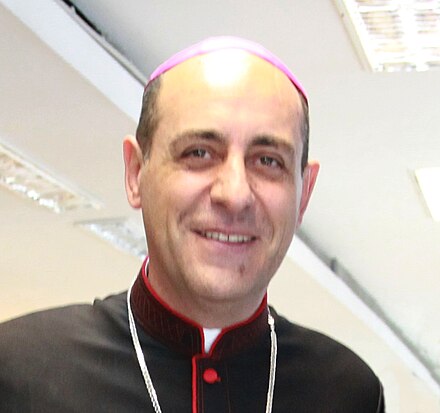
V%C3%ADctor Manuel Fern%C3%A1ndez-%28cropped%29.
(Image by Wikipedia (commons.wikimedia.org), Author: Dirección de Relaciones Institucionales de la Universidad Católica Argentina) Details Source DMCA
Duluth, Minnesota (OpEdNews) April 19, 2024: My first OEN article was titled "Why Obama Should Shun the Pope's Views on Abortion" (dated October 10, 2009):
In it, I made it clear that I regard the Roman Catholic Church's position that distinctively human life begins at the moment of conception as mistaken and untenable.
Granted, a life-form begins at the moment of conception. But I do not think that that life-form is distinctively human life. Rather, I see distinctively human life as beginning at birth when the fetus emerges from the mother's womb and is viable.
More recently, I have reflected on the doctrinally conservative Pope Francis' objections to gender theory in my somewhat lengthy OEN article "Walter Ong, Judith Butler, and the Vatican on Gender" (dated April 8, 2024):
Next, I shifted my focus in my short OEN article "How Important Will the Abortion Debate Be in the 2024 elections?" (dated April 10, 2024):
Now, in the present essay, I am still concerned about how important the abortion debate will be in the 2024 elections.
However, certain recent events have brought home just how radical the Church's teaching about the moment of conception is.
In February 2024, the Alabama Supreme Court ruled that frozen embryos (i.e., the life-forms produced at the moment of conception), produced through in vitro fertilization (IVF) are considered to be human children and that a person could be held liable for accidentally destroying them. Because in vitro fertilization is a widespread practice in the United States today, the ruling set off alarm bells, to say the least.
See Kayla Epstein's BBC article "Alabama IVF ruling: What does it mean for fertility patients?" (dated February 22, 2024):
Not surprisingly, the Roman Catholic Church has not only opposed legalized abortion, but also in vitro fertilization. See the online article "Each Life has Immeasurable Value from the Moment of Conception, says Bishop Burbidge on IVF Issues" (dated March 8, 2024):
More recently, the Vatican's Dicastery for the Doctrine of the Faith has issued a new document titled "Dignitas Infinita: On Human Dignity" (dated April 8, 2024):
As the document's title indicates, much of the document is devoted to operationally defining and explaining the Church's position regarding human dignity.
The Church's position regarding human dignity explains the Church's position on each of the numerous particular issues itemized and discussed in the document.
The Vatican document includes 116 endnotes giving specific references to the sources quoted in the document's text. The most frequent source of quoted material is the doctrinally conservative Pope Francis (born in 1936; elected pope in March 2013).
I have profiled Pope Francis in my widely read OEN article "Pope Francis on Evil and Satan" (dated March 19, 2019):
However, even though Pope Francis is doctrinally conservative, certain conservative American Catholics have generated vociferous anti-Francis polemics. The Italian philosopher and papal biographer Massimo Borghesi discusses their anti-Francis polemics in his 2021 book Catholic Discordance: Neoconservatism vs. the Field Hospital Church of Pope Francis, translated by Barry Hudock (Liturgical Press Academic; orig. Italian ed., 2021).
For background reading about American neoconservatism, see Peter Steinfels' 1979 book The Neoconservatives: The Men Who are Changing America's Politics (Simon and Schuster) and Gary Dorrien's 1993 book The Neoconservative Mind: Politics, Culture, and the War of Ideology (Temple University Press).
Now, the new 2024 Vatican document includes four numbered sections, after the introductory section:
1. A Growing Awareness of the Centrality of Human Dignity (paragraphs 10-16);
2. The Church Proclaims, Promotes, and Guarantees Human Dignity (paragraphs 17-22);
3. Dignity, the Foundation of Human Rights and Duties (paragraphs 23-32);
4. Some Grave Violations of Human Dignity (paragraphs 33-62).
The concluding section includes paragraphs 63-66.
Now, in section 4. Some Grave Violations of Human Dignity, we find the subsection on "Abortion" (paragraph 47), with its terminology about the moment of conception:
"The Church consistently reminds us that 'the dignity of every human being has an intrinsic character and is valid from the moment of conception [my emphasis] until natural death. It is precisely the affirmation of such dignity that is the inalienable prerequisite for the protection of a personal and social existence, and also the necessary condition of fraternity and social friendship to be realized among all the peoples of the earth.' On account of the intangible value of human life, the Church's magisterium has always spoken out against abortion. In this regard, Pope St. John Paul II writes:
"'Among all the crimes which can be committed against life, procured abortion has characteristics making it particularly serious and deplorable. [ . . . ] But today, in many people's consciences, the perception of its gravity has become progressively obscured. The acceptance of abortion in the popular mind, in behavior, and even in law itself [e.g., in the U.S. Supreme Court's Roe v. Wade ruling in 1973] is a telling sign of an extremely dangerous crisis of the moral sense, which is becoming more and more incapable of distinguishing between good and evil, even when the fundamental right to life is at stake. Given such a grave situation, we need now more than ever to have the courage to look the truth in the eye and to call things by their proper name, without yielding to convenient compromises or to the temptation of self-deception. In this regard, the reproach of the Prophet [Isaiah] is extremely straightforward: "Woe to those who call evil good and good evil, who put darkness for light and light for darkness" (Isaiah 5:20). Especially in the case of abortion, there is widespread use of ambiguous terminology, such as "interruption of pregnancy," which tends to hide abortion's true nature and to attenuate its seriousness in public opinion. Perhaps this linguistic phenomenon is itself a symptom of an uneasiness of conscience. But no word has the power to change the reality of things: procured abortion is the deliberate and direct killing, by whatever means it is carried out, of a human being in the initial phase of his or her existence, extending from conception to birth" [end of quotation from JPII].
"'Unborn children are, thus, "the most defenseless and innocent among us. Nowadays, efforts are made to deny them their human dignity and to do with them whatever one pleases, taking their lives and passing laws preventing anyone from standing in the way of this" [end of quotation from Pope Francis]. It must, therefore, be stated with all force and clarity, even in our time, that "this defense of unborn life is closely linked to the defense of each and every other human right. It involves the conviction that a human being is always sacred and inviolable, in any situation and at every stage of development. Human beings are ends in themselves and never a means of resolving other problems. One this conviction disappears, so do solid and lasting foundations for the defense of human rights, which would be subject to the passing whims of the powers that be. Reason alone is sufficient to recognize the inviolable value of each single human life, but is we also look at the issue from the standpoint of faith, 'every violation of the personal dignity of the human being cries out in vengeance to God and is an offense against the Creator of the individual' [end of quotation from Pope Francis, who, in turn, quoted somebody else at the end]. In this context, it is worth recalling St. Teresa of Calcutta's generous and courageous commitment to the defense of every person conceived."
(The bracketed ellipsis here is in the document's text; I have added the boldface here, and I have broken up what is one lengthy paragraph in the document's text into three paragraphs here.)
Now, your guess is as good as mine as to how many American Catholics are likely to read the Vatican's new document.
However, those American Catholics who do read it will probably be impressed by the document's forceful text about procured abortion.
In my OEN article "How Important Will the Abortion Debate Be in the 2024 Elections?" (dated April 10, 2024), I did not attempt to answer the question that I posed in the article's title - and I am still not going to attempt to answer that question here.
Authors Website: http://www.d.umn.edu/~tfarrell
Authors Bio:
Thomas James Farrell is professor emeritus of writing studies at the University of Minnesota Duluth (UMD). He started teaching at UMD in Fall 1987, and he retired from UMD at the end of May 2009. He was born in 1944. He holds three degrees from Saint Louis University (SLU): B.A. in English, 1966; M.A.(T) in English 1968; Ph.D.in higher education, 1974. On May 16, 1969, the editors of the SLU student newspaper named him Man of the Year, an honor customarily conferred on an administrator or a faculty member, not on a graduate student -- nor on a woman up to that time. He is the proud author of the book WALTER ONG'S CONTRIBUTIONS TO CULTURAL STUDIES: THE PHENOMENOLOGY OF THE WORD AND I-THOU COMMUNICATION (Cresskill, NJ: Hampton Press, 2000; 2nd ed. 2009, forthcoming). The first edition won the 2001 Marshall McLuhan Award for Outstanding Book in the Field of Media Ecology conferred by the Media Ecology Association. For further information about his education and his publications, see his UMD homepage: Click here to visit Dr. Farrell's homepage.
On September 10 and 22, 2009, he discussed Walter Ong's work on the blog radio talk show "Ethics Talk" that is hosted by Hope May in philosophy at Central Michigan University. Each hour-long show has been archived and is available for people who missed the live broadcast to listen to. Here are the website addresses for the two archived shows:
Click here to listen the Technologizing of the Word Interview
Click here to listen the Ramus, Method & The Decay of Dialogue Interview